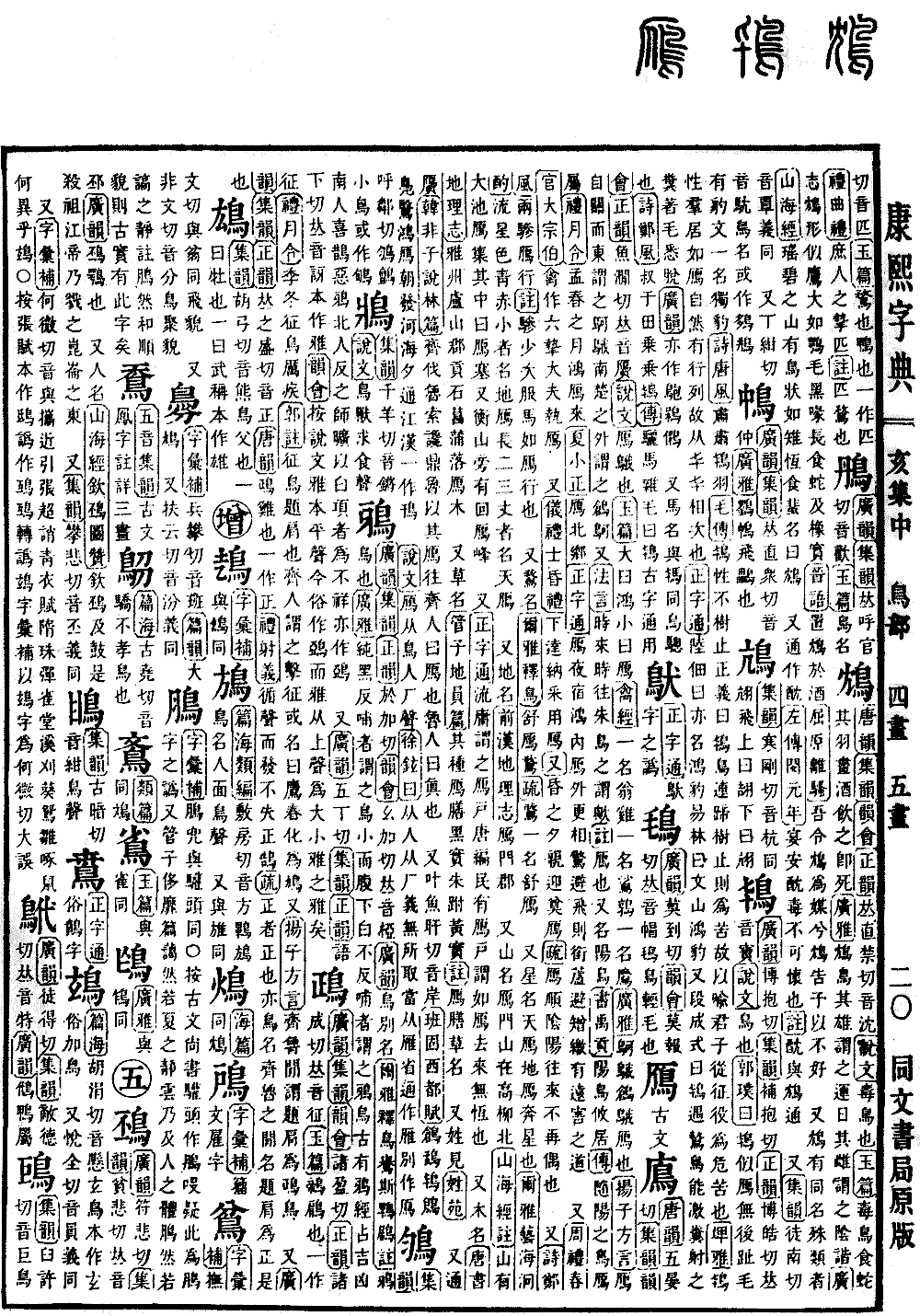
Hai Collection, Middle Volume
Radical: Bird (niǎo)
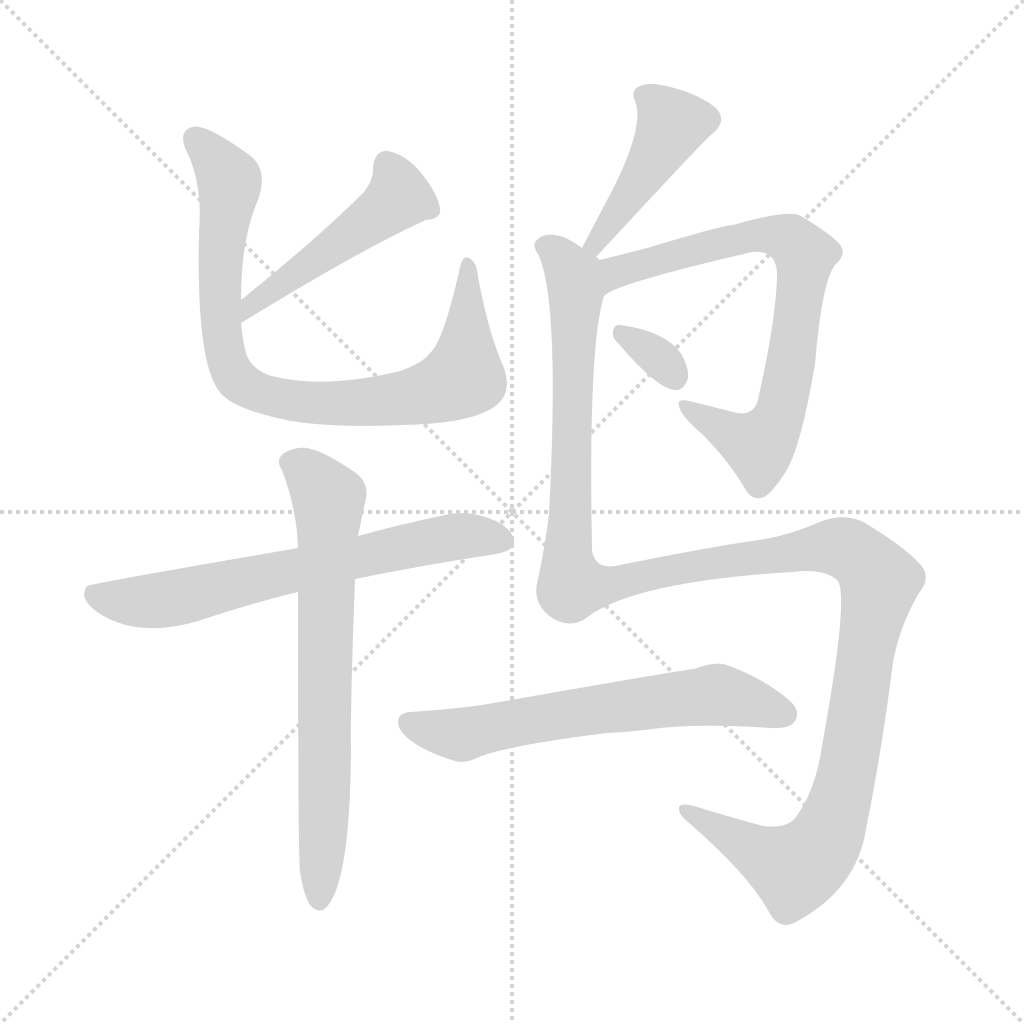
Bao
Kangxi stroke count: 15
Page 1484, Entry 01
Pronounced bao (rising tone).
According to the Shuo Wen Jiezi (Shuo Wen): A type of bird.
Guo Pu states: The bao resembles a wild goose but lacks a hind toe, and its feathers feature leopard-like markings. It is also known as the solitary leopard.
Book of Odes (Shijing), Tang Odes: With the rustling wings of a bao.
Mao Commentary: The nature of the bao is that it does not perch in trees.
The Correct Meaning (Zhengyi) states: The feet of the bao are joined; perching in trees causes it distress. Thus, it is used as a metaphor for the hardships and dangers faced by a gentleman on a military campaign.
Piya: The nature of the bao is to live in groups like wild geese, naturally maintaining formation, hence the character is composed of the radical for bird and the element meaning to follow in sequence.
Zhengzitong: Lu Dian states: It is also known as the wild goose leopard. The Yilin says: The patterned mountain wild goose leopard. Furthermore, Duan Chengshi states: When a bao encounters a bird of prey, it can spray excrement at it; wherever the excrement touches, the feathers fall out.
Guangyun: Also written as a variant form.
Also refers to a horse. Identical to the character for a black-maned, piebald horse. It is a black-spotted white horse.
Book of Odes (Shijing), Zheng Odes: Uncle went into the fields, riding in a carriage pulled by piebald horses.
Commentary: A black horse with mixed-colored hair is called a bao. In ancient times, the characters were used interchangeably.