Si Collection, Middle Volume
Radical: Fire (huǒ)
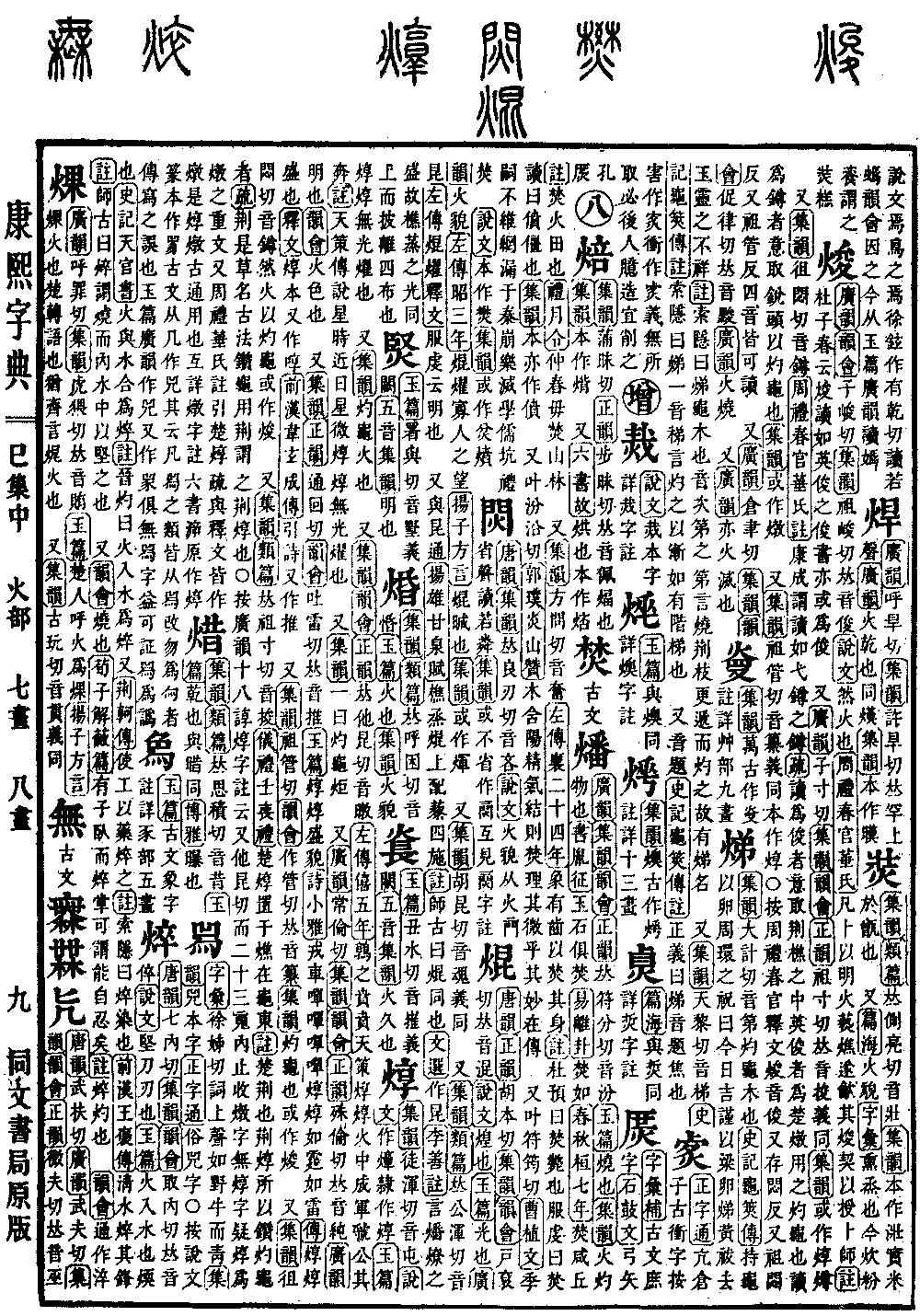
焜
Kangxi Strokes: 12
Page 673, Entry 16
Pronounced hun (falling-rising tone).
Shuowen Jiezi (Explaining Single-component Characters and Analyzing Compound Characters) defines it as the appearance of brightness.
Yupian (Jade Chapters) defines it as luminous.
Guangyun (Broad Rhymes) defines it as the appearance of a flame.
Zuo Zhuan (Commentary of Zuo) states: "Brightening the expectations of my ruler."
Yangzi Fangyan (Regional Speech) defines it as brightness.
Jiyun (Collection of Rhymes) notes that it is sometimes written in a variant form (hui).
Also pronounced hun (rising tone), with the same meaning.
Also pronounced kun (level tone).
In the commentary to the Zuo Zhuan, Fu Qian explains: it means brightness.
It is also used interchangeably with kun.
In Yang Xiong's Ganquan Fu (Rhapsody on Sweet Spring), it is written: "Firewood burning brightly upward, matching the spreading of the pigweed."
The commentary by Shigu states: "kun means the same."
In the Wen Xuan (Selections of Refined Literature), it is written as kun.
The commentary by Li Shan explains: this describes the burning of firewood as very vigorous, so the light of the burning firewood rises upward and spreads in all directions.