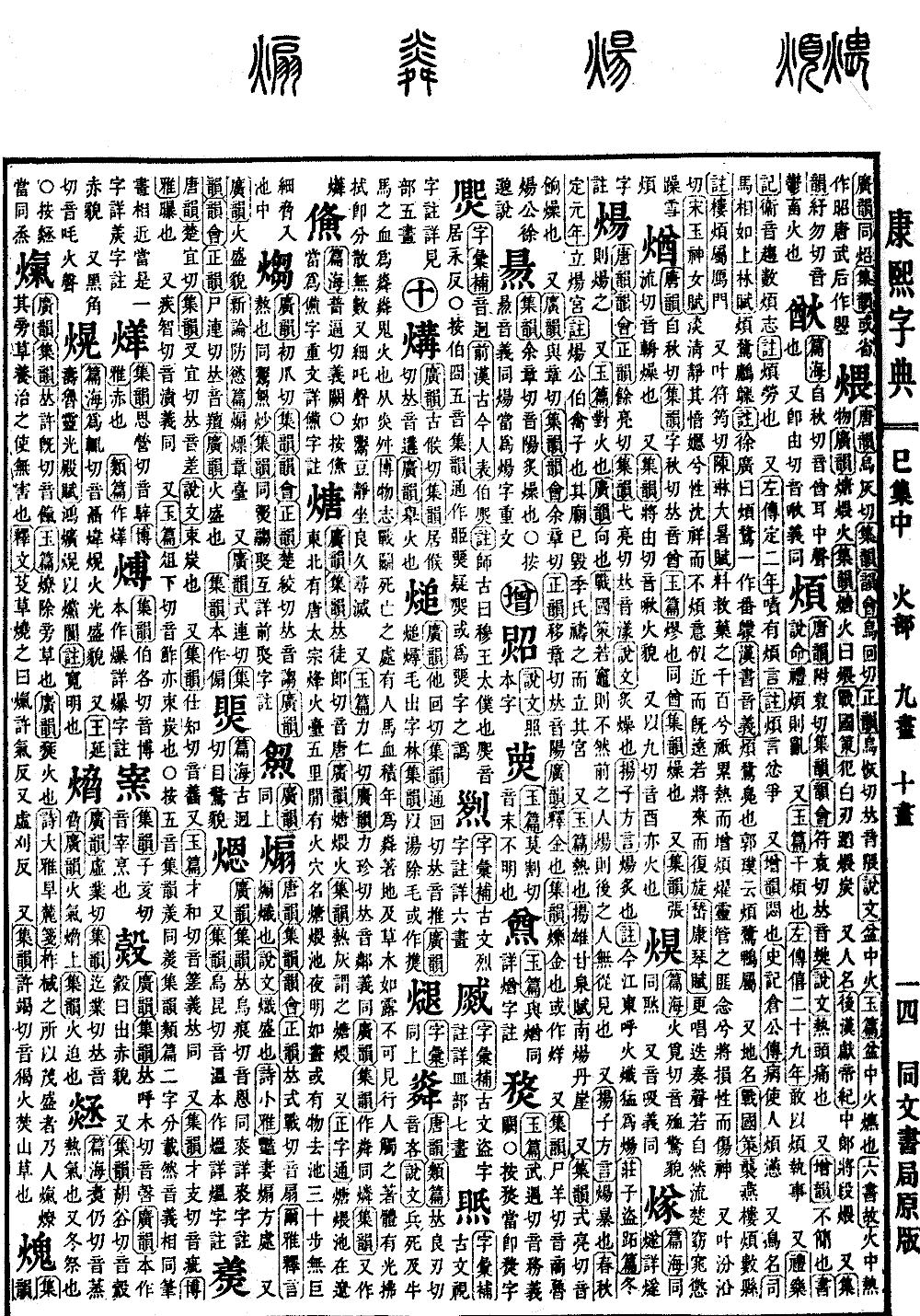
Si Collection, Middle Volume. Radical: Fire (huǒ). Kangxi stroke count: 13. Page 678, Entry 01.
Pronounced yang (falling tone). From Tang Rhymes (Tangyun), Rhyme Collection (Yunhui), and Correct Rhymes (Zhengyun), and from Collected Rhymes (Jiyun), pronounced identical to the sound of yang (falling tone). According to Explaining Graphs and Analyzing Characters (Shuowen), it refers to roasting or drying. According to Dialects (Fangyan) by Yang Xiong, yang means to roast or broil. The commentary notes that in the Jiangdong region, people refer to intense fire as yang. In the Robber Zhi chapter of the Zhuangzi, it refers to warming oneself by a fire in winter.
Also, from Jade Chapters (Yupian), it refers to facing a fire. From Broad Rhymes (Guangyun), it carries the meaning of facing toward. According to Strategies of the Warring States (Zhanguoce), it is like the fire in a stove; those in front block the fire, and those behind cannot see it.
Also, from Dialects (Fangyan) by Yang Xiong, yang refers to exposure to the sun. In the first year of Duke Ding of the Spring and Autumn Annals (Chunqiu), it mentions the establishment of the temple for Duke Yang. The commentary notes that Duke Yang was the son of Boqin and that his ancestral temple had fallen into ruin. After the Ji family offered prayers, they rebuilt his temple.
Also, from Jade Chapters (Yupian), it refers to intense heat. In the Ganquan Rhapsody (Ganquan fu) by Yang Xiong, it mentions the southern face being scorched by the heat of the cinnabar cliffs.
Also, from Collected Rhymes (Jiyun), pronounced xiang (falling tone), identical to the sound of xiang (falling tone), meaning to dry.
Also, from Broad Rhymes (Guangyun), pronounced yang (rising tone), from Collected Rhymes (Jiyun) and Rhyme Collection (Yunhui), and from Correct Rhymes (Zhengyun), pronounced identical to the sound of yang (rising tone). Broad Rhymes (Guangyun) and Collected Rhymes (Jiyun) both define it as melting metal. It is sometimes written in a variant form (yang).
Also, from Collected Rhymes (Jiyun), pronounced shang (rising tone), identical to the sound of shang (rising tone). It refers to Duke Yang of Lu, according to the interpretation of Xu Miao.