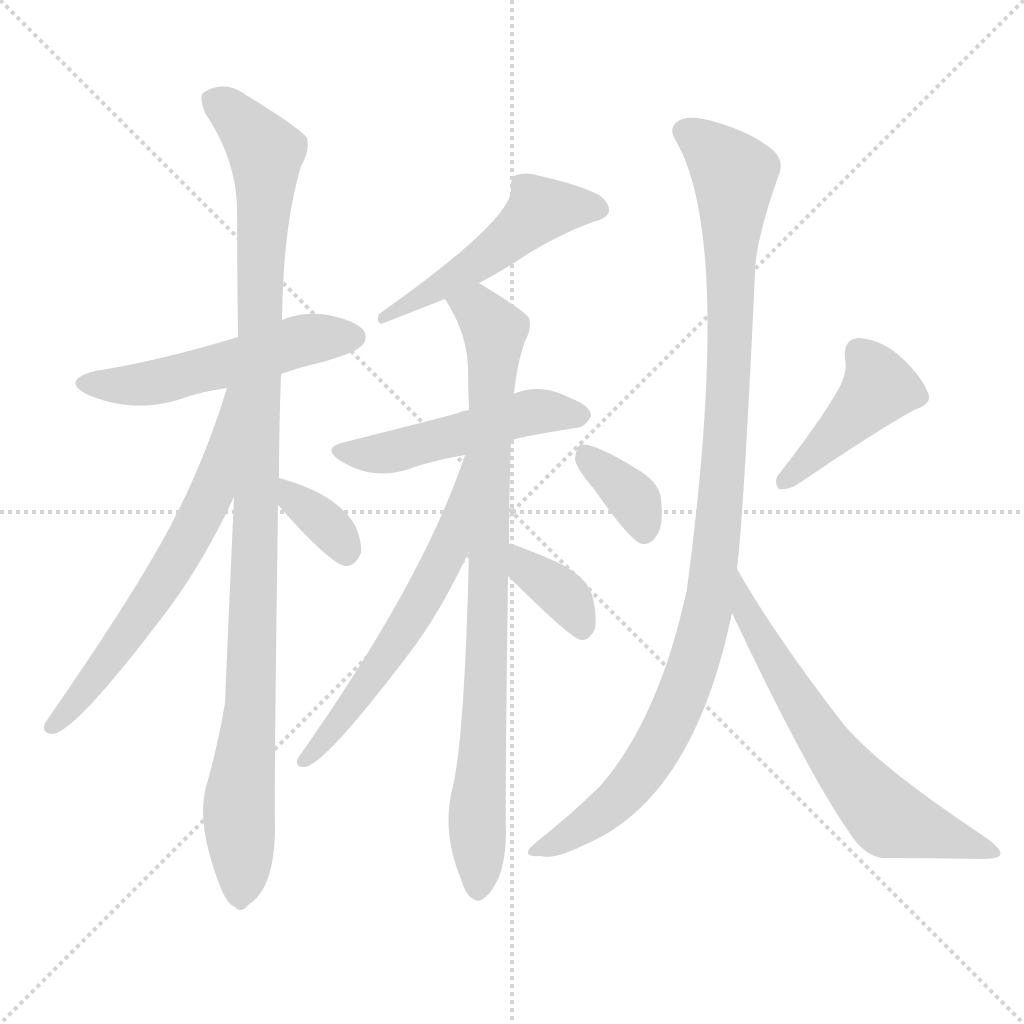
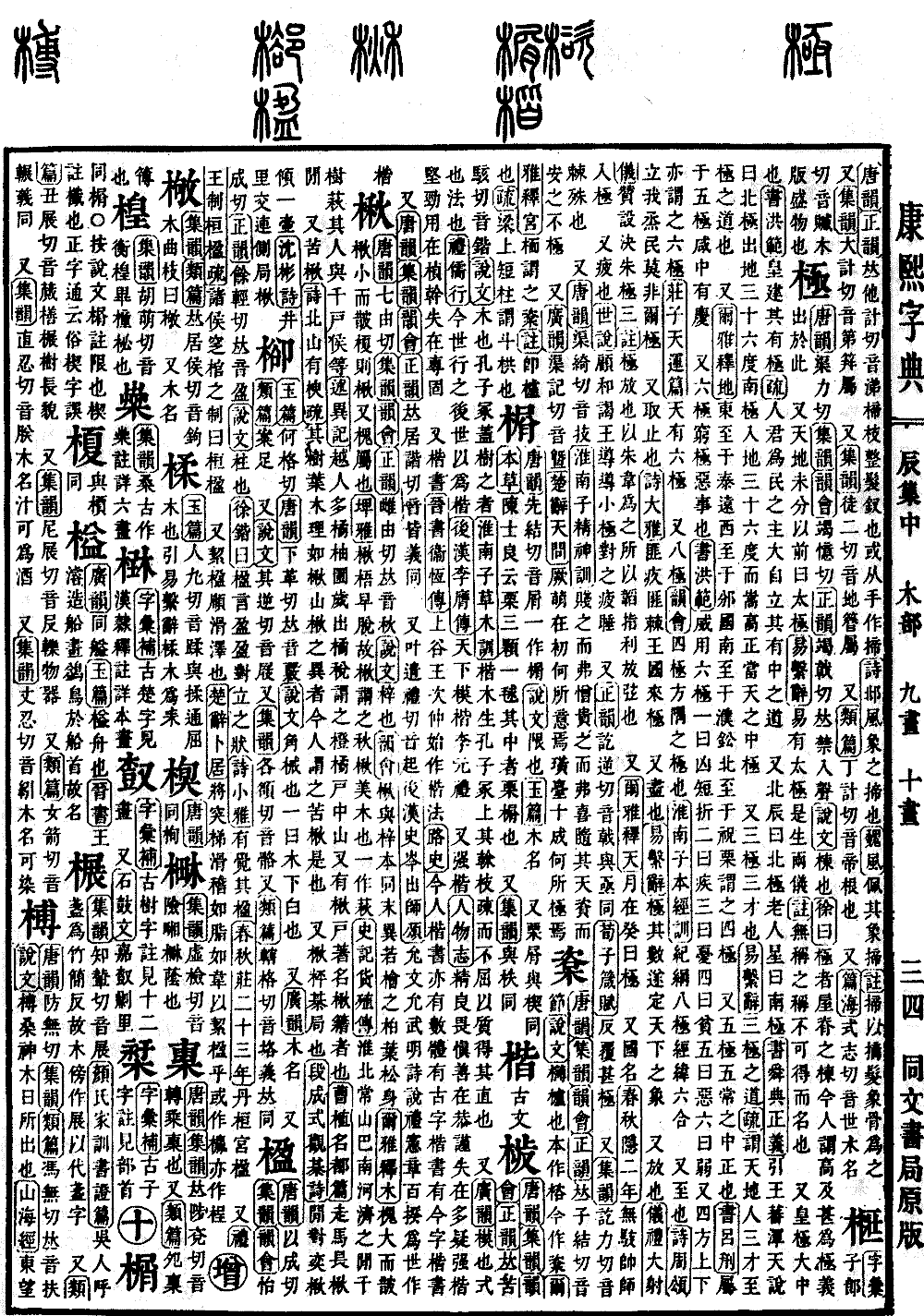
Chen Collection, Middle Volume. Radical: Tree (mù). 13 strokes. Page 542, Entry 07.
Pronounced qiu. According to the Explanation of Writing (Shuowen), it is a type of catalpa tree. The Collection of Rhymes (Yunhui) states that the catalpa and this tree were originally considered the same species, but later became distinguished, much like the cypress-like leaves and pine-like trunks of the Chinese juniper. In the Erya: Explanation of Trees (Erya Shimu), it is noted that the locust tree, when possessing rough and fissured bark, is referred to as the catalpa-type tree, while finer bark characterizes the Japanese raisin tree. Therefore, this tree is classified under the locust family. The Piya states that because the catalpa and the parasol tree shed their leaves early, the name of the tree is associated with the autumn season. It is a high-quality timber. It is sometimes also written in a variant form (qiu). The Records of the Grand Historian: Biographies of Wealth-Makers (Shiji Huozhizhuan) notes that in the regions of Huabei, Changshan, Banan, and Heji, if one owns a thousand of these trees, one's wealth is equivalent to that of a marquis of a thousand households. The Record of Extraordinary Things (Shuyiji) mentions that the Yue region contains many mandarin and pomelo orchards where taxes are paid accordingly, known as orange-mandarin households. In the Zhongshan region, there are also catalpa households, which refers to families registered under a specific household category for this tree. In the Cao Zhi poem Famous Capitals (Mingdou Pian), the verse describes running horses between long rows of these trees. There is also a variety known as bitter catalpa. In the Commentary on the Book of Odes: Northern Mountain (Shi Beishan Youyu Shu), it is described as having leaves and wood grain resembling the catalpa, serving as a distinct species within the mountain catalpa family, which is what people today call the bitter catalpa. It also refers to a chessboard. Duan Chengshi’s Poem on Watching Chess (Guanqi Shi) describes leisurely playing against a chessboard while finishing a jug of wine. Shen Bin’s poem mentions lanes connecting, with chessboards set out on the sides.