Si Collection, Middle Volume
Radical: Fire (huǒ)
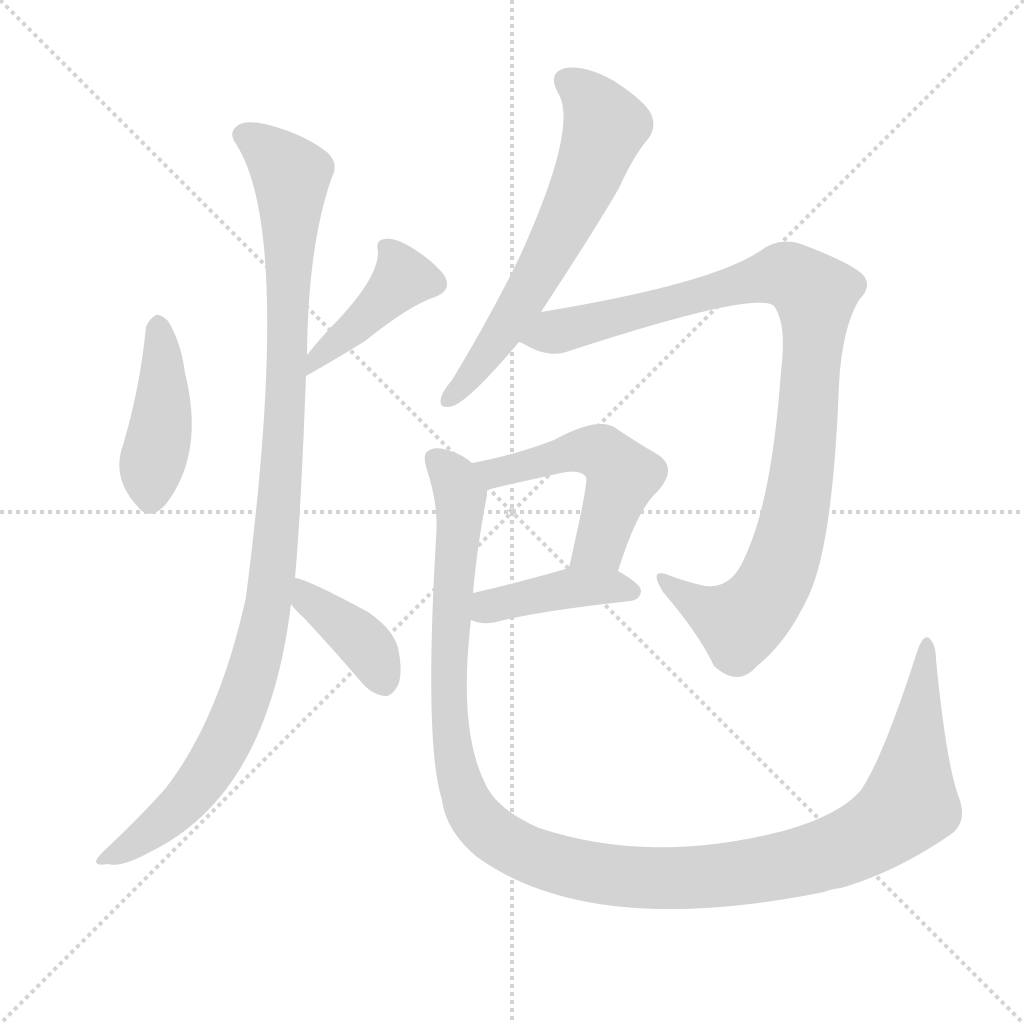
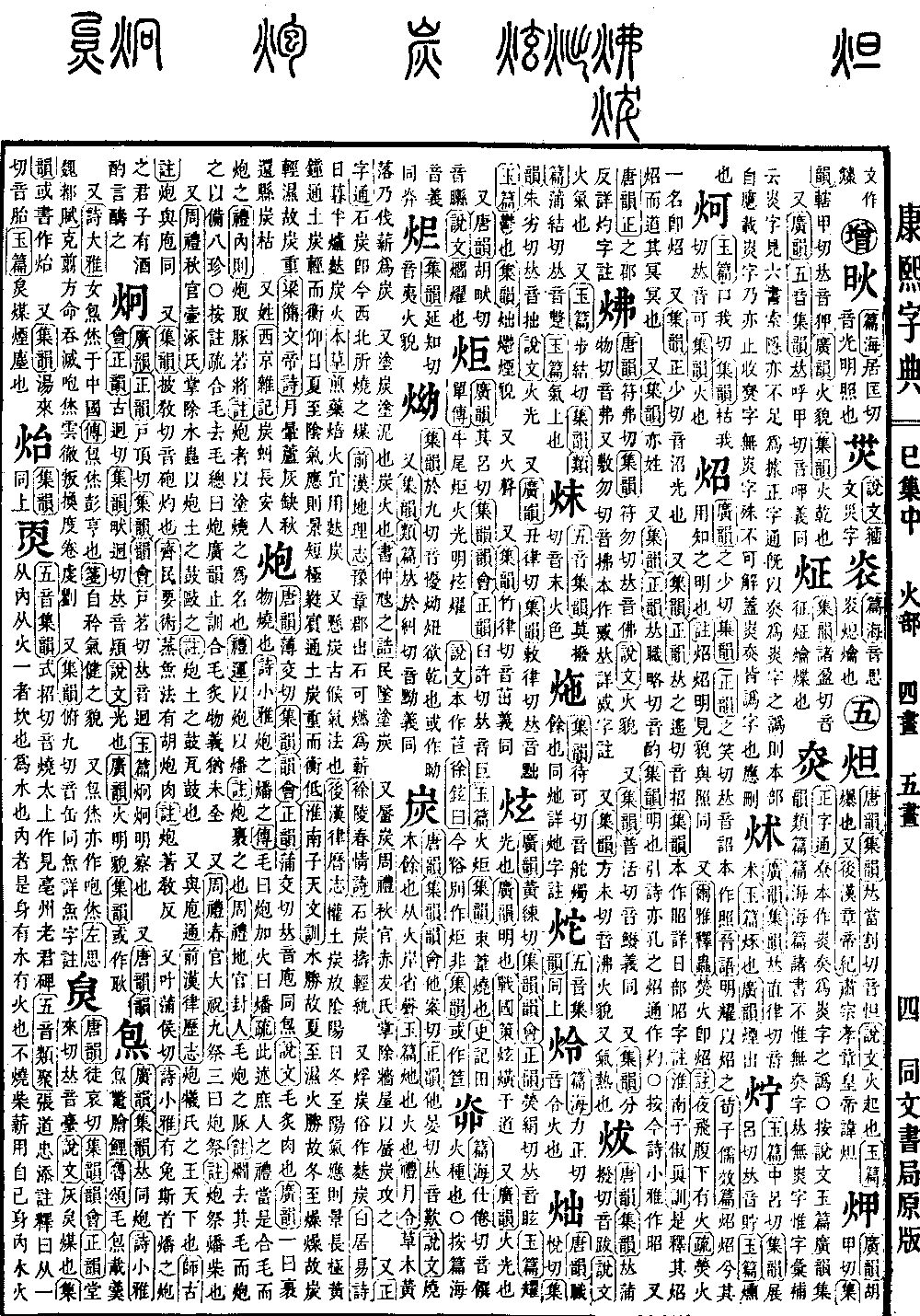
炮
Kangxi stroke count: 9
Page 668, Entry 25
Pronounced pao. The reading is identical to that of the character for kitchen (páo). It is equivalent to the character for roasting (póu).
Explanation in the Explaining Graphs and Analyzing Characters (Shuowen Jiezi): To roast meat while it is still covered in hair.
According to the Broad Rhymes (Guangyun), another definition is to wrap items for burning or roasting.
Book of Odes (Shijing), Lesser Odes (Xiaoya): It is recorded, "Roast it, sear it." The commentary states that roasting while still covered in hair is called "pao," while roasting directly over an open fire is called "fan." The sub-commentary explains that this describes the customs of common people, implying that the item should be wrapped with hair intact and roasted.
Book of Rites (Liji), Inner Chapters (Neize): It is recorded, "For pao, take a suckling pig as if taking a general." The commentary explains that the name "pao" is derived from the method of coating an item in mud before roasting it.
Book of Rites (Liji), Conveyance of Rites (Liyun): It is recorded, "By pao, by fan." The commentary explains that this refers to wrapping the item.
Rites of Zhou (Zhouli), Earth Officers (Diguan), Office of the Mound Keeper (Fengren): It is recorded, "Pao the suckling pig with hair." The commentary explains that this involves scalding the hair off the pig before wrapping it for roasting, which is done to prepare the eight delicacies. Based on these commentaries and sub-commentaries, whether with hair or without, the term "pao" is used for both. The Broad Rhymes (Guangyun) only explains the meaning of roasting with hair intact, which is not comprehensive.
Additionally, Rites of Zhou (Zhouli), Spring Officers (Chunguan), Office of the Grand Invoker (Dazhu), records nine types of sacrifices, the third of which is called the "pao sacrifice." The commentary explains that the pao sacrifice is one performed by burning firewood.
Furthermore, Rites of Zhou (Zhouli), Autumn Officers (Qiuguan), Office of the Hutuo Official (Huzhuoshi), records their responsibility as managing the removal of poisonous water insects, using a "pao-earth drum" to drive them away. The commentary explains that the "pao-earth drum" is an earthenware drum.
This character is also interchangeable with the character for kitchen (páo).
History of the Former Han (Qian Hanshu), Treatises on Harmonics and Calendrics (Lulizhi): It is recorded, "When Pao Xi ruled all under heaven." The commentary by Shi Gu states that the character "pao" is identical to the character for kitchen (páo).
According to the Collected Rhymes (Jiyun), it is also pronounced pao, with the same sound as the character for catapult (pào), meaning to scorch or burn.
Essential Techniques for the Peasantry (Qimin Yaoshu), regarding steaming and boiling methods, mentions "Hu-pao meat." The commentary states that the character "pao" is pronounced pao.
In the ancient rhyming tradition, it can also be rhymed as pu.
Book of Odes (Shijing), Lesser Odes (Xiaoya): There is a poem that says, "There is a hare's head, sear it and roast it; the gentleman has wine, pour it to reward him."
Verification: Essential Techniques for the Peasantry (Qimin Yaoshu) mentions "Hu-pao meat." The commentary says the character "pao" is pronounced zhu. Following the original text with caution, "zhu" has been corrected to "pu."