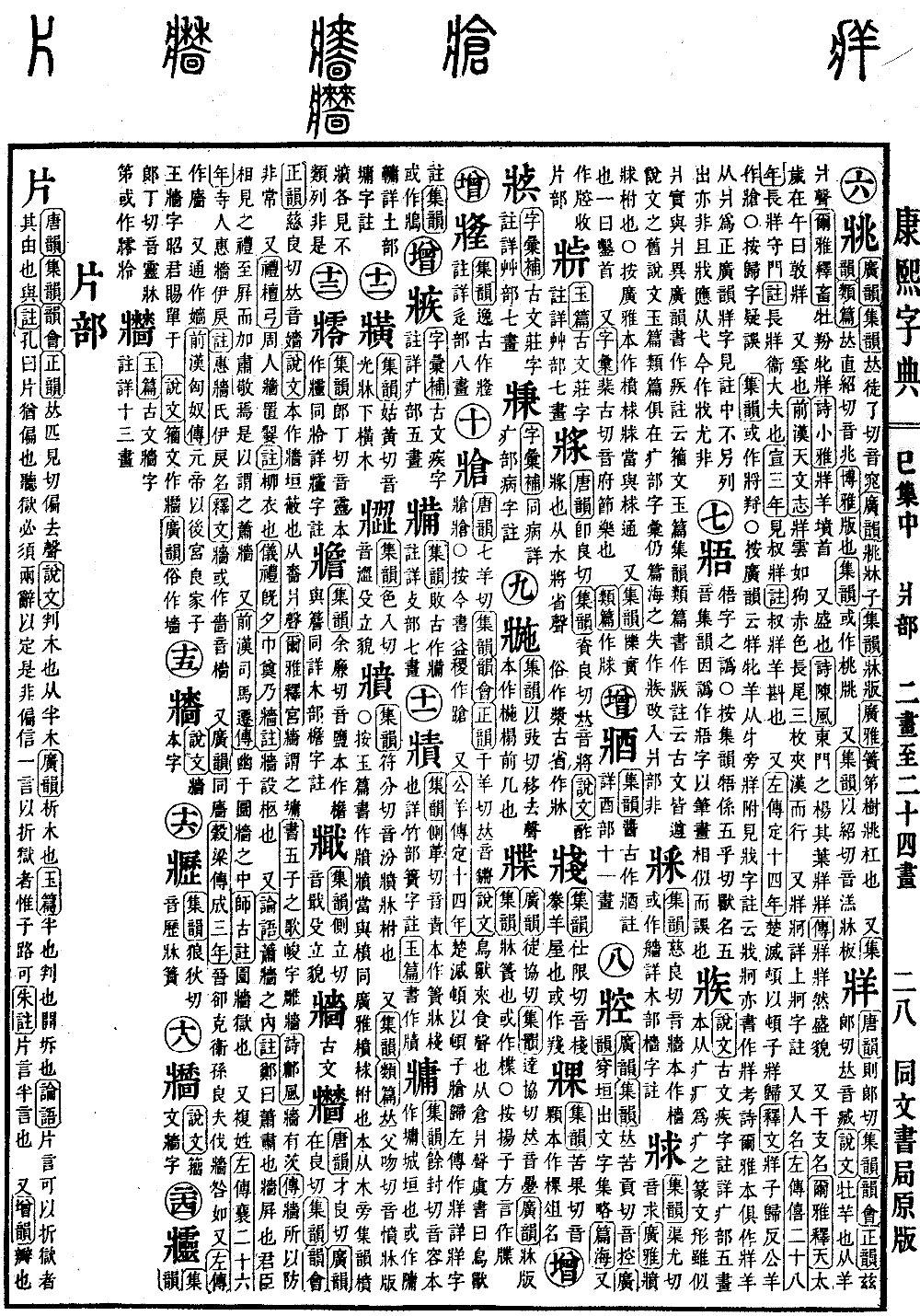
Si Collection, Middle Volume
Radical: Splinter (páng)
Kangxi strokes: 10
Page 692, Entry 02
Pronounced zāng
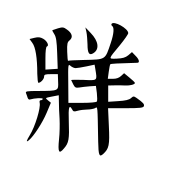
Shuowen Jiezi (Explanation of Simple and Compound Characters): A ram. Composed of the radical for sheep (yáng) with the component for splinter (páng) providing the sound.
Erya (Approaching Elegance), Commentary on Livestock: A male sheep is called a fen, and a female sheep is called a zāng.
Book of Odes (Shijing), Xiao Ya (Minor Odes of the Kingdom): The ewe has a large head.
Also refers to a luxuriant appearance.
Book of Odes (Shijing), Chen Feng (Odes of Chen): The poplar trees at the east gate, their leaves are very lush.
Commentary: Zāng zāng means a lush appearance.
Also a name in the sexagenary cycle.
Erya (Approaching Elegance), Commentary on Heaven: When the Grand Duke (Jupiter) is in the wu year, it is called dūn zāng.
Also refers to cloud formations.
Book of Han (Hanshu), Treatise on Astronomy: Zāng clouds are shaped like dogs, red with long tails, appearing in three clusters, and travel flanking the Milky Way.
Also zāng kē, see the entry for the character kē for details.
Also a personal name.
Zuo Commentary (Zuozhuan), 28th Year of Duke Xi: Cháng Zāng guarded the gate.
Annotation: Cháng Zāng was a grand master of the State of Wei.
3rd Year of Duke Xuan: Saw Shū Zāng.
Annotation: Shū Zāng is Yáng Zhēn.
Also Zuo Commentary (Zuozhuan), 14th Year of Duke Ding: The State of Chu destroyed the State of Dun and brought the ruler of Dun, Zāng, back to their state.
Explanation of Texts: Zāng, pronounced zǐ. In the Gongyang Commentary (Gongyang Zhuan), it is written as the variant character chāng. Note: The character guī may be an error.
Jiyun (Compilation of Rhymes): Sometimes written with the character jiāng.
Note: Guangyun (Broad Rhymes) states: A female sheep, written with the ox radical as the side component. An appended note under the entry for the character qiāng states: Qiāng kē is also written as zāng.
Critical examination of the Book of Odes and Erya suggests that both originally used the character zāng (with the sheep radical), confirming that the splinter component is correct. The entry for zāng in the Guangyun is included only within annotations and not listed as a primary character, which is incorrect. Furthermore, qiāng should properly take the dagger radical. Current usage, written as qiāng, is even more incorrect.