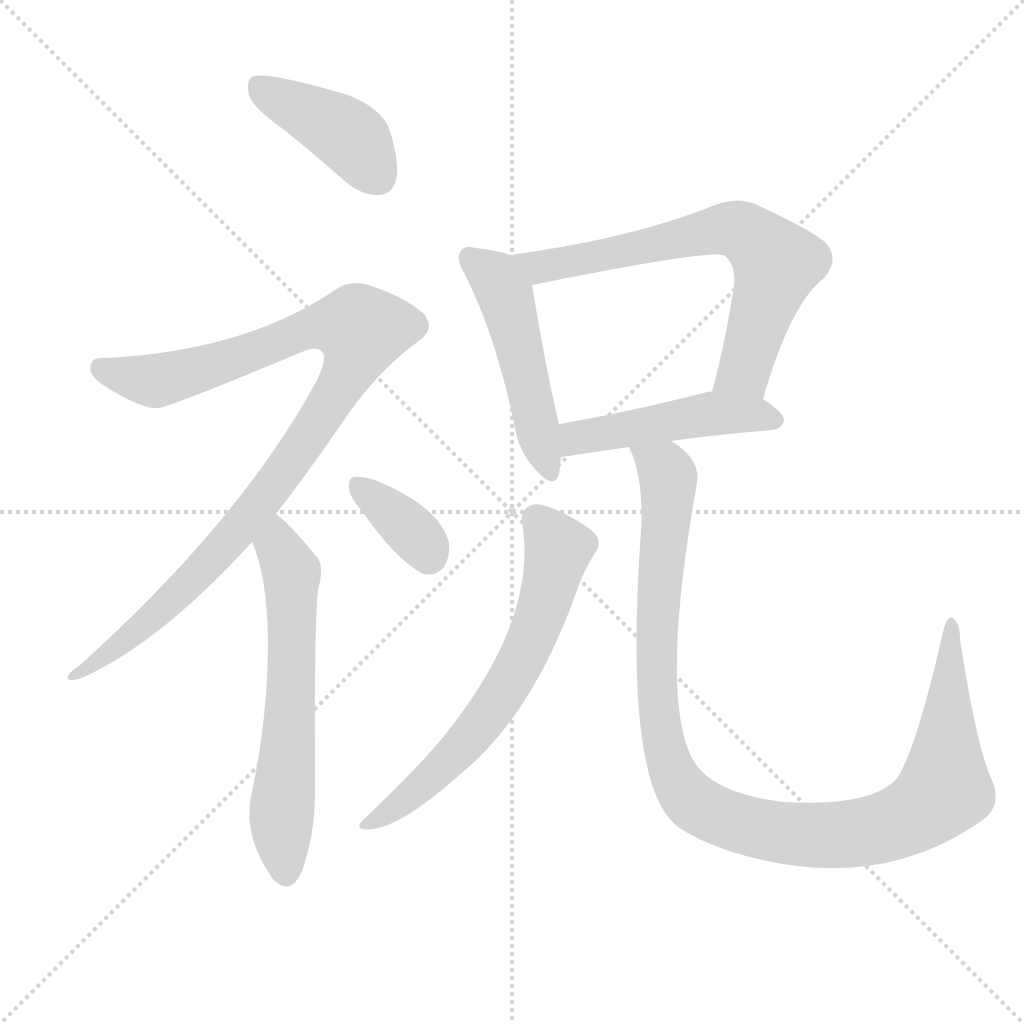
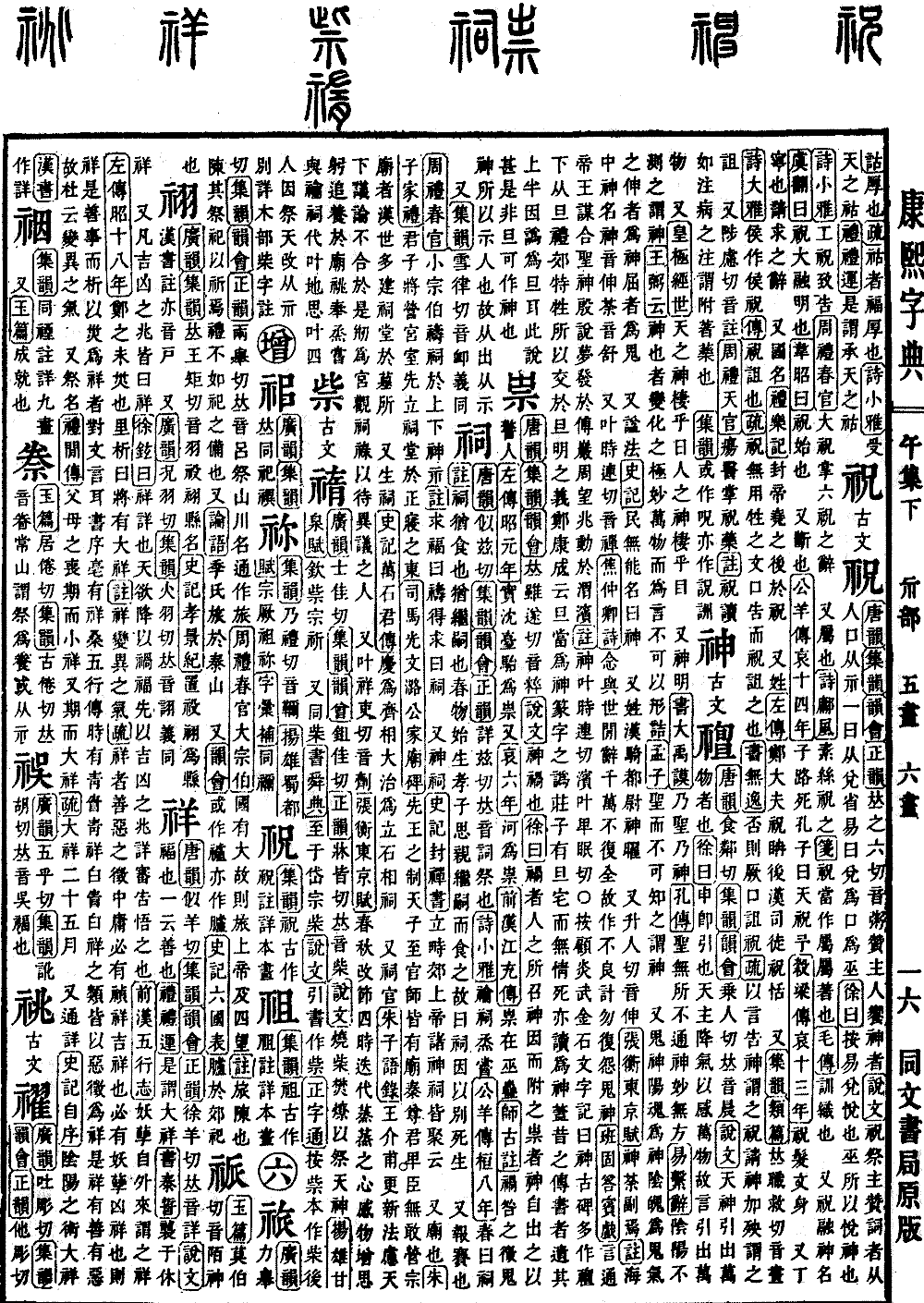
Wu Collection, Lower Volume
Radical: Spirit (shì)
Kangxi Strokes: 10
Page 842, Entry 01
Ancient form. Tang Rhymes (Tangyun), Collected Rhymes (Jiyun), Dictionary of Rhymes (Yunhui), Correct Rhymes (Zhengyun). Pronounced zhou. Refers to the person who presides over sacrifices and offers prayers to the spirits. In the Explaining Graphs and Analyzing Characters (Shuowen Jiezi), it is stated that a zhu is one who presides over prayers during sacrifice, and the graph is composed of human, mouth, and spirit. Another theory states that the graph is derived from a simplified form of the character for exchange. The Book of Changes (Yijing) states: The exchange graph represents the mouth, representing a shaman. Xu states: Upon examining the Book of Changes, the exchange graph implies joy, and the shaman is one used to bring joy to the spirits. In the Book of Odes (Shijing), Lesser Odes of the Kingdom (Xiaoya), the sacrificial official known as zhu conveys the will of the spirits. In the Rites of Zhou (Zhouli), Spring Officials (Chunguan), the Great Zhu oversees the six types of prayer rhetoric.
Also interchangeable with the character meaning to connect or attach. In the Book of Odes (Shijing), Odes of Yong (Yongfeng), use white silk to join it together. The commentary states: Zhu should be read as attached. Attached means to adhere. Mao commentary interprets it as weaving.
Also refers to Zhurong, the name of a deity. Yu Fan states: Zhu means great, and rong means bright. Wei Zhao states: Zhu means to begin.
Also refers to cutting off. In the Gongyang Commentary on the Spring and Autumn Annals (Gongyang Zhuan), 14th year of Duke Ai: When Zilu died, Confucius sighed and said: Alas, this is Heaven wishing to cut me off. In the Guliang Commentary on the Spring and Autumn Annals (Guliang Zhuan), 13th year of Duke Ai: To cut hair and tattoo the body.
Also refers to instructions or exhortations, which are forms of petitioning speech.
Also refers to the name of a feudal state. In the Record of Music (Yueji) of the Book of Rites (Liji), descendants of Emperor Yao were enfeoffed in the land of Zhu.
Also a surname. The Zuo Commentary on the Spring and Autumn Annals (Zuozhuan) records a high official of the Zheng state named Zhu; in the Eastern Han dynasty, there was a Minister of Instruction named Zhu Tian.
According to Collected Rhymes (Jiyun) and Classified Dictionary (Leipian), also pronounced zhou. In the Book of Odes (Shijing), Greater Odes of the Kingdom (Daya): Some create, some curse. The commentary states: Zhu refers to cursing. The sub-commentary states: Zhu, here there is no record of animal sacrifice, it refers to verbal prayers and cursing. In the Book of Documents (Shujing), Against Luxurious Ease (Wuyi): Otherwise they will utter curses. The sub-commentary states: Using words to petition the spirits is called zhu, requesting the spirits to send down calamity is called zhou.
Also pronounced zhu. In the Rites of Zhou (Zhouli), Heaven Officials (Tianguan), the surgeon oversees the application of medicine. The commentary states: Zhu is read like the pronunciation of the word for pouring medicine, meaning to attach the medicine to the affected area.
Collected Rhymes (Jiyun): Sometimes written in a variant form (zhou). Also written as (shuo) and (chou).
Textual research: In the Gongyang Commentary on the Spring and Autumn Annals (Gongyang Zhuan), 14th year of Duke Ai, Zilu died, Confucius said: Heaven destroys me. Note: Corrected the original text from Confucius said to the Master said, Alas.