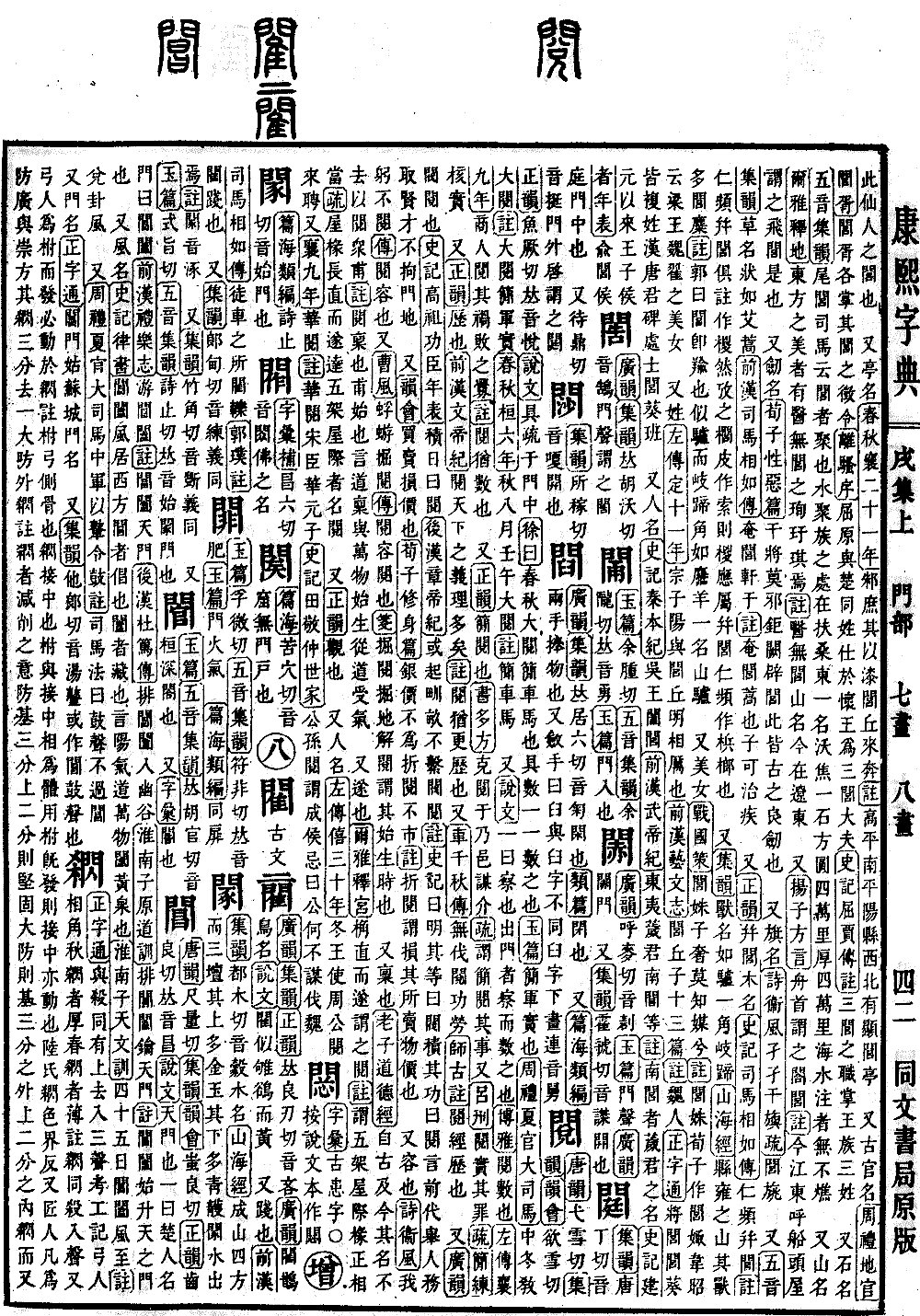
Xu Collection, Upper Volume
Radical: Gate (mén)
Kangxi stroke count: 15
Page 1336, Entry 01
Pronounced yue.
Shuowen Jiezi (Shuowen): To assemble within a gate. Xu Xuan says: The Great Review in the Spring and Autumn period (Chunqiu) refers to inspecting chariots and horses. To assemble and count means to count the number one by one.
Yupian: Refers to military supplies and equipment.
Rites of Zhou (Zhouli), Ministry of Summer (Xiaguan), Grand Marshal (Da Sima): In the middle of winter, conduct a Great Review. Commentary: Great Review means to inspect military equipment.
Spring and Autumn Annals (Chunqiu), Duke Huan, Year 6: In autumn, in the eighth month, on the day of Renwu, a Great Review was held. Commentary: Refers to inspecting chariots and horses.
Also, according to Shuowen, another interpretation is to inspect or examine. To observe and count people as they exit a gate.
Guangya: Yue means to calculate.
Zuo Tradition (Zuozhuan), Duke Xiang, Year 9: Merchants looking back at the signs of their disaster and failure. Commentary: Yue is synonymous with calculating or looking back.
Also, Zheng Yun: To inspect or review.
Book of Documents (Shujing), Numerous Regions (Duofang): Able to inspect matters within your cities and seek assistance. Exegesis: Refers to reviewing affairs.
Also, Marquis of Lu on Punishments (Lü Xing): To verify crimes. Exegesis: Refers to auditing and verifying.
Also, Zheng Yun: To experience.
Book of Han (Hanshu), Annals of Emperor Wen: Having experienced many of the righteous principles of the world. Commentary: Yue is synonymous with experience.
Also, Biography of Che Qianqiu: Without (relying on) qualifications or merit. Yan Shigu commentary: Yue means experience.
Also, Guangyun: Refers to achievements and seniority.
Records of the Grand Historian (Shiji), Table of Merit for the Ministers of the High Ancestor: Accumulating time is called yue.
Book of the Later Han (Hou Hanshu), Annals of Emperor Zhang: Some come from the fields and are not constrained by family status or seniority. Commentary: The Records of the Grand Historian states: To manifest rank is called fa, to accumulate merit is called yue. This means that in the selection of talent in previous eras, it was essential to select the virtuous, regardless of family background.
Also, Yunhui: Refers to lowering prices during trade.
Xunzi, Cultivating the Self: A good merchant does not cease trading because of a loss in price. Commentary: Zhe yue refers to lowering the price of goods sold.
Also, to contain or accommodate.
Book of Odes (Shijing), Odes of Bei (Beifeng): I myself am not accommodated. Commentary: Yue means to accommodate.
Also, Odes of Cao (Caofeng): The mayfly digs into its hole and emerges. Commentary: Yue refers to a hole that accommodates the body. Jian commentary: Jue yue refers to digging into the earth to form a hole. It refers to the time when it has just been born.
Also, to receive or inherent.
Laozi, Dao De Jing: From ancient times to the present, its name has not vanished, and through it, one observes the beginning of all things. Commentary: Yue means to receive or observe. Fu means beginning. It says that endowment occurs at the beginning of the generation of all things; all things receive their vital energy (qi) from the Dao.
Also, to be straight and connected.
Erya, Explaining Dwellings (Shigong): When rafters are straight and connected, it is called yue. Commentary: Refers to the rafters of a five-bay house being perfectly aligned. Exegesis: House rafters that are long, straight, and connected, such that the rafter heads of a five-bay house are aligned, are called yue.
Also, Zheng Yun: To watch or look at.
Also, a personal name.
Zuo Tradition (Zuozhuan), Duke Xi, Year 30: In winter, the Zhou Emperor sent Duke Yue of Zhou to visit.
Also, Duke Xiang, Year 9: Hua Yue. Commentary: Hua Yue is the son of the Song state minister Hua Yuan.
Records of the Grand Historian (Shiji), Hereditary House of Tian Jingzhong: Gongsun Yue said to Cheng Hou Tian Ji: Why do you not plan to attack the State of Wei?