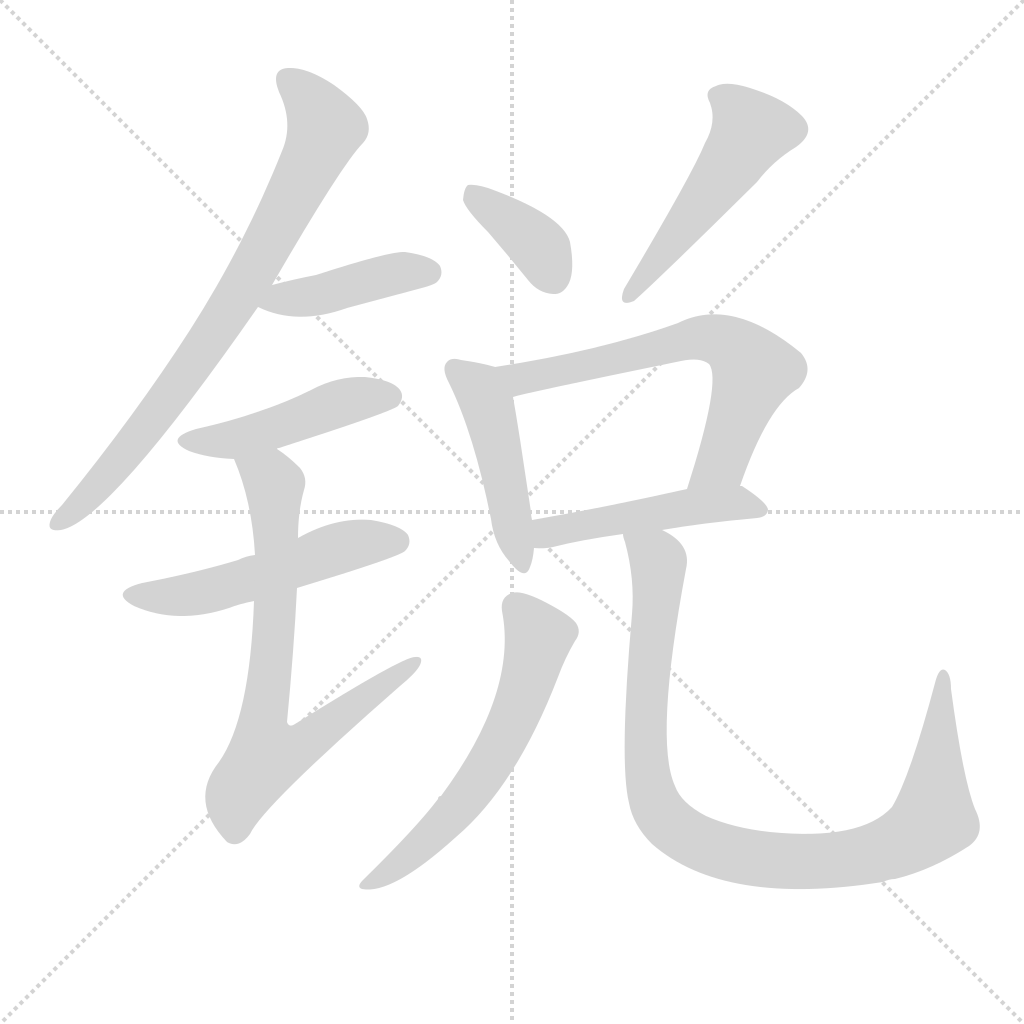
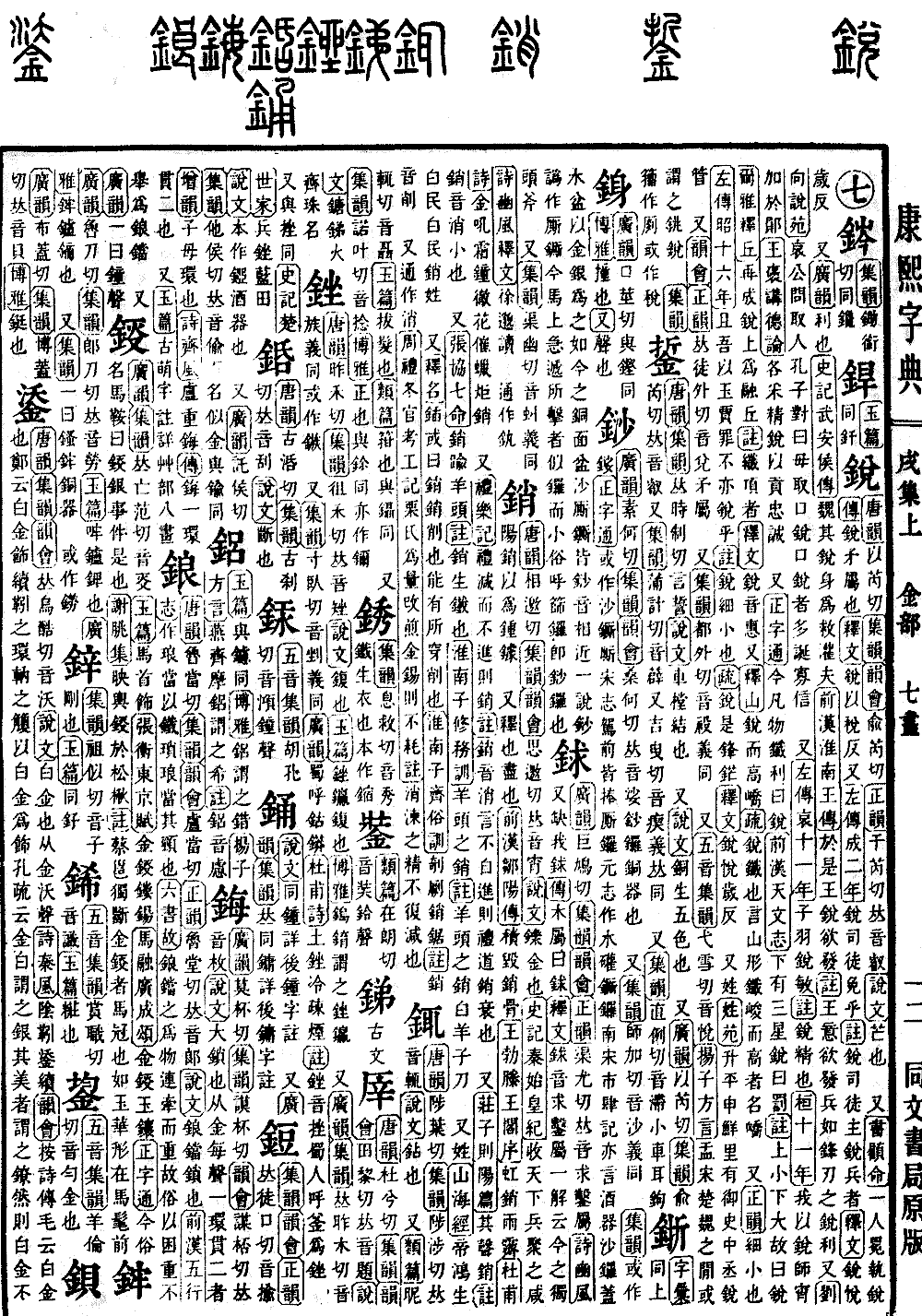
Xu Collection, Upper Volume
Radical: Metal (jīn)
Page 1306, Entry 15
Pronounced rui (fourth tone)
Shuowen Jiezi (Explanation of Simple and Compound Characters): The point of a blade.
Book of Documents (Shujing), Guming chapter: One person wearing a ceremonial cap and holding a sharp weapon. Commentary: Sharp refers to a type of spear. Interpretation of Text: Pronounced rui (fourth tone).
Zuo Zhuan (Chronicle of Zuo), 2nd Year of Duke Cheng: Is the official in charge of weapons exempt? Commentary: The official in charge of weapons is one who manages sharp armaments. Interpretation of Text: Pronounced yue (fourth tone).
Guangyun (Broad Rhymes): Sharp.
Records of the Grand Historian (Shiji), Biography of Marquis Wu'an: Wei Qi eagerly exerted himself to save Guan Fu.
Book of Han (Hanshu), Biography of the Prince of Huainan: Thereupon, the Prince was keen to dispatch troops. Commentary: The Prince’s intention was to send out troops, like the keen sharpness of a blade.
Liu Xiang, Shuoyuan (Garden of Stories): Duke Ai asked about how to recruit men. Confucius replied: Do not recruit those who are sharp-tongued. Those who are sharp-tongued tell many lies and have little credibility.
Zuo Zhuan (Chronicle of Zuo), 11th Year of Duke Ai: Ziyu was sharp and quick-witted. Commentary: Sharp means astute. 11th Year of Duke Huan: I used elite troops to strike at Yun at night. Wang Bao, Discourse on Virtue: Each selects the elite to contribute loyalty.
Zhengzitong (Correction of Characters): Nowadays, anything pointed and sharp is called rui.
Book of Han (Hanshu), Treatise on Astronomy: Below there are three stars, sharp in shape, called the Penalty. Commentary: Small at the top and large at the bottom, therefore it is called sharp.
Erya (Approaching Elegance), Explanation of Hills: A mound that is double-tiered and pointed at the top is called a Rong hill. Commentary: Meaning it has a slender neck. Interpretation of Text: Pronounced rui (fourth tone).
Explanation of Mountains: Pointed and high is called qiao. Commentary: Pointed means sharp; it refers to the shape of a mountain that is sharp, steep, and high, which is called qiao.
Zhengzitong: Fine and small.
Zuo Zhuan (Chronicle of Zuo), 16th Year of Duke Zhao: Moreover, for me to use jade to pay for a crime, is that not petty? Commentary: Sharp means fine and small. Commentary: Sharp refers to the blade tip. Interpretation of Text: Pronounced yue (fourth tone).
A surname. Xingyuan (Garden of Surnames): In the Shenxian neighborhood during the Shengping era, there was an Imperial Censor named Rui Guan.
Yunhui (Collection of Rhymes) and Zhengzitong: Pronounced dui (fourth tone). A type of spear.
Jiyun (Collection of Rhymes): Pronounced dui (fourth tone). Same meaning.
Wuyin Jiyun (Five Tones Collection of Rhymes): Pronounced yue (entering tone).
Yang Xiong, Fangyan (Regional Dialects): A basin is sometimes called a yao-rui in the region between Song, Chu, and Wei.
Jiyun: The seal script form is written as a variant. Sometimes written in a variant form (shui).
Textual Research: Erya, Explanation of Hills: A mound that is double-tiered and pointed at the top is called a Rong hill. Interpretation of Text: Pronounced hui (fourth tone). I respectfully note that rui and hui do not have the same pronunciation. The character rui cannot be pronounced hui. There is no such text stating that rui is pronounced hui. I have corrected it to the original text reading of rui (fourth tone).