You Collection, Upper Volume
Radical: Speech (yán)
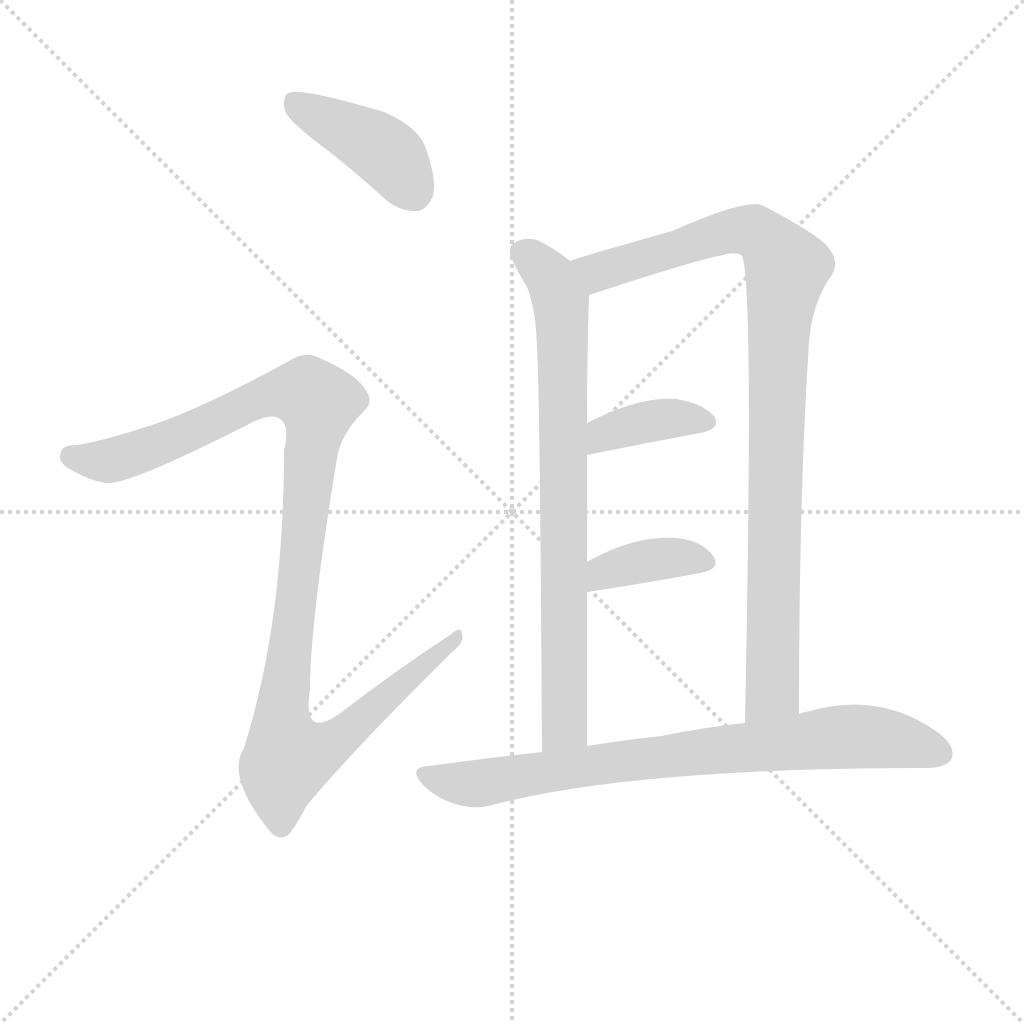
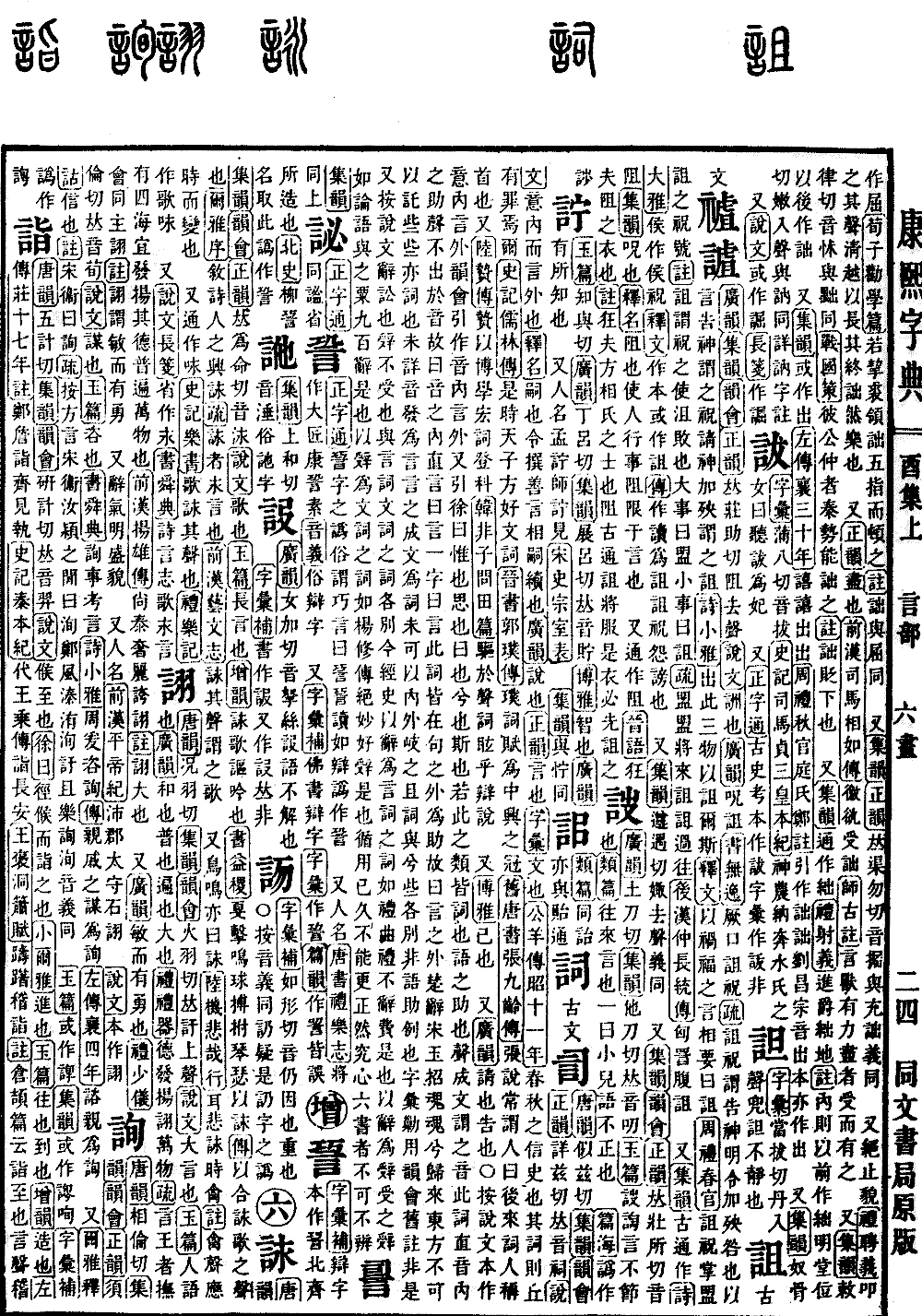
詛
Kangxi Dictionary Stroke Count: 12
Page 1156, Entry 03
Ancient form: 謯
Guangyun (Broad Rimes), Jiyun (Collected Rimes), Yunhui (Collection of Rimes), Zhengyun (Correct Rimes): Pronounced zu (falling tone)
Shuowen Jiezi (Explaining Graphs and Analyzing Characters): To pledge or vow.
Guangyun (Broad Rimes): To curse or hex.
Book of Documents (Shangshu), chapter "None Easeful" (Wuyi): Their mouths utter curses and invocations.
Sub-commentary: Curses and invocations refer to addressing the spirits to bring misfortune or blame upon someone. Addressing the spirits with words is called invocation (zhu). Asking the spirits to inflict misfortune is called cursing (zu).
Book of Odes (Shijing), Xiao Ya: Brought out these three things to curse you.
Explanation of Texts: Words of misfortune or blessings used to constrain others are called cursing (zu).
Rites of Zhou (Zhouli), Spring Officials: The officials of curses and invocations manage the oaths and cursing titles.
Commentary: Cursing refers to invoking the spirits to cause someone to fail or suffer defeat. A major matter is called a covenant (meng); a minor matter is called a curse (zu).
Sub-commentary: A covenant (meng) applies to future events; a curse (zu) applies to past events.
Book of the Later Han (Houhan shu), Biography of Zhongchang Tong: Scolding in the belly and cursing.
Jiyun (Collected Rimes): Anciently often written as the variant form (zu).
Book of Odes (Shijing), Da Ya: They create, they invoke.
Explanation of Texts: The character (zuo) in the original text is sometimes written as (zu).
Zhu Xi's Commentary: The character (zuo) is read as (zu). Cursing and invoking are expressions of resentment and slander.
Jiyun (Collected Rimes): Pronounced zu (falling tone). Meaning is the same.
Jiyun (Collected Rimes), Yunhui (Collection of Rimes), Zhengyun (Correct Rimes): Pronounced zu (rising tone).
Jiyun (Collected Rimes): To curse.
Explanation of Names: To obstruct. To use words to cause someone's actions to be hindered or limited.
Also commonly written as the variant form (zu).
Discourses of the States (Jin yu): The madmen hindered his clothing.
Commentary: The madmen refer to the officials of the Fangxiang (a type of ritual exorcist). The character (zu) is the ancient equivalent of (zu). Before wearing this garment, one must perform a curse (zu) upon it.
Textual Research:
Book of Odes (Shijing), Da Ya: They create, they invoke.
Explanation of Texts: The character (zuo) in the original text is sometimes written as (zu).
Commentary: The character (zuo) is read as (zu).
Corrected according to the original text by adding the character Zhu before the word Commentary.