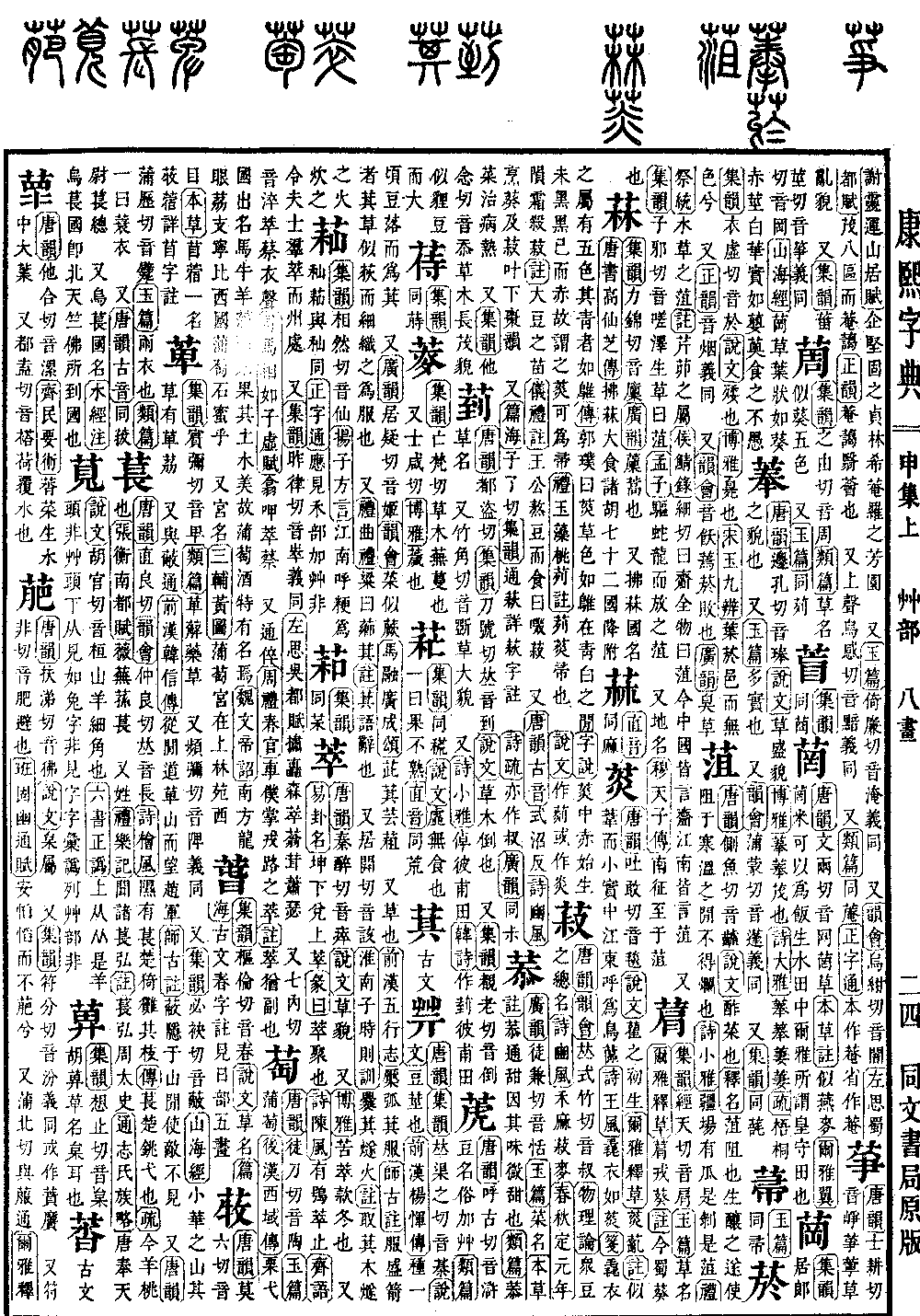
Shen Collection, Upper Volume
Radical: Grass (cǎo)
菹; Kangxi stroke count: 14; Page 1040, Entry 09
Pronounced zu.
According to the Explaining Graphs and Analyzing Characters (Shuowen Jiezi), it refers to pickled vegetables.
According to the Explaining Names (Shiming), a pickled vegetable is called zu because it is obstructed (zu). By fermenting it while raw, it is kept in a state between cold and warm so that it does not decompose.
Book of Odes (Shijing): In the border fields there are melons; these are peeled and pickled.
Book of Rites (Liji): Pickled aquatic plants.
Commentary: This refers to plants such as water celery or cogon grass.
According to the Houqing Lu: Finely chopped vegetables are called ji, while whole vegetables are called zu. Today in the central regions all are called ji, while in the Jiangnan region all are called zu.
Also, according to the Collected Rhymes (Jiyun), pronounced jie. Grass growing in a marsh is called zu.
Mencius: Drove the snakes and dragons and released them into the marshes.
Also a place name.
Biography of King Mu, Son of Heaven (Mu Tianzi Zhuan): On the southern expedition, reached Zu.
Textual research: In the Book of Odes (Shijing), the term border fields has been corrected to reflect the original text.