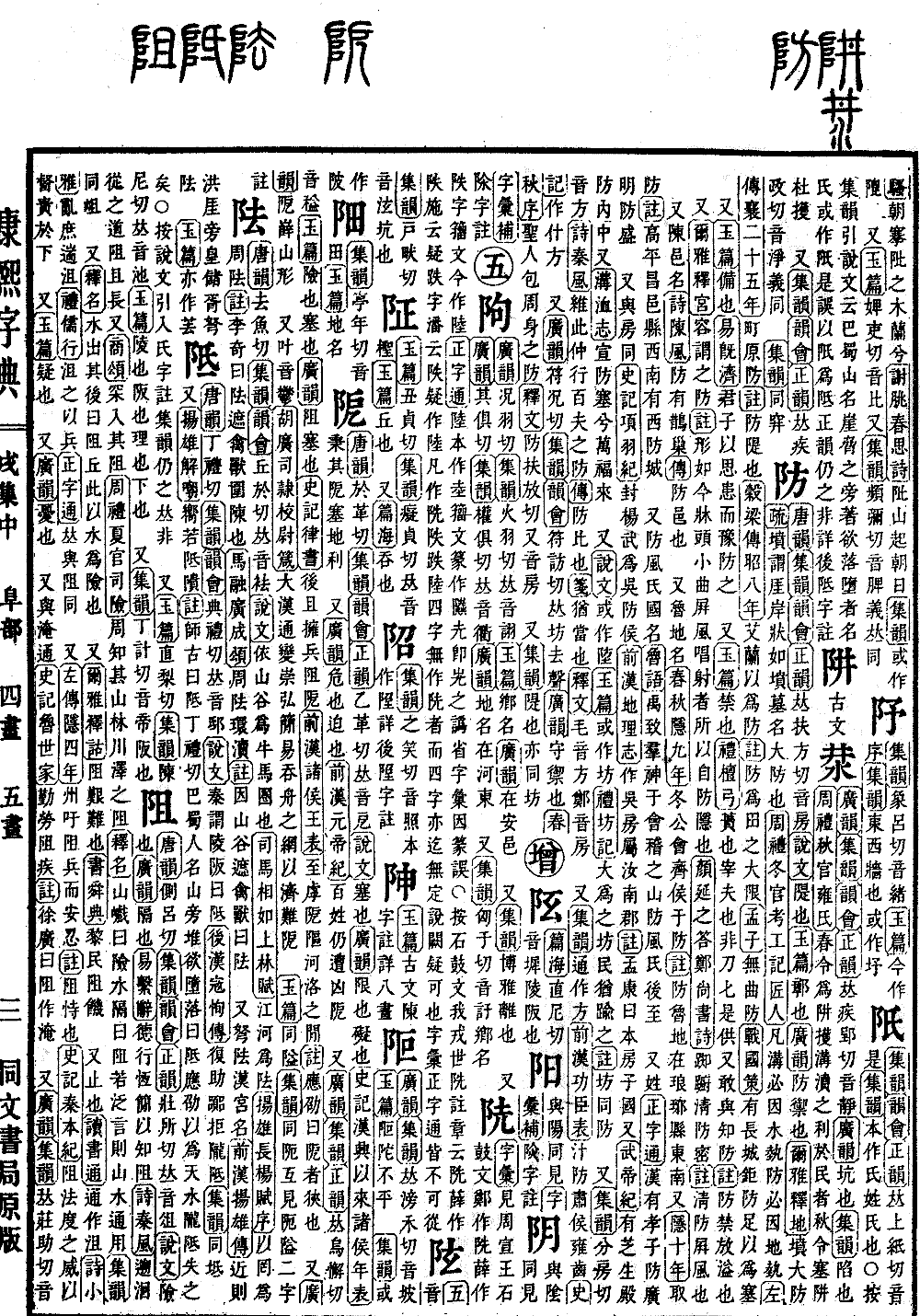
Xu Collection, Middle Volume
Radical: Mound (fù)
Kangxi stroke count: 13
Page: 1347, entry 20
Tangyun (Tangyun): cè lǚ qiē. Jiyun (Jiyun), Yunhui (Yunhui), Zhengxun (Zhengxun): zhuàng suǒ qiē, pronounced zǔ.
Shuowen Jiezi (Shuowen Jiezi): danger, peril.
Guangyun (Guangyun): blocked, separated.
"Moral conduct constantly makes one aware of obstacles." — Yijing (Yijing), Xici.
"Following the stream upstream, the way is difficult and long." — Book of Odes (Shijing), Qin Feng.
"Deeply entering its inaccessible parts." — Book of Odes (Shijing), Shang Song.
"Thoroughly understanding the obstacles of mountains, forests, rivers, and swamps." — Rites of Zhou (Zhouli), Xia Guan, Si Xian.
Shiming (Shiming): A rugged mountain is called xiǎn, a water barrier is called zǔ. When speaking generally, it applies to both mountains and water.
Jiyun (Jiyun): Same as ju.
Shiming (Shiming): A hill with water emerging from behind it is called zǔqiū; this uses water as the perilous element.
Erya (Erya), Shigu: zǔ means difficult, hard.
"The common people were hindered by hunger." — Book of Documents (Shangshu), Shun Dian.
Also, to stop.
Dushu Tong (Dushu Tong): Often written as jǔ.
"May disorder quickly be stopped." — Book of Odes (Shijing), Xiao Ya.
"To stop it with weapons." — Book of Rites (Liji), Ru Xing.
Zhengzi Tong (Zhengzi Tong): Same as zǔ.
"Zhou Xu relied on his military strength and was content in his cruelty." — Zuo Zhuan (Zuo Zhuan), Yin 4th Year.
Commentary: zǔ means to rely on.
"Relied on the authority of laws and regulations to supervise those below." — Records of the Grand Historian (Shiji), Annals of Qin.
Also, Yupian (Yupian): to doubt.
Also, Guangyun (Guangyun): to worry.
Also interchangeable with yān.
"Toil and prolonged sickness." — Records of the Grand Historian (Shiji), House of Lu.
Note: Xu Guang said: zǔ is used for yān.
Also, Guangyun (Guangyun), Jiyun (Jiyun): zhuāng zhù qiē, pronounced zǔ.
Guangyun (Guangyun): Horse with hindered hooves.
Jiyun (Jiyun): to walk improperly. Originally written as jǔ. Also written as cuò.