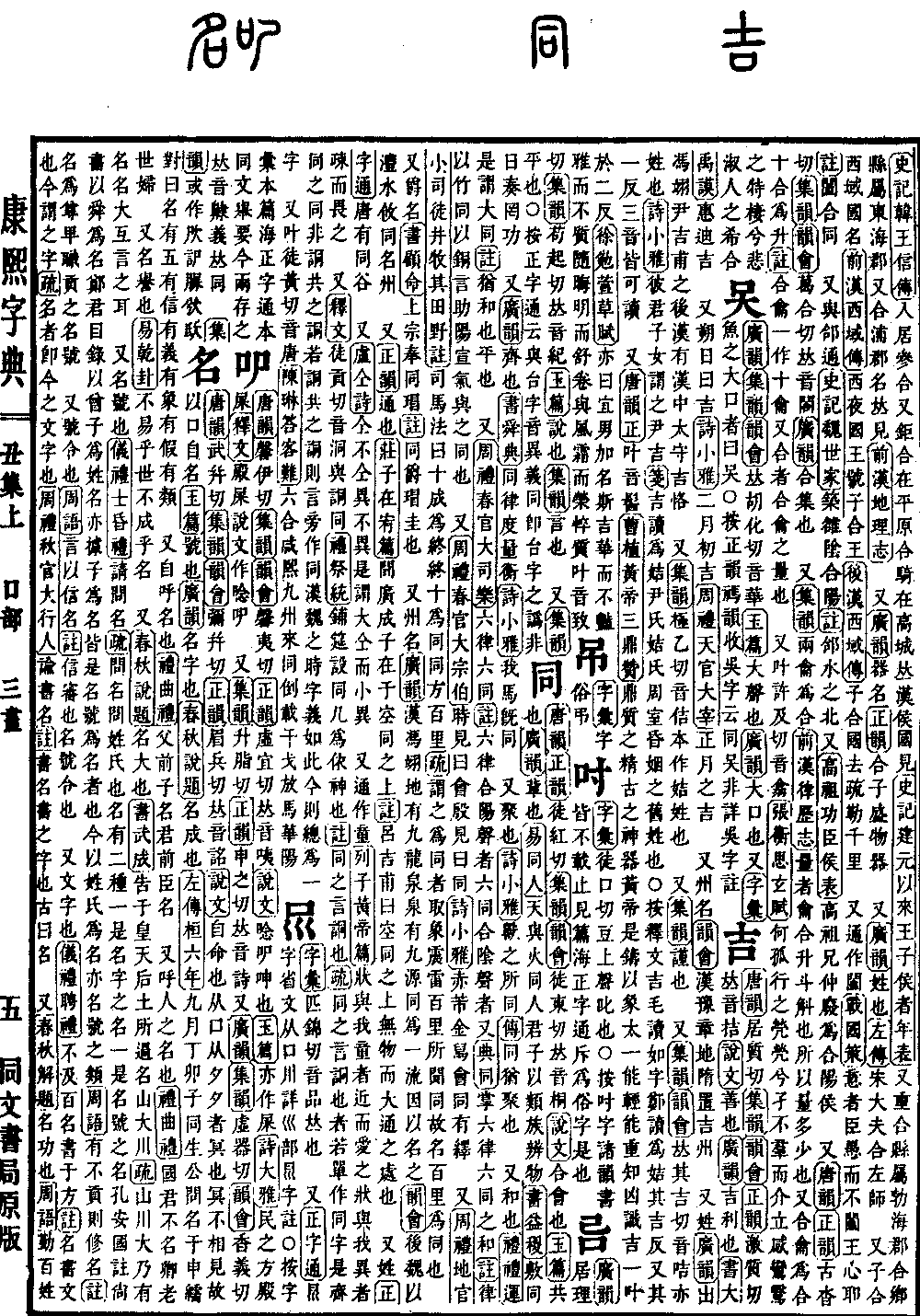
Chou Collection, Upper Volume
Radical: Mouth (kǒu)
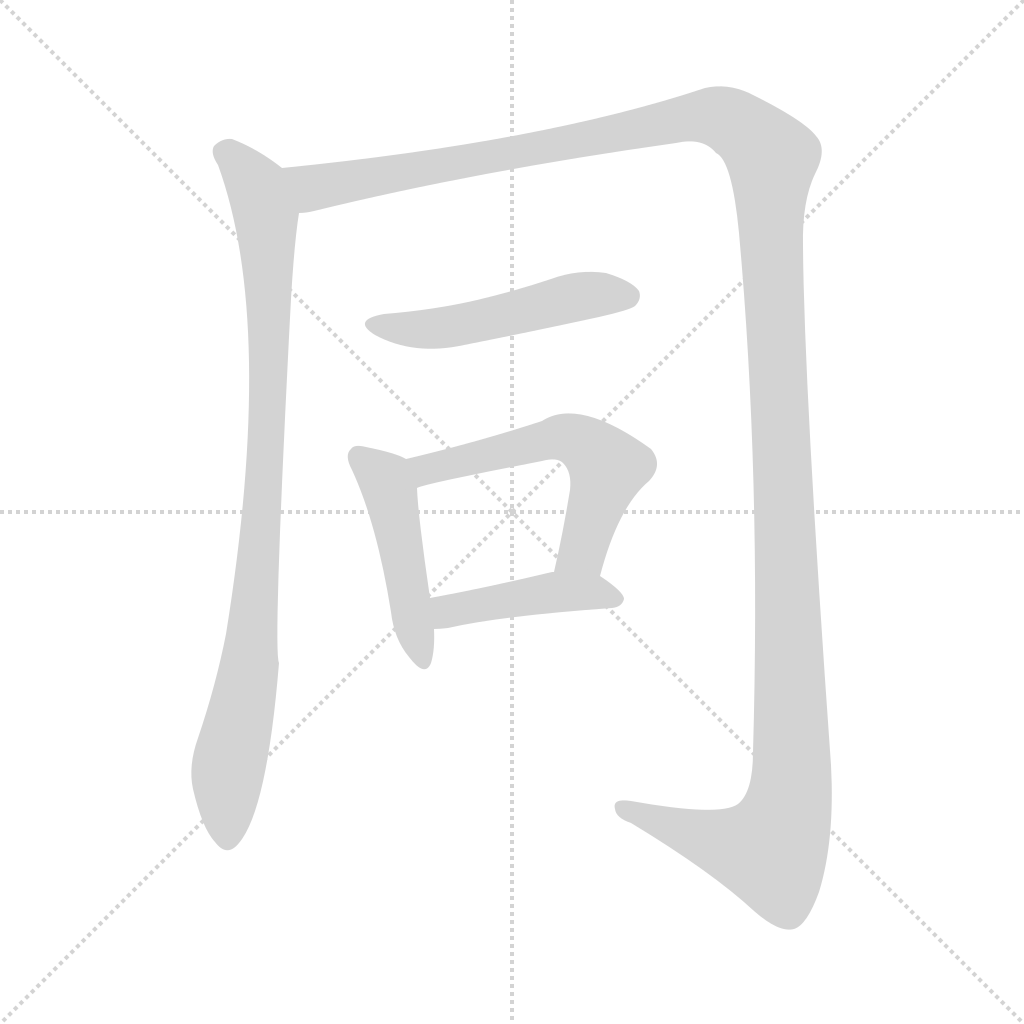
Same. Kangxi strokes: 6.
Page 175, Entry 06
Pronounced tóng.
Shuowen Jiezi (Shuowen): To unite or gather.
Yupian (Yupian): To share.
Guangyun (Guangyun): Also means to be the same.
Book of Changes (Yijing), section Tongren: Heaven and fire are together in kind; the superior man differentiates things according to the nature of their clan.
Book of Documents (Shujing), section Yiji: If they all report on the same day, there will be no success.
Also, according to Guangyun (Guangyun): To be equal.
Book of Documents (Shujing), section Shundian: To standardize the pitch pipes, weights, and measures.
Book of Odes (Shijing), Xiaoya section: Our horses are already matched.
Also means to assemble.
Book of Odes (Shijing), Xiaoya section: Where the beasts assemble. Commentary: Tong here means to gather.
Also means harmony.
Book of Rites (Liji), Liyun section: This is called the Great Harmony (Datong). Commentary: Means harmony and equality.
Also, Zhou Rites (Zhouli), Chunguan section, Grand Master of Music: The six pitch pipes and the six tong (a type of instrument). Commentary: The six pitch pipes combine with the yang sounds, the six tong combine with the yin sounds.
Also, Diantong (official title): In charge of the six pitch pipes and the harmony of the six tong. Commentary: The pipes are made of bamboo; the tong are made of copper. They assist the yang in spreading energy, making them one with it.
Also, Zhou Rites (Zhouli), Chunguan section, Grand Minister of Rites: A meeting at the prescribed time is called a hui, an official audience is called a tong.
Book of Odes (Shijing), Xiaoya section: With red knee-covers and golden shoes, at the meetings and audiences, there is a continuous sequence.
Also, Zhou Rites (Zhouli), Diguan section, Xiaositu (Minor Sima), section on well-field divisions. Commentary: The Sima Fa (Method of Sima) states: Ten cheng make a zhong, ten zhong make a tong, a tong is one hundred li square. Sub-commentary: It is called a tong because it takes the image of the sound of thunder which is heard across one hundred li; thus, one hundred li is called a tong.
Also, a type of ritual vessel.
Book of Documents (Shujing), section Gumeng: The supreme ancestor offered the tong and the mao. Commentary: Tong is a vessel, mao is a jade tablet.
Also, a prefecture name.
Guangyun (Guangyun): The land of Fengyi during the Han dynasty had the Nine Dragon Springs. The springs had nine sources that flowed into one, hence the name.
Yunhui (Yunhui): During the Later Wei, it was named for the Feng River where the waters converge.
Also, according to Zhengyun (Zhengyun): To penetrate or circulate.
Zhuangzi, Zaiyou chapter: Hearing that Guangchengzi was on Mount Kongtong. Commentary: Lü Jifu says: Above Kongtong is a place that is empty, grand, and all-penetrating.
Also, a surname.
Zhengzitong (Zhengzitong): During the Tang dynasty, there was Tong Gu.
Also, in a poem by Lu Tong: To be the same yet not the same, to be different yet not different, this is called being largely the same while differing in small ways.
Also, written as a variant form (tóng).
Liezi, Huangdi chapter: Those whose appearance is the same as mine, I draw near and love; those whose appearance is different from mine, I distance myself from and fear.
Also, according to Shiwen (Shiwen): Pronounced dòng. Same as the character variant (dòng).
Book of Rites (Liji), Jitong section: Spread the mats and set the tong tables to welcome the spirits. Commentary: The word tong here means to prepare or provide.
Sub-commentary: The statement that tong means to prepare is because if it were simply the character for the same, it would mean equality, not the meaning of providing or preparing. If it were for providing or preparing, then the side would be written with the same character. In the Han and Wei periods, character meanings were like this; today, they are unified into one character.
Also, rhyming variant: Pronounced táng.
Lin, Da Ke Nan: The six directions are all prosperous, the nine provinces come to be united. Laying down shields and spears, releasing horses at Huayang. The character is written as north below.
Editorial note: The Sima Fa (Method of Sima) states: Ten cheng make a zhong, ten zhong make a tong. Corrected according to the original text of the Zhou Rites (Zhouli) commentary, changing ten zhong to ten zhong.