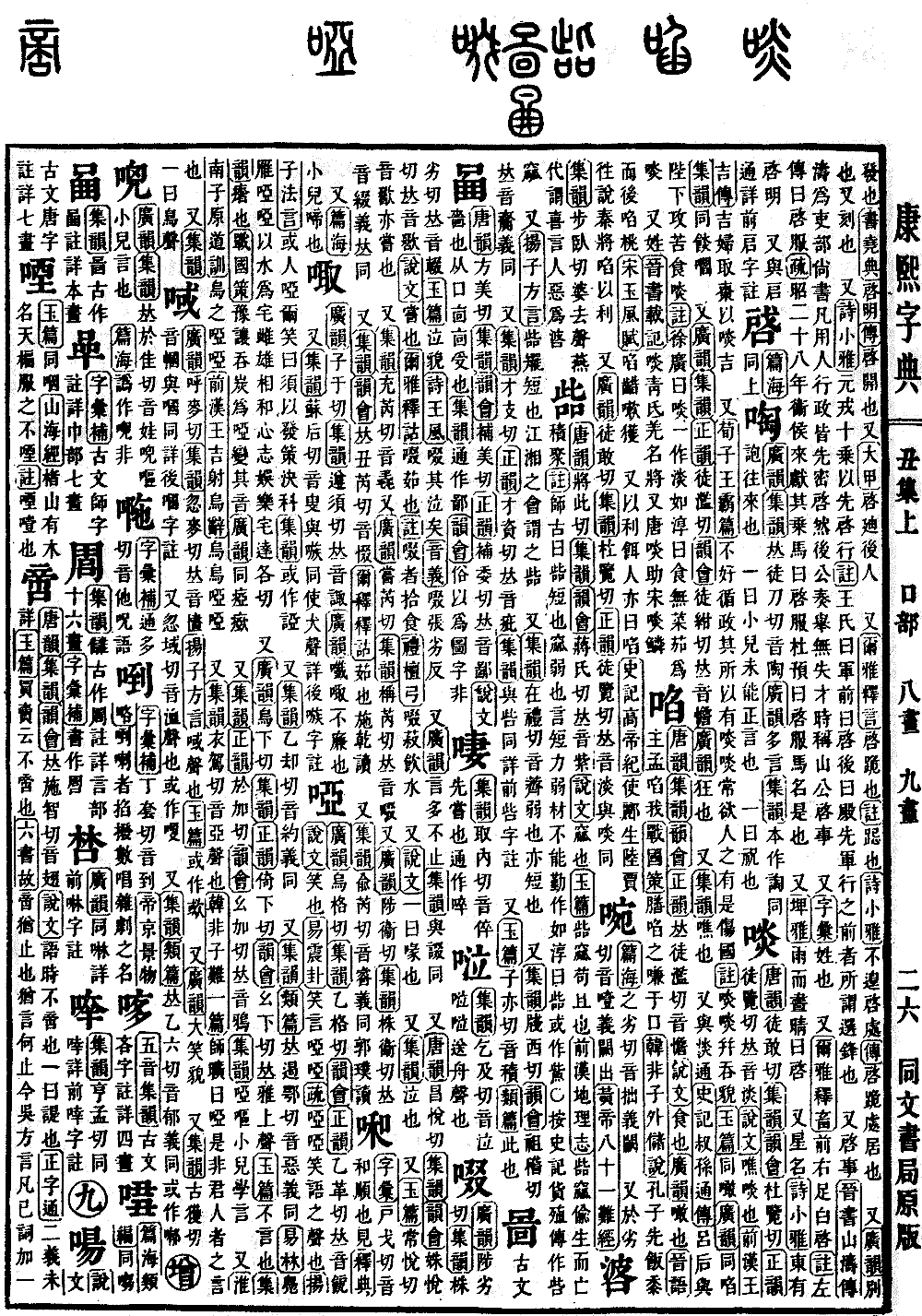
Chou Collection, Upper Volume
Radical: Mouth (kǒu)
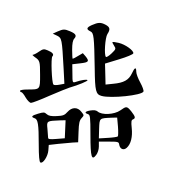
Character: zi
Kangxi Stroke Count: 11
Page 196, Entry 07
Pronounced zi (rising tone).
Shuowen Jiezi (Explanation of Simple and Compound Characters): To be lazy or indolent.
Yupian (Jade Chapters): zi-yu, meaning to be careless or perfunctory.
Book of Han (Hanshu), Geographical Treatise: Indolent and living only for the moment, without saving for the future.
Commentary: Shigu says: zi means short or lacking, yu means weak. It describes those who are physically weak or lacking in ability, unable to work diligently. Ruzhun says: zi is sometimes written as a variant form (zi). Note: The Records of the Grand Historian (Shiji), Biographies of Money-makers (Huozhi Zhuan) writes it as zi-yu.
Also, Yangzi's Regional Speech (Fangyan): zi-ba means short; in the region where the Yangtze and Xiang rivers meet, it is called zi.
Also, according to Jiyun (Compilation of Rhymes): Pronounced ji (falling tone). Means weak; also means short.
Also, according to Jiyun and Yunhui (Collection of Rhymes): Pronounced ji (level tone). The meaning is the same.
Also, according to Jiyun and Zhengyun (Correct Rhymes): Pronounced ci (level tone). Same as the character ci; see the previous entry for the character ci.
Also, according to Yupian: Pronounced ji (entering tone).
According to Leipian (Categorized Compilation): This.