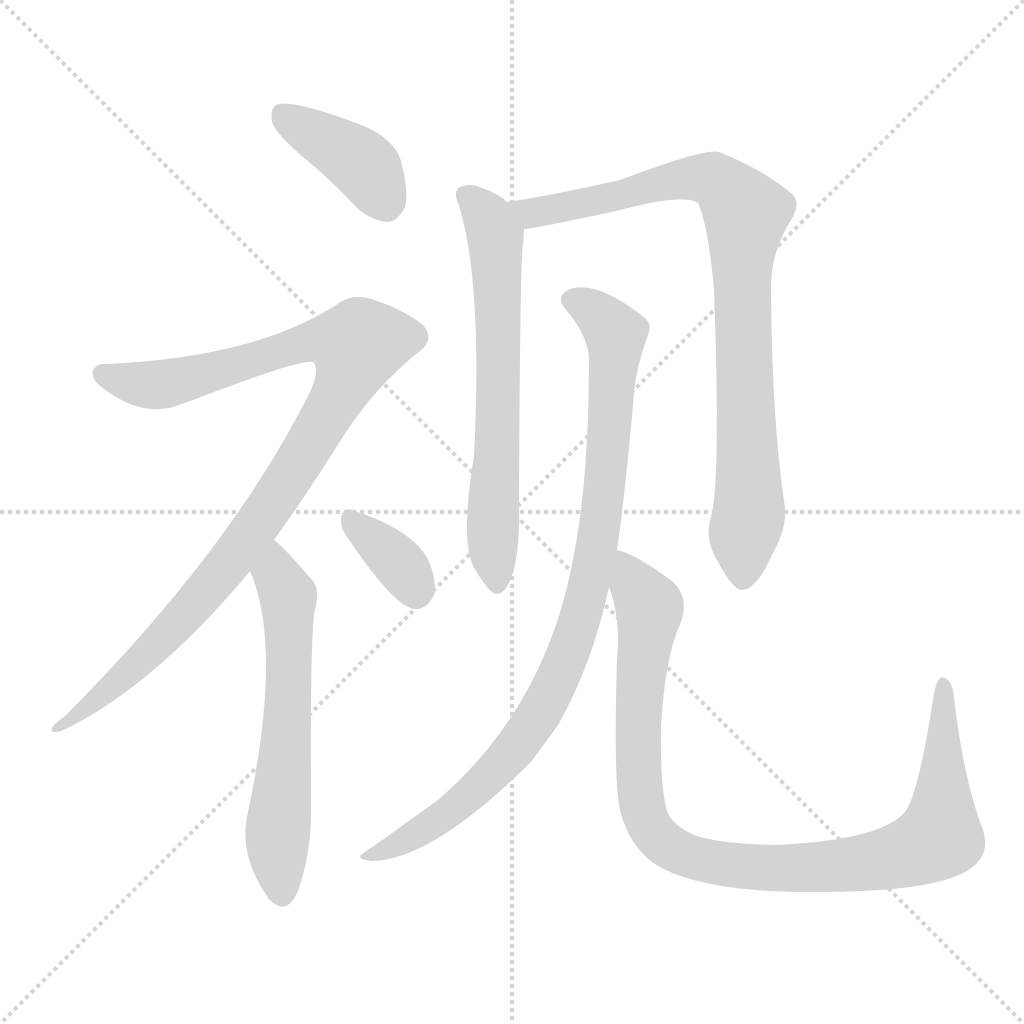
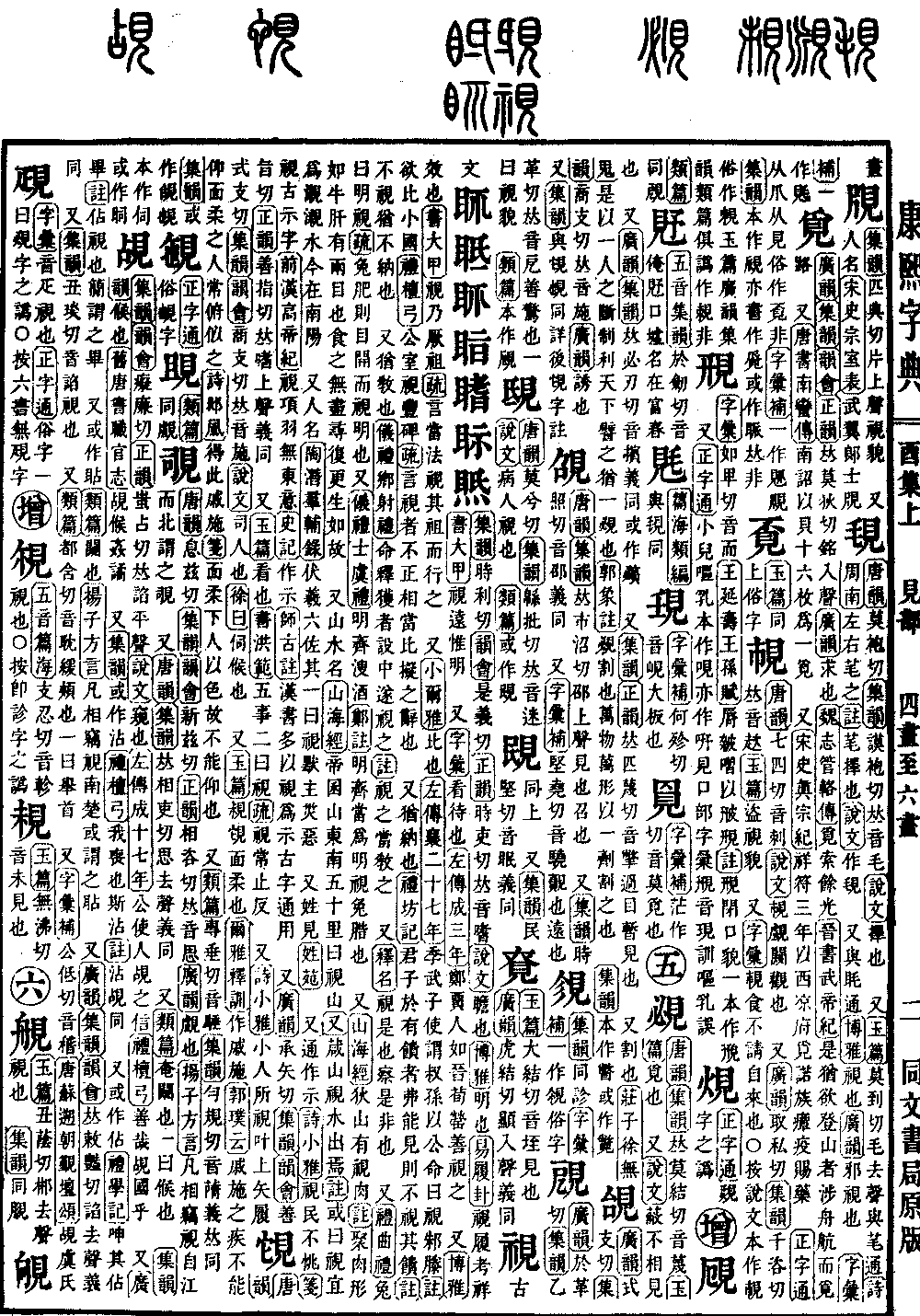
You Collection, Upper Volume
Radical: See (jiàn)
Kangxi Strokes: 12
Page 1134, Entry 01
Ancient forms: shi (眡), shi (眎)
Pronounced shi.
Shuowen Jiezi (Shuowen): To gaze or look.
Guangya: To observe clearly.
Book of Changes (Yijing): To examine footprints carefully to investigate good and bad fortune.
Book of Documents (Shangshu): Only with long-term foresight can one observe clearly.
Also: To treat or deal with.
Zuo Tradition (Zuo Zhuan): A Zheng merchant traveled to the Jin state, and Xun Ying treated him with great kindness.
Also: To emulate or imitate.
Book of Documents (Shangshu): Emulate your ancestors.
Commentary: The meaning is that one should emulate the conduct of one's ancestors.
Also: To compare or match.
Zuo Tradition (Zuo Zhuan): Ji Wuzi sent an envoy in the name of the ruler to speak to Shusun: Compare with the states of Zhu and Teng.
Commentary: Wishing to draw a comparison with small states.
Book of Rites (Liji): The rituals of the ducal house were compared to those of the Feng state.
Commentary: Saying "shi" does not mean to look directly, but is a way of saying to compare with one another.
Also: Similar to accepting.
Book of Rites (Liji): If a gentleman receives a gift from someone he cannot meet, he does not accept the gift.
Commentary: Not to "shi" is equivalent to not accepting.
Also: Similar to instructing.
Book of Etiquette and Ceremonial (Yili): Ordered the one releasing the target to set up the central vessel, then instructed him.
Commentary: To "shi" him means one should instruct him.
Also: Shiming: To "shi" is to affirm, to observe right and wrong clearly.
Also: Book of Rites (Liji): The rabbit is called "mingshi" (clear-sighted).
Commentary: When a rabbit is fat, its eyes open wide and it sees clearly.
Also: Book of Etiquette and Ceremonial (Yili): Mingqi (clear wine) and soujiu (fermented wine).
Commentary: Mingqi should be "mingshi," referring to dried rabbit meat.
Also: Classic of Mountains and Seas (Shanhaijing): In Mount Di there is "shirou" (vision flesh).
Commentary: Accumulated flesh shaped like a cow's liver with two eyes. If one eats it, it is never exhausted; it grows back soon as it was before.
Also: Name of a mountain and a river.
Classic of Mountains and Seas (Shanhaijing): Fifty miles southeast of Mount Dikun is Mount Shi.
Also: Mount Zhen, the Shi River originates here.
Commentary: Some say Shi should be Qin. The Qin River is currently in Nanyang.
Also: A personal name.
Tao Qian, Qunfu Lu: Among the six assistants to Fuxi, one was named Shimo, in charge of disasters and evil.
Also: A surname, found in Xingyuan.
Also: Interchangeable with shi (示).
Book of Odes (Shijing): To show the people not to be frivolous.
Commentary: "Shi" (视) is the ancient character for "shi" (示).
History of the Former Han (Hanshu): To show Xiang Yu there was no intention to march east.
Records of the Grand Historian (Shiji): Uses the character "shi" (示).
Commentary: The Hanshu often uses "shi" (视) for "shi" (示); the ancient characters were interchangeable.
Pronounced shi (rising tone).
The meaning is the same.
Also: Yupian: To look.
Book of Documents (Shangshu): Of the five matters, the second is to look.
Commentary: Shi, pronounced chang zhi fan.
Also: Book of Odes (Shijing): What petty people fix their gaze upon.
Rhymes with "shi" (矢) and "lv" (履) in the preceding line.