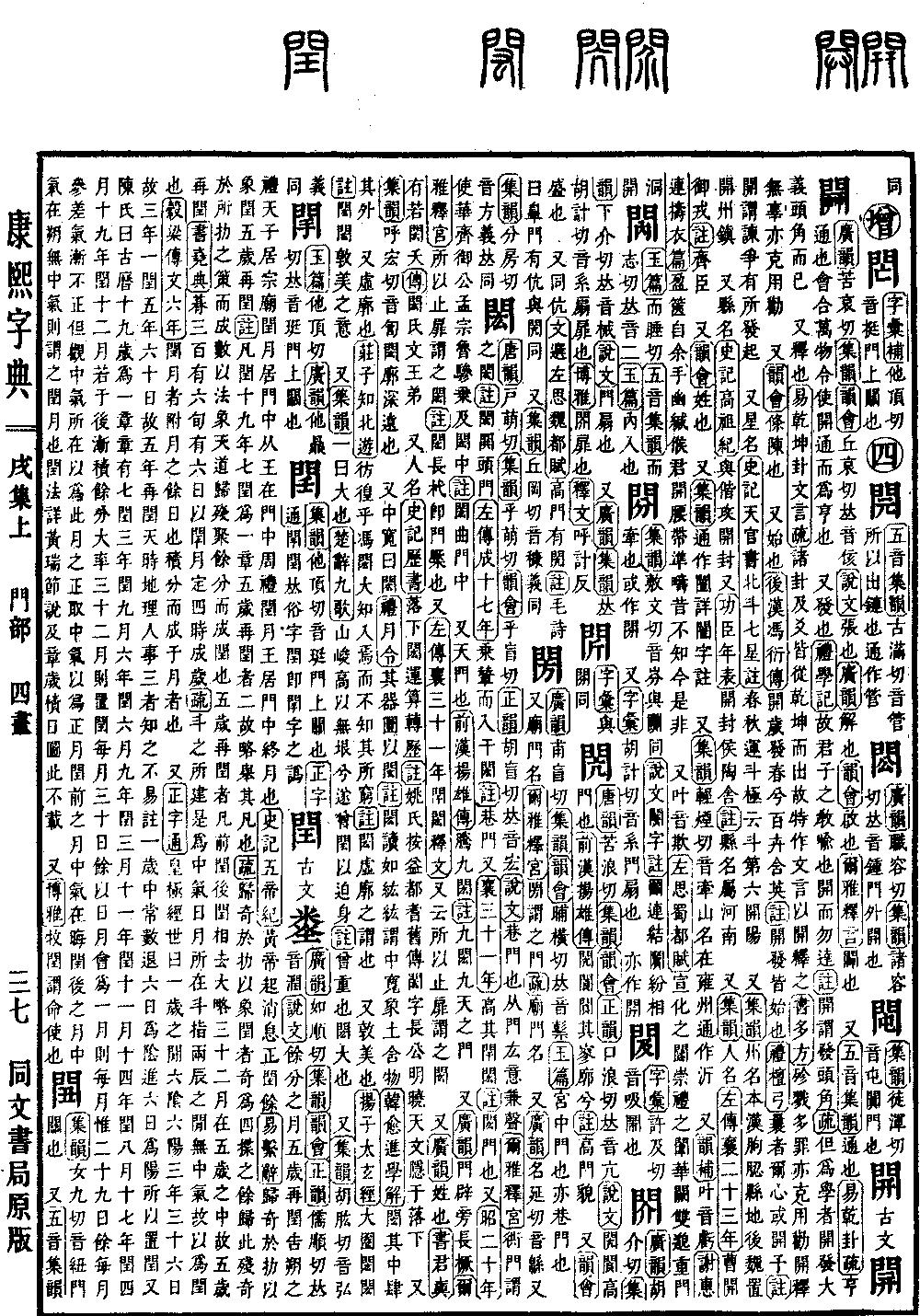
Xu Collection, Upper Volume
Radical: Gate (mén)
12 strokes
Page 1331, Entry 01
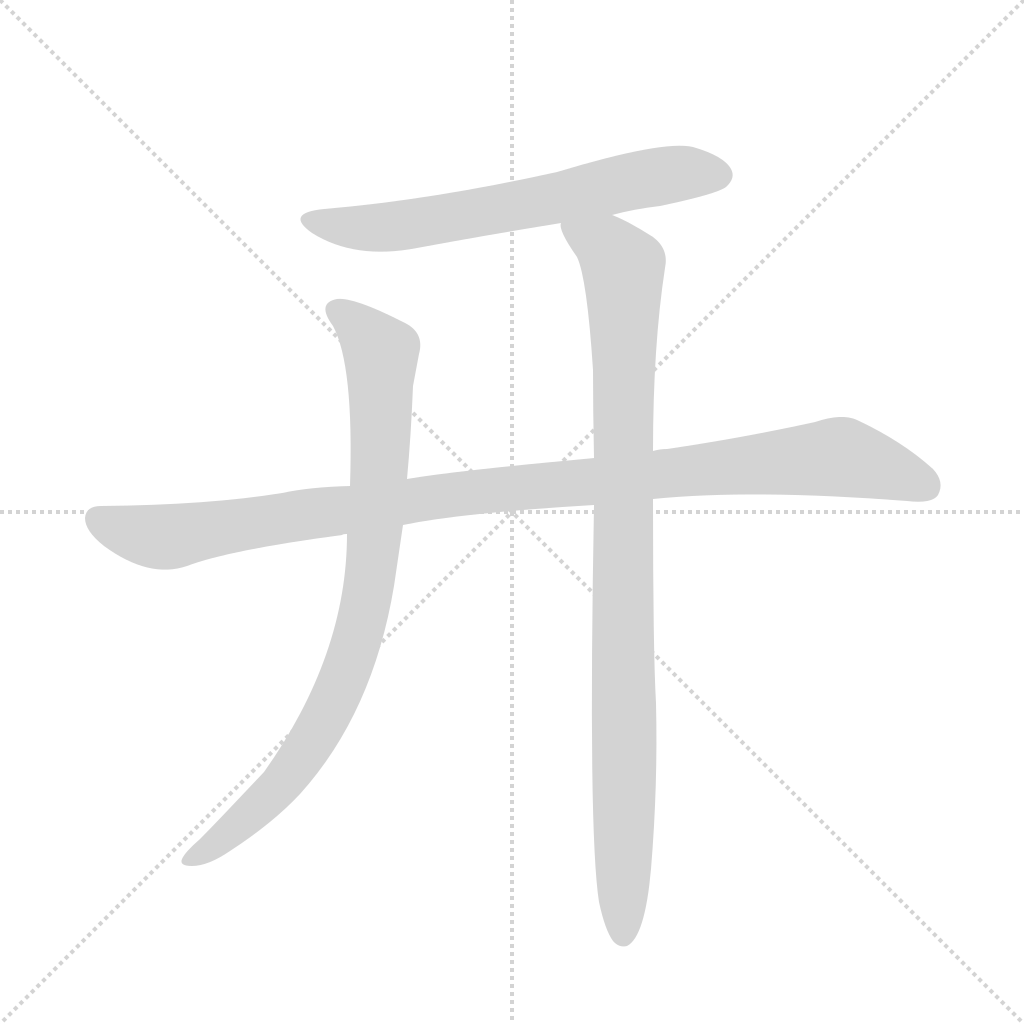
Archaic script form. Pronounced kai.
Shuowen Jiezi (Shuowen): To open or expand.
Guangyun (Guangyun): To undo or release.
Yunhui (Yunhui): To initiate or start.
Erya (Erya), Explanation of Words: To open or break through.
Also, Wuyin Jiyun (Wuyin Jiyun): To connect or facilitate.
Book of Changes (Yijing), Commentary on the Qian Hexagram: To facilitate and connect. To gather all things and enable them to flourish and connect, thus creating success.
Also, to initiate or reveal.
Book of Rites (Liji), Record on Education: Therefore, the gentleman's instruction is to enlighten; he initiates without forcing completion.
Commentary: To initiate refers to guiding the initial grasp of the subject.
Sub-commentary: To guide the learner by revealing the primary essential meanings.
Also, to interpret or explain.
Book of Changes (Yijing), Commentary on the Qian and Kun Hexagrams: Since all hexagrams and lines arise from Qian and Kun, special commentary is written to explain them.
Book of Documents (Shangshu), Numerous Regions: To punish the many criminals is also a way to encourage others; to release the innocent is also a way to encourage others.
Also, Yunhui (Yunhui): A list or segment.
Also, to begin or start.
History of the Later Han (Hou Hanshu), Biography of Feng Yan: As the year begins and spring stirs, the hundred flowers contain their beauty.
Commentary: To initiate and develop both mean to start.
Book of Rites (Liji), Tan Gong: Previously, your heart was perhaps moved to enlighten me.
Commentary: To enlighten means to offer counsel and initiate understanding.
Also, a star name.
Records of the Grand Historian (Shiji), Treatise on the Celestial Offices, Notes on the Seven Stars of the Northern Dipper: The Spring and Autumn Operations of the Dipper Pivot states: the sixth star of the Dipper is Kaiyang.
Also, Jiyun (Jiyun): The name of a prefecture. Originally the territory of Qu County during the Han Dynasty; the Northern Wei Dynasty established Kai Prefecture Garrison here.
Also, the name of a county.
Records of the Grand Historian (Shiji), Annals of Emperor Gaozu: Together they attacked Kaifeng.
Also, Table of Meritorious Officials: The Marquis of Kaifeng, Tao She.
Commentary: A county name, belonging to Henan.
Also, Jiyun (Jiyun): A name of a person.
Zuo Tradition (Zuozhuan), Twenty-third Year of Duke Xiang: Cao Kai was the chariot driver.
Commentary: An official of Qi.
Also, Yunhui (Yunhui): A surname.
Also, Jiyun (Jiyun): Commonly written as the variant form (kai). See the entry for that character for details.
Also, Jiyun (Jiyun): Pronounced qian. The name of a mountain. Located in Yong Province. Commonly written as the variant form (qian).
Also, Yunbu (Yunbu): Rhymes with kui.
Xie Huilian, Poem on Fulling Clothes: Filling the chest from my hands, you open the secluded seal. My belt is measured as it was in the past; I do not know if today is right or wrong.
Also, rhymes with qi.
Zuo Si, Rhapsody on the Capital of Shu: The gates for propagating transformation, the portals for revering ritual. The magnificent towers stand in pairs, the heavy doors open wide.
Correction: Jiyun (Jiyun): Pronounced qian. The name of a mountain. Located in Yong Province. Commonly written as the variant form (qian). Corrected from the original text (yi) to (qian).