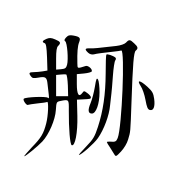
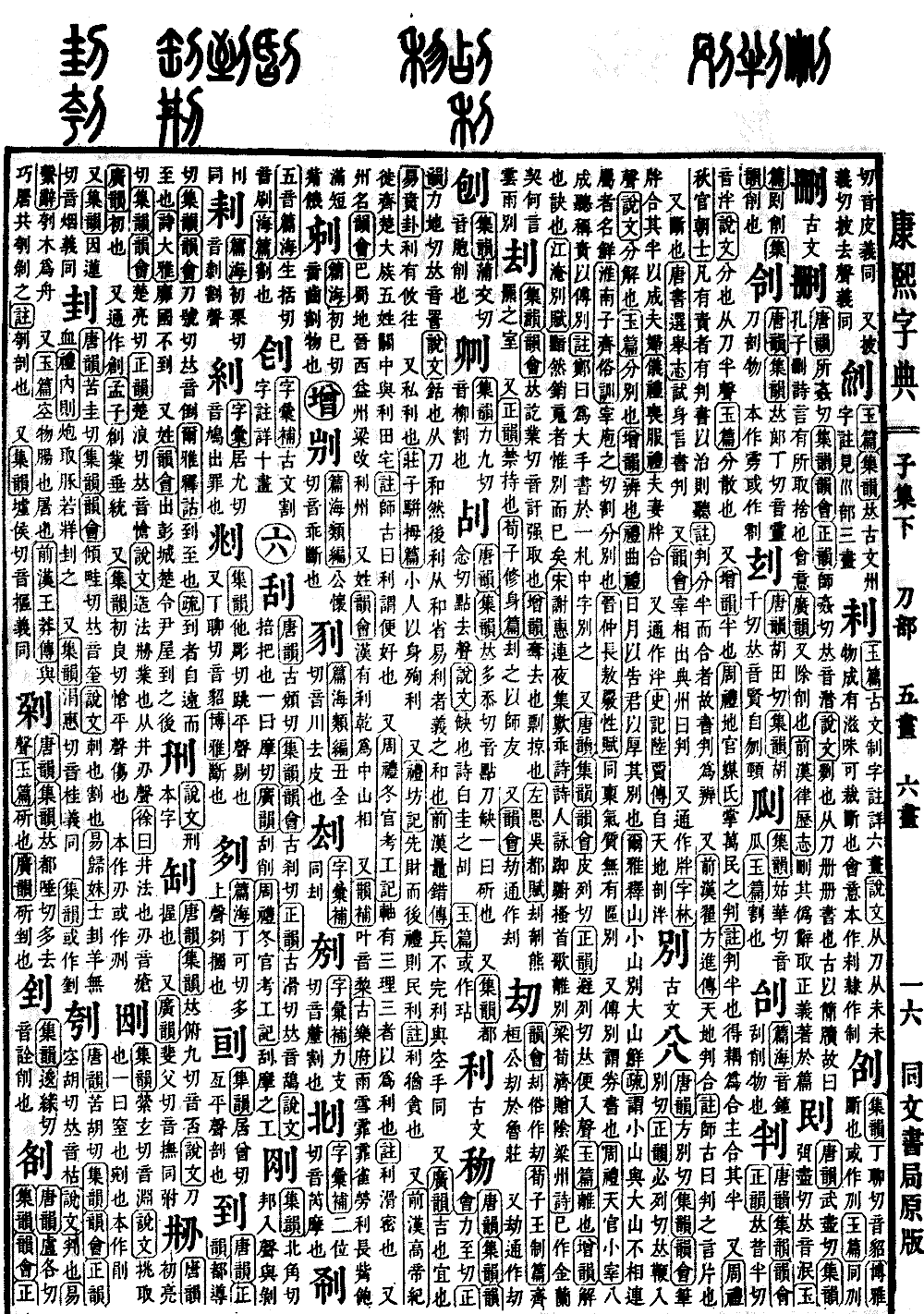
Zi Collection, Page Position: Lower. Radical: Knife (dāo). Character: Chuang. Kangxi strokes: 8. Page number: page 138, number 39.
In the Tang Dynasty Rhyme Dictionary (Tangyun), the pronunciation is recorded via the fanqie method as chu and liang. In the Collected Rhymes (Jiyun) and Rhyme Collection (Yunhui), the pronunciation is recorded as chu and liang. In the Correct Rhymes (Zhengyun), the pronunciation is recorded as chu and lang. It is pronounced the same as the character chuàng.
In Explaining Graphs and Analyzing Characters (Shuowen Jiezi), it is interpreted as establishing laws or founding an enterprise. The character structure is composed of the elements for well (jǐng) and blade (chuāng), with the blade element serving as the phonetic component.
The commentary by Xu Xuan states that the well element represents laws. The blade element is pronounced the same as the character for sore (chuāng).
In the Expanded Rhymes (Guangyun), the definition is given as the beginning or initial stage.
The character is also used interchangeably with the character for create (chuàng).
In the Mencius (Mengzi), it appears in the context of founding an enterprise and handing down a legacy.
Furthermore, the Collected Rhymes (Jiyun) records a level tone pronunciation via the fanqie method as chu and liang, sounding like the level tone of the character chuàng. In this instance, it is defined as to injure or harm. The original form is the character for blade (chuāng), which can also be written in other variant forms.