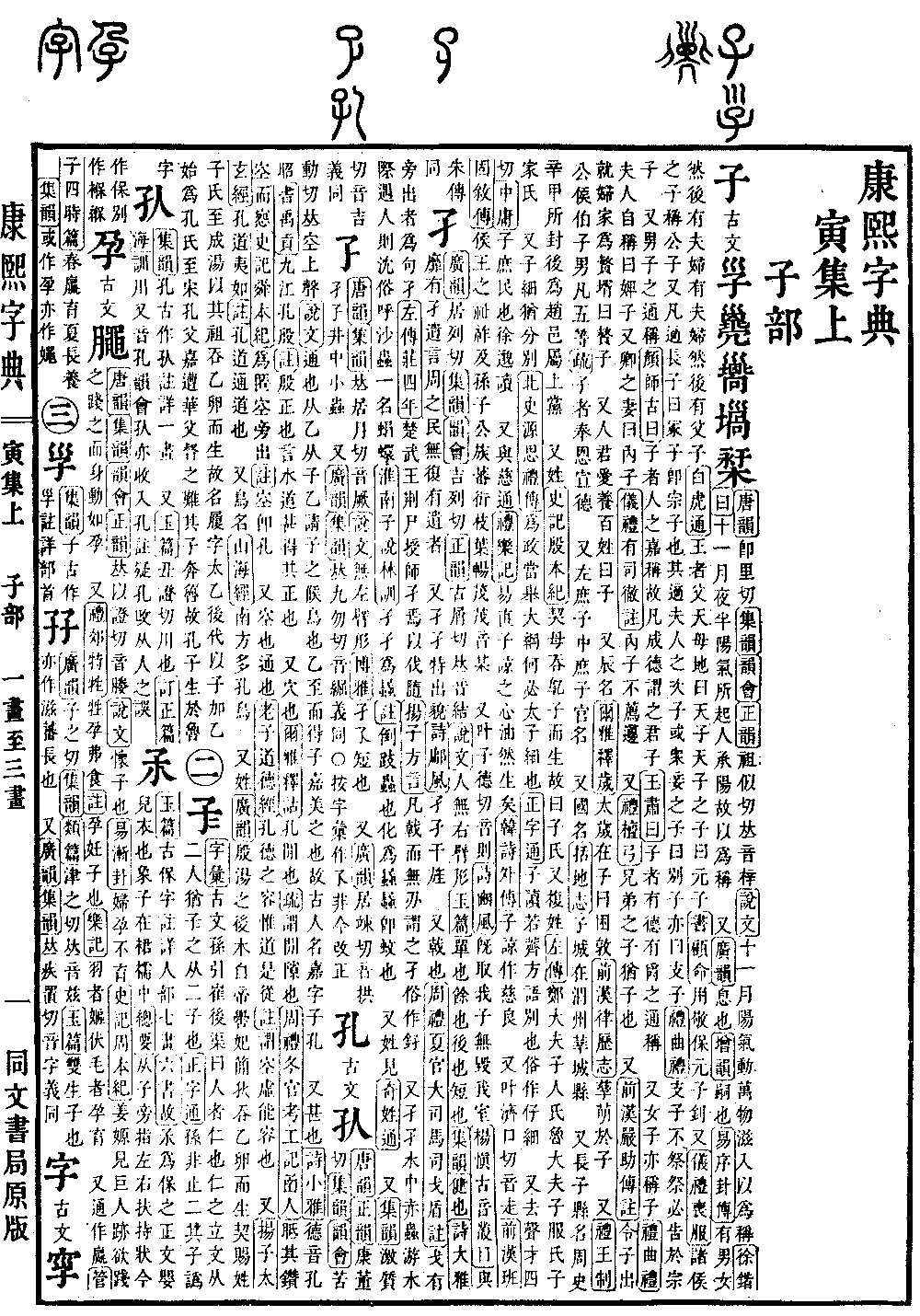
Yin Collection, Upper Volume
Radical: Child (zǐ)
Kangxi stroke count: 6
Page 277, Entry 18
Ancient phonology: According to the Tang Rhymes (Tangyun), Collected Rhymes (Jiyun), and Rhyme Compilation (Yunhui), the pronunciation is ji (falling tone); according to the Correct Rhymes (Zhengyun), the pronunciation is ji (falling tone). The pronunciation is the same as the word for self.
According to the Explaining Graphs and Analyzing Characters (Shuowen Jiezi), it means to give birth to or to nurse. It also refers to cherish or protect.
Book of Documents (Shangshu), Kang Gao chapter: Fathers cannot cherish their sons, but instead hate their sons.
Rites of Zhou (Zhouli), Earth Offices, commentary by Zheng Xuan: When gifts sent as tribute by a small state are light, it is out of a desire to cherish them.
Zuo Tradition (Zuo Zhuan), Year 4 of Duke Cheng: Although the state of Chu is powerful, it is not of our clan, so how would it cherish us?
It also refers to characters. The word for character means to multiply, as the six methods of character formation derive from one another without end. Cang Jie and Ju Song, ministers of the Yellow Emperor, relied upon the lines of the trigrams and imitated the footprints of birds and beasts, linking them to related things, and only then was the form of writing established.
Rites of Zhou (Zhouli), Spring Offices, External Historian: Responsible for transmitting writing to the four directions. The commentary states: In ancient times it was called a name, now it is called a character. The sub-commentary states: Because they gradually increase and become many, they are renamed as characters.
It also refers to the formal name and the courtesy name. Book of Rites (Liji), Qu Li chapter: Men take a courtesy name upon reaching twenty years of age and undergoing the capping ceremony. Ceremonial Rites (Yili), Master’s Capping Ceremony: Taking a courtesy name for him after the capping ceremony is to show respect for his given name. One uses the given name when speaking to a ruler or father, and the courtesy name when speaking to others. Also: A woman takes a courtesy name after her betrothal and the hair-pinning ceremony. Commentary: This is also a sign of reaching adulthood.
It also means for a woman to be betrothed. Book of Changes (Yijing), Tun hexagram: A girl keeps her chastity and does not marry, only becoming betrothed after ten years.
It also refers to a female animal capable of becoming pregnant and giving birth, thus a female is called by this term. Records of the Grand Historian (Shiji), Treatise on the Balance of Standards: Those riding female horses were excluded and not allowed to participate in the gathering. Sometimes also written in a variant form (zi).
It also serves as a surname. Correct Character Guide (Zhengzitong): There was a person named Zi E who served as a judge in Lianzhou during the Song dynasty.
Verification: Rites of Zhou (Zhouli), Spring Offices, Grand Master and Internal Historian: Responsible for transmitting writing to the four directions. Commentary: In ancient times it was called a name, now it is called a character. Because they gradually increase and become many, they are renamed as characters. Corrected according to the original text: Rites of Zhou, Spring Offices, External Historian: Responsible for transmitting writing to the four directions. The commentary states: In ancient times it was called a name, now it is called a character. The sub-commentary states: Because they gradually increase and become many, they are renamed as characters.