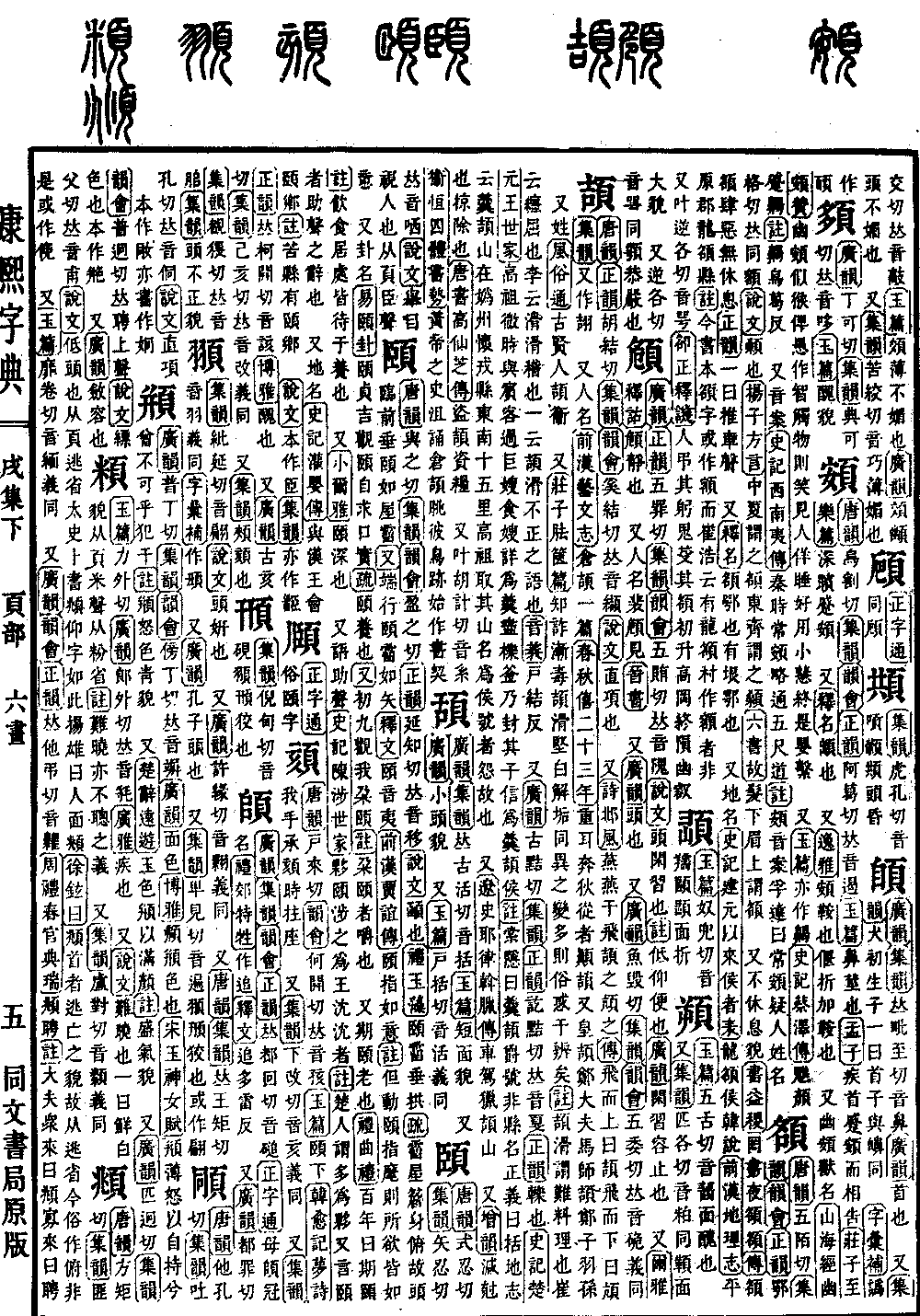
Xu Collection, Lower Volume
Radical: Leaf (yè)
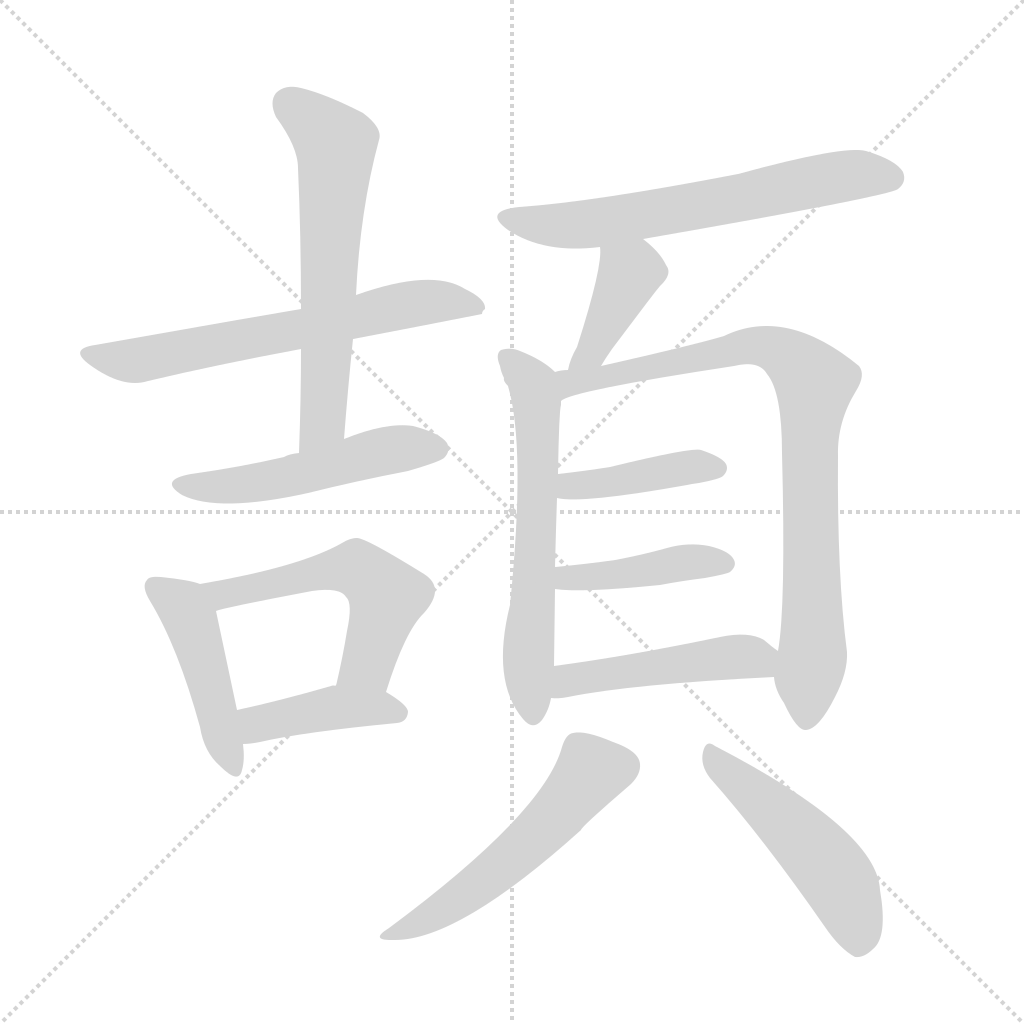
頡
Kangxi strokes: 15
Page 1403, Entry 10
Pronounced jié
Pronounced jié
Pronounced jié
According to the Explaining Graphs and Analyzing Characters (Shuowen), it refers to the appearance of a neck held straight.
Also, in the Book of Odes (Shijing), in the section Odes of Bei (Beifeng), swallows flying, at times flying upward is called jie, and at times flying downward is called hang. The commentary states: flying upward is called jie, and flying downward is called hang.
The Phonological Compendium of Collected Rhymes (Jiyun) also writes it as a variant form (lie).
Also used as a personal name. In the Book of Han (Hanshu), in the Treatise on Arts and Letters (Yiwenzhi), there is one chapter titled Cangjie. In the Spring and Autumn Annals (Chunqiu), in the twenty-third year of Duke Xi (Xi), when Chong'er fled to the state of Di, among his followers was Dianjie. There was also Huangjie, who was a grandee of the state of Zheng. Mashi Jie was the grandson of Ziyu of the state of Zheng.
Also used as a surname. According to the Comprehensive Account of Customs (Fengsutong), ancient worthies included Jiewei.
Also, in the Book of Master Zhuang (Zhuangzi), in the section Opening Trunks (Quqie), wisdom and craftiness gradually deepen the harm, with verbal entanglement and sophistry, theories of hardness and whiteness, and forced interpretations of the changes in sameness and difference; once this becomes excessive, the common people are misled by these arguments. The commentary states: jiehua refers to being difficult to sort out. The Cui family states: entangled and crooked. The Li family states: hua refers to humor. Another explanation states: jiehua refers to inappropriate speech.
Pronounced jie
Pronounced jiá
Pronounced jiá
Meaning to crush or bully. In the Records of the Grand Historian (Shiji), in the Hereditary House of Prince Yuan of Chu, when the Han Emperor Gaozu was of humble status, he took guests to eat at his eldest sister-in-law's house; she pretended the soup was finished and scraped the bottom of the pot. Later, Gaozu enfeoffed her son, Liu Xin, as the Marquis of Gengjie. The commentary notes: the Commentary on the Hidden Meanings (Suoyin) says: Gengjie is a title of nobility, not the name of a district. The Correct Meaning (Zhengyi) says: The Geography of the World (Kuodizhi) records: Gengjie Mountain is located fifteen li southeast of Huairong County in Guizhou; Gaozu used the name of this mountain as a marquis title out of resentment.
In the History of the Liao Dynasty (Liaoshi), in the biography of Yelu Wo, the imperial carriage arrived at Jie Mountain.
According to the Additional Rhymes (Zengyun), it also has the meaning of withholding or reducing, and also to plunder or remove. In the Old Book of Tang (Tangshu), in the biography of Gao Xianzhi, it refers to stealing and withholding provisions and rations.
Also, the rhyme is changed to be pronounced ji (rising tone).
In Four Styles of Calligraphy (Siti Shushi) by Wei Heng, the Yellow Emperor's scribes, Jusong and Cangjie, observed the footprints of birds and beasts and began to create characters.