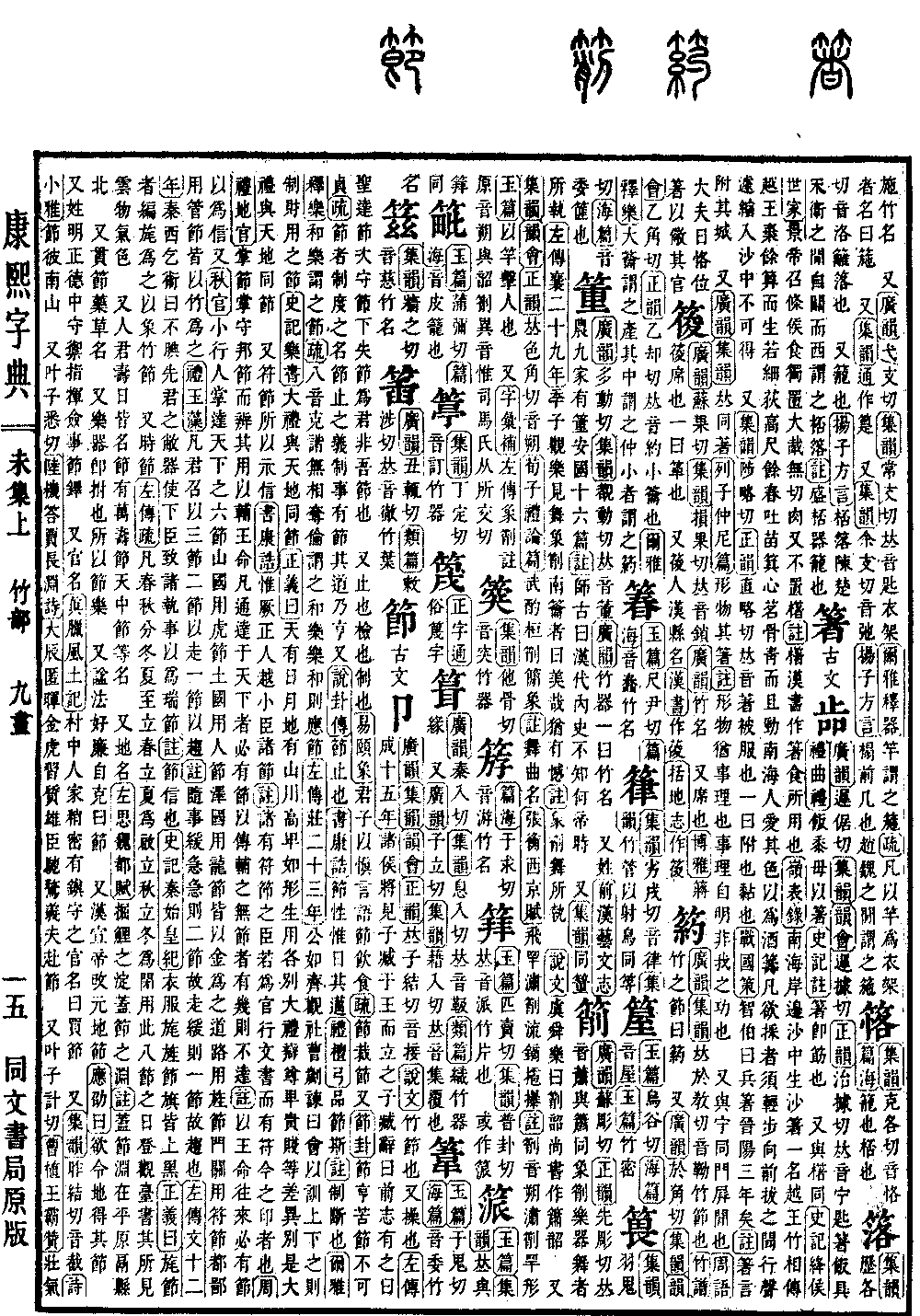
Wei Collection, Upper Volume
Radical: Bamboo (zhú)
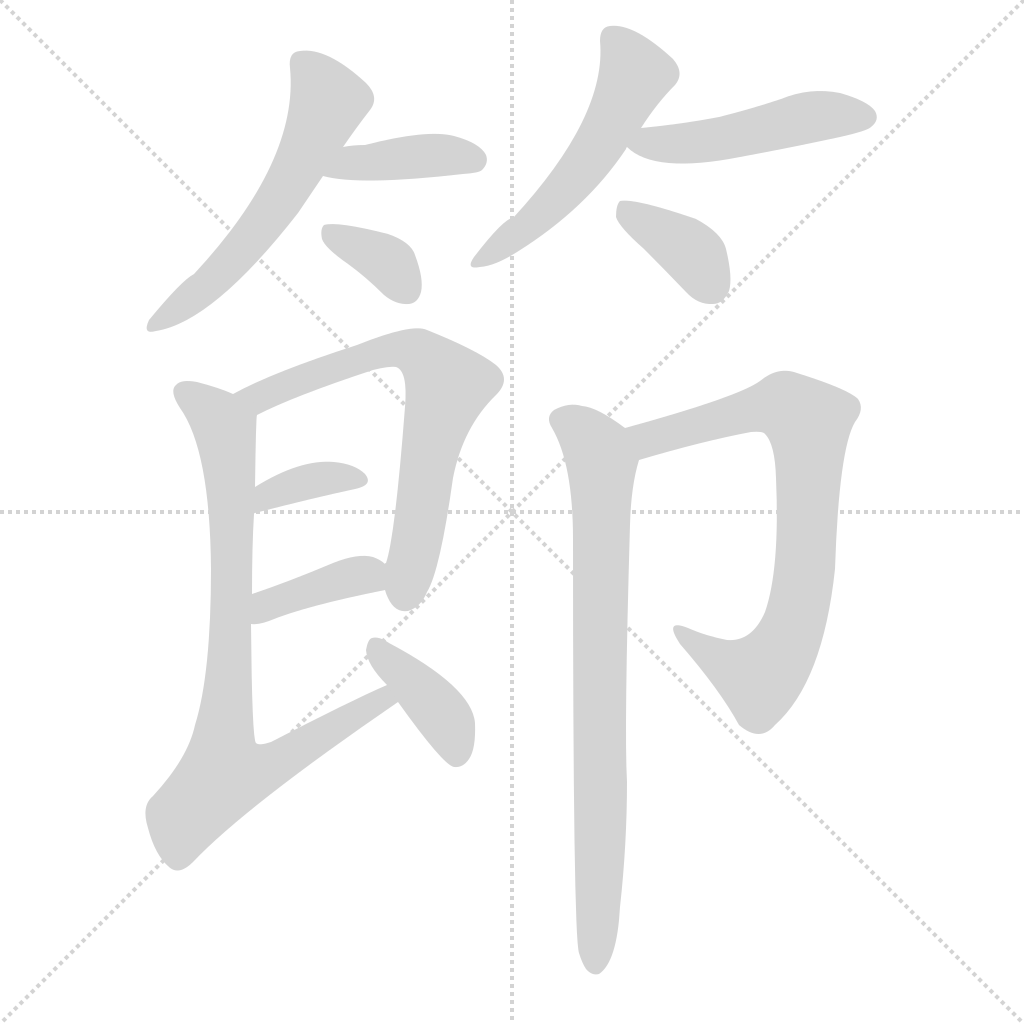
Jie
Kangxi Strokes: 15
Page 891, Entry 24
Ancient form of the character (jié).
According to Guangyun (Guǎngyùn), Jiyun (Jíyùn), Yunhui (Yùnhuì), and Zhengyun (Zhèngyùn), pronounced jie (rising tone).
According to Shuowen (Shuōwén): The node of a bamboo stalk.
Also refers to personal integrity, moral rectitude, or spirit.
According to Zuo Zhuan (Zuǒ Zhuàn), 15th Year of Duke Cheng: When the feudal lords intended to present Zizang to the King and establish him as ruler, Zizang declined, stating: Past records contain these words: The sage understands moral integrity, the next best preserves it, and the lowest loses it. Serving as a sovereign is not where my moral integrity lies.
Also means to restrain, restrict, or regulate.
According to the Book of Changes (Yì Jīng), Xiang Commentary on the Yi hexagram: The superior man uses this to be cautious in speech and to regulate eating and drinking.
According to the commentary (Shū): Jie means to judge and regulate.
Also, the Jie hexagram: The Jie hexagram brings success. Excessive restraint (bitter restraint) cannot be divined.
According to the commentary (Shū): Jie is the title for a system of rules; it carries the meaning of restraint and cessation. When handling affairs with restraint, one's path will be successful.
Also, according to the Shuo Gua Zhuan (Shuōguà Zhuàn): Jie means to cease.
According to the Book of Documents (Shàngshū), Kang Gao (Kāng Gào): Regulate one's nature, causing it to progress day by day.
According to the Book of Rites (Lǐjì), Tan Gong (Tángōng): Ranks and regulations reside here.
According to the annotation (Zhù): Means to judge or decide.
According to Erya (Ěryǎ), Explanation of Music: Harmonious music is called jie.
According to the commentary (Shū): When the eight musical instruments are harmonious and do not disturb each other, it is called harmonious music; when music is harmonious, it corresponds to the rhythm.
According to Zuo Zhuan (Zuǒ Zhuàn), 23rd Year of Duke Zhuang: When Duke Zhuang went to the State of Qi to observe the sacrifice to the soil gods, Cao Gui advised him: Treaties are the laws used to instruct superiors and inferiors and to regulate expenditures.
According to the Records of the Grand Historian (Shǐjì), Treatise on Music: The great rituals share the same regulations as Heaven and Earth.
According to the Correct Meaning (Zhèngyì): Heaven has the sun and moon, Earth has mountains and rivers; their high and low positions are like physical forms, and their growth and functions each differ. Great rituals distinguish the hierarchical differences between the noble and the humble; this is why the great rituals share the same regulations as Heaven and Earth.
Also refers to a tally or credential used as proof.
According to the Book of Documents (Shàngshū), Kang Gao (Kāng Gào): As well as those officials, minor ministers, and the masses who possess tally-holding ministers.
According to the annotation (Zhù): Various ministers who hold tallies, such as those who carry official documents and have credentials, much like modern-day seals.
According to the Rites of Zhou (Zhōu Lǐ), Earth Office: The official in charge of tallies, who manages the protection of the state's credentials and distinguishes their uses to assist the King's orders. All who travel across the world must have a tally to transmit and receive assistance. Those without a tally cannot pass through inspection points.
According to the annotation (Zhù): Because the King's orders travel back and forth, a tally must serve as evidence.
Also, according to the Rites of Zhou (Zhōu Lǐ), Autumn Office: The minor official in charge of travel manages the six types of tallies used throughout the world: states in mountainous regions use tiger tallies; states in plains use human tallies; states in watery regions use dragon tallies; all are made of metal. Roads use banner tallies; city gates and passes use seal tallies; capitals and border regions use tube tallies; all are made of bamboo.
According to the Book of Rites (Lǐjì), Yu Zao (Yùzǎo): Whenever a sovereign summons someone, he uses three-tally credentials; if using two tallies, one runs; if using one tally, one walks quickly.
According to the annotation (Zhù): Depending on the urgency of the matter, if urgent, two tallies are used, hence one runs; if leisurely, one tally is used, hence one walks quickly.
According to Zuo Zhuan (Zuǒ Zhuàn), 12th Year of Duke Wen: Xiqi Shu of the State of Qin said: A small, humble object from our late ruler, sent by me, your humble servant, to you officials as a token of auspiciousness.
According to the annotation (Zhù): Jie means a token or pledge.
According to the Records of the Grand Historian (Shǐjì), Annals of Qin Shi Huang: Clothing, banners, and tally flags all favored the color black.
According to the Correct Meaning (Zhèngyì): The banner tally (mao jie) is made of woven yak tails and is used to symbolize bamboo nodes.
Also refers to seasons or solar terms.
According to the Zuo Zhuan commentary (Zuǒ Zhuàn Shū): All instances of the Spring Equinox, Autumn Equinox, Winter Solstice, Summer Solstice, Beginning of Spring, and Beginning of Summer are called "opening." The Beginning of Autumn and Beginning of Winter are called "closing." On the days of these eight solar terms, one ascends the observatory to record the clouds and atmospheric colors observed.
Also, the sovereign's birthday is referred to as a jie, with names such as the Longevity Festival or the Mid-Heaven Festival.
Also a place name.
According to Zuo Si (Zuǒ Sī), Rhapsody on the Capital of Wei: Excavating the Carp Marsh, covering the Jie Abyss.
According to the annotation (Zhù): The Jie Abyss is located north of Ge County in Pingyuan Commandery.
Also refers to Guanjie, a type of medicinal herb.
Also refers to a musical instrument, the fu, used to regulate music.
Also, in the system of posthumous titles, a love for integrity and self-restraint is called jie.
Also, Emperor Xuan of the Han Dynasty changed the reign title to Di Jie.
According to Ying Shao (Yìng Shào): Wishing for the earth to receive its proper regulation.
Also a surname. During the Zhengde era of the Ming Dynasty, there was a defense commander named Jie Duo.
Also an official title.
According to the Zhen Fengtu Ji (Zhēn Fēngtǔ Jì): In villages where households were somewhat dense, officials were stationed to guard them, called "buying jie."
Also, according to Jiyun (Jíyùn), pronounced jie (entering tone).
According to the Book of Odes (Shī Jīng), Lesser Odes: That high and steep Southern Mountain.
Also pronounced xi (entering tone).
According to Lu Ji (Lù Jī), Responding to Jia Changyuan's Poem: The great star hides its radiance, the metal star (White Tiger star) reveals its texture. Brave ministers rush to fulfill their duties, righteous men rush toward their moral integrity.
Also pronounced ji (entering tone).
According to Cao Zhi (Cáo Zhí), Eulogy for Kings and Hegemons: The bold spirit rushes to the heavens, rising up to stir one's moral integrity. What is attacked is surely conquered, and strategies are displayed, leaving behind kindness.