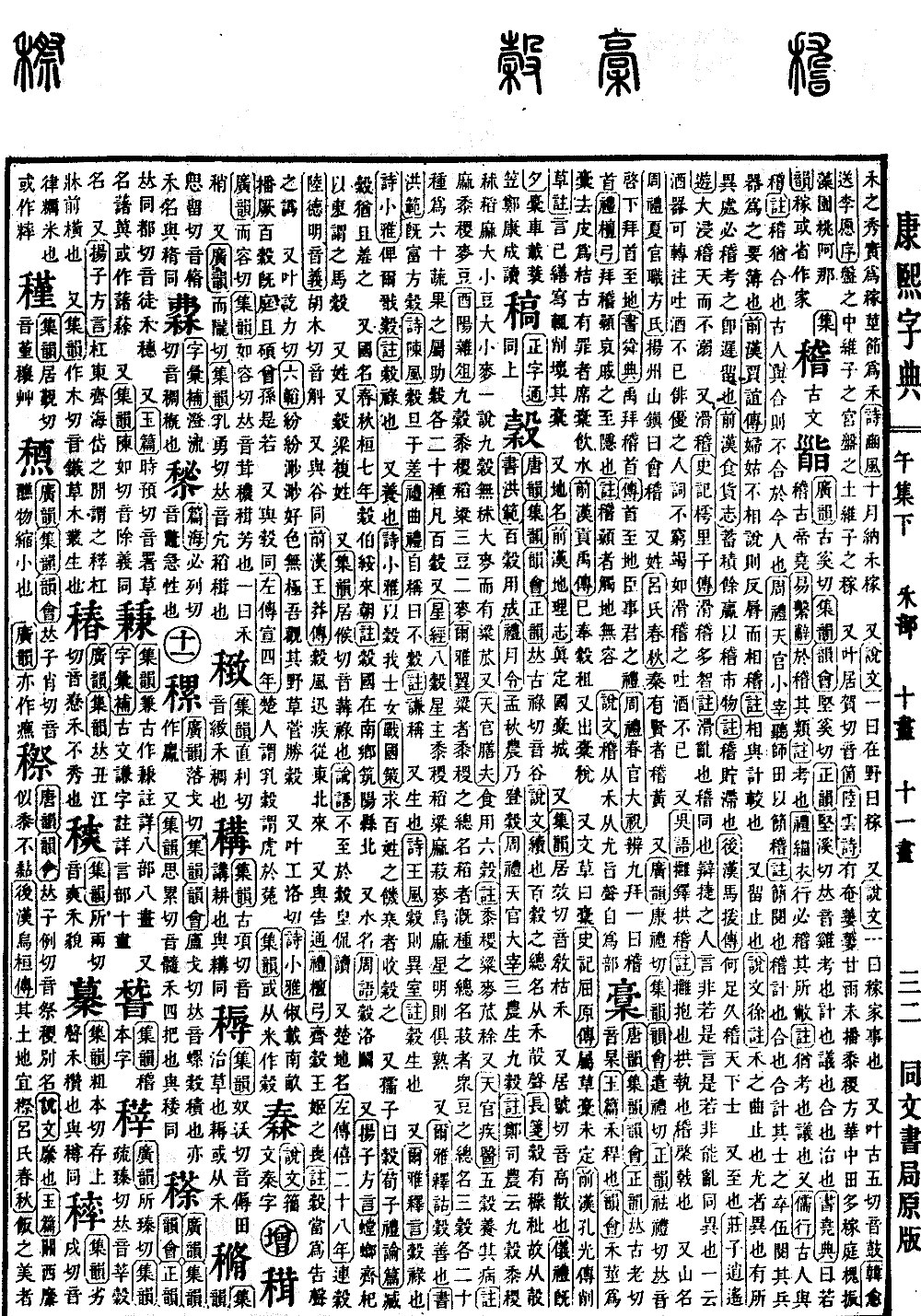
You Collection, Middle Volume
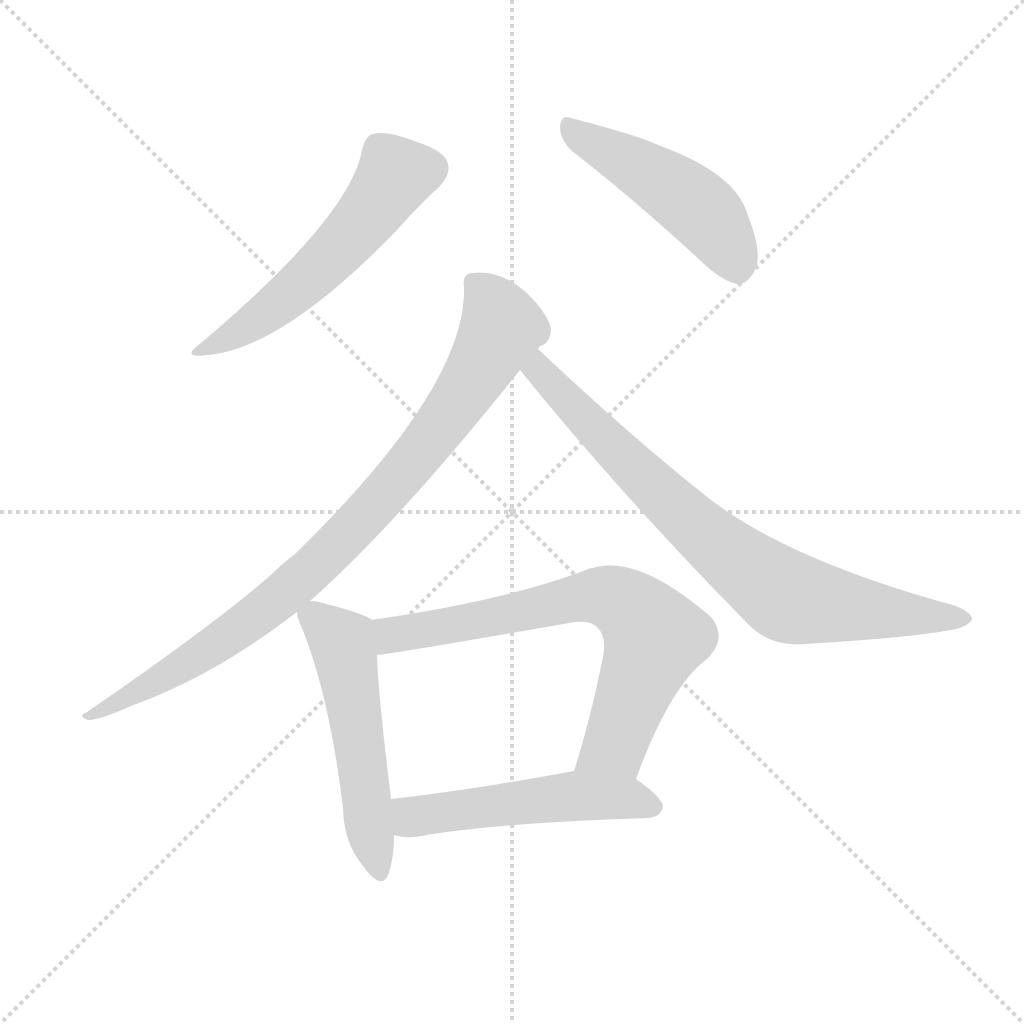
Radical: Valley (gǔ)
Page 858, Entry 01
Tang Rhyme (Tangyun), Collection Rhymes (Jiyun), Rhyme Compendium (Yunhui), Correct Rhymes (Zhengyun): Pronounced gǔ.
Explaining Graphs and Analyzing Characters (Shuowen Jiezi): A place where spring water flows out and converges into a river is called a gǔ. The character shape uses water as a radical, resembling water half-hidden and half-revealed, flowing out from a mountain pass.
Rhyme Compendium (Yunhui): A channel for flowing water between two mountains.
Er Ya, Explaining Water (Er Ya, Shishui): Water flowing into a stream is called gǔ.
Commentary: This refers to water in a mountain valley pouring into a stream.
Book of Changes (Yijing), Well Hexagram (Jinggua): The well gǔ shoots a fish.
Commentary: Water exits from a mountain stream and flows downward.
Gongyang Commentary (Gongyang Zhuan), Third Year of Duke Xi (Xi sannián): Duke Huan said: Do not block the gǔ path.
Commentary: Water flowing into a river is called a stream (xi), and water flowing into a stream is called a gǔ.
Book of Rites (Liji), Law of Sacrifices (Jifa): Mountains, forests, rivers, valleys (gǔ), and hills are places where the people obtain resources.
Laozi, Dao De Jing: The reason why rivers and seas can become the destination for numerous mountain valleys and streams is that they are adept at occupying a low position.
Also refers to gǔ water.
Guanzi, Measuring Land Chapter (Dudipian): Mountain gullies that sometimes have water and sometimes do not are called gǔ water.
Also refers to Yanggǔ, the place where the sun rises. Meigǔ is the place where the sun sets.
Book of Documents (Shangshu), Canon of Yao (Yaodian): Ordered Xi Zhong to reside at Yuyi, called Yanggǔ. Ordered He Zhong to reside in the west, called Meigǔ.
Also, Collection Rhymes (Jiyun): Meaning a state of poverty or difficulty.
Book of Odes (Shijing), Greater Odes (Daya): Advancing or retreating, one is in a gǔ.
Commentary: Gǔ refers to a mountain valley; falling into a valley is a metaphor for being in a desperate situation.
Also, Broad Rhymes (Guangyun): Meaning to nurture.
Laozi, Dao De Jing: The spirit of the valley (gǔ shén) does not die.
Also, Er Ya, Explaining Heaven (Er Ya, Shitian): The east wind is called the gǔ wind.
Book of Odes (Shijing), Odes of Bei (Beifeng): The gǔ wind blows gently.
Poetry Exegesis (Shigu): Wind blowing out from a mountain valley.
Commentary: Gǔ implies the meaning of grain (gǔ). Grain means growth. It is a wind that aids growth.
Former Han History (Qian Han Shu), Biography of Wang Mang: That evening, the gǔ wind was swift.
Shigu: It refers to the gǔ wind.
Also, Rhyme Compendium (Yunhui): A bamboo gutter is called a gǔ.
Former Han History (Qian Han Shu), Treatise on Rites and Music (Lülishi): The Yellow Emperor sent Ling Lun to gather bamboo from Jiegu.
Commentary: Jie means to remove; gǔ means a gutter. Gathering bamboo without nodes. Another theory suggests Jiegu is the name of a valley north of the Kunlun Mountains.
Also, ravine, referring to an underground cellar.
Zuo Commentary (Zuo Zhuan), Thirtieth Year of Duke Xiang (Xiang sanshinian): Boyou of Zheng dug an underground cellar to drink at night. Those at court asked where the master was, and his subordinates said: Our master is in the ravine (hègǔ).
Commentary: An underground residence.
Also, the depression in front of and behind the inner ankle of a human foot is called the Rangu acupoint.
Records of Miraculous Meridians (Qijing Kao): The Yin Qiao vessel originates behind the Rangu acupoint of the Foot Shaoyang channel.
Also, a place name.
Spring and Autumn Annals (Chunqiu), Tenth Year of Duke Ding (Ding shinian): Duke Ding of Lu met the Marquis of Qi at Jiagu.
Du Commentary: This is the place of Zhuqi.
Also, a commandery or county name.
Former Han History (Qian Han Shu), Geography Treatise (Dilishi): Shanggu Commandery, established during the Qin dynasty.
Book of Wei (Weishu), Topography Treatise (Dixingshi): Guyang County, belonging to Liu Commandery.
Also, a mountain name.
Classic of Mountains and Seas (Shanhai Jing): Bogu Mountain, where the Kingdom of Great People is located.
Also, a surname. In the Han dynasty, there was Gu Yong.
Also, a compound surname. In the Jin dynasty, there was Jiagu Xienu.
Jin, Explanation of National Surnames (Guoyu Xingshi Jie): The surname Jiagu is also written as Tong.
Also, Broad Rhymes (Guangyun): Pronounced yù. The meaning is the same as in the Shuowen and Er Ya.
Also, a surname. In the Northern Wei, there was the Guhun clan. Also, the Tuguhun clan.
Golden Jar Character Examination (Jinhu Zikao): The pronunciation is Tuyuhun.
Also, Broad Rhymes (Guangyun), Collection Rhymes (Jiyun), Rhyme Compendium (Yunhui): Pronounced lù.
Records of the Grand Historian (Shiji), Account of the Xiongnu (Xiongnuzhuan): Established the Left and Right Guli Kings.
Commentary: Guli is pronounced Luli.
Also, ending in the sound qù (as a departing tone): Pronounced què.
Records of the Grand Historian (Shiji), Account of Tortoise Divination (Gucezhuan): For insects with shells, place them in the streams and valleys (gǔ). Gather and manage the people, and build city walls for them.
Also, rhyming with the sound lǜ: Pronounced yù.
Yilin: The deer, fearing humans, hides and runs into deep valleys (gǔ). Its life is not long; it is captured by a tiger.
Orthography of Sounds (Yinxue Wushu): The gǔ in mountain valley (shāngǔ), although it has the pronunciations gǔ and yù, in fact, yù is the standard sound. In the Book of Changes (Yijing), the well gǔ has a reading of yù in Lu Deming's commentary. In the Book of Documents (Shangshu), Yanggǔ has a reading of yù. In Zuo Commentary (Zuo Zhuan), Nangu has a reading of yù. In Records of the Grand Historian (Shiji), Fan Kuai's account of Henggǔ, the Zheng Yi commentary notes the sound as yù. In the Biographies of Money-makers (Huozhiliezhuan), the gǔ (quantity) for cattle and horses is noted by Suoyin as yù. The Laozi Inscription in Ku County writes gǔ spirit as yù spirit; this is the case. If turned to the level tone, it is read as yú; in the rising tone, as yǔ; in the departing tone, as yù. Modern people read gǔ as grain (gǔ) and add a mountain radical to write it as a gully (yù), which is read in the departing tone, but this is incorrect.