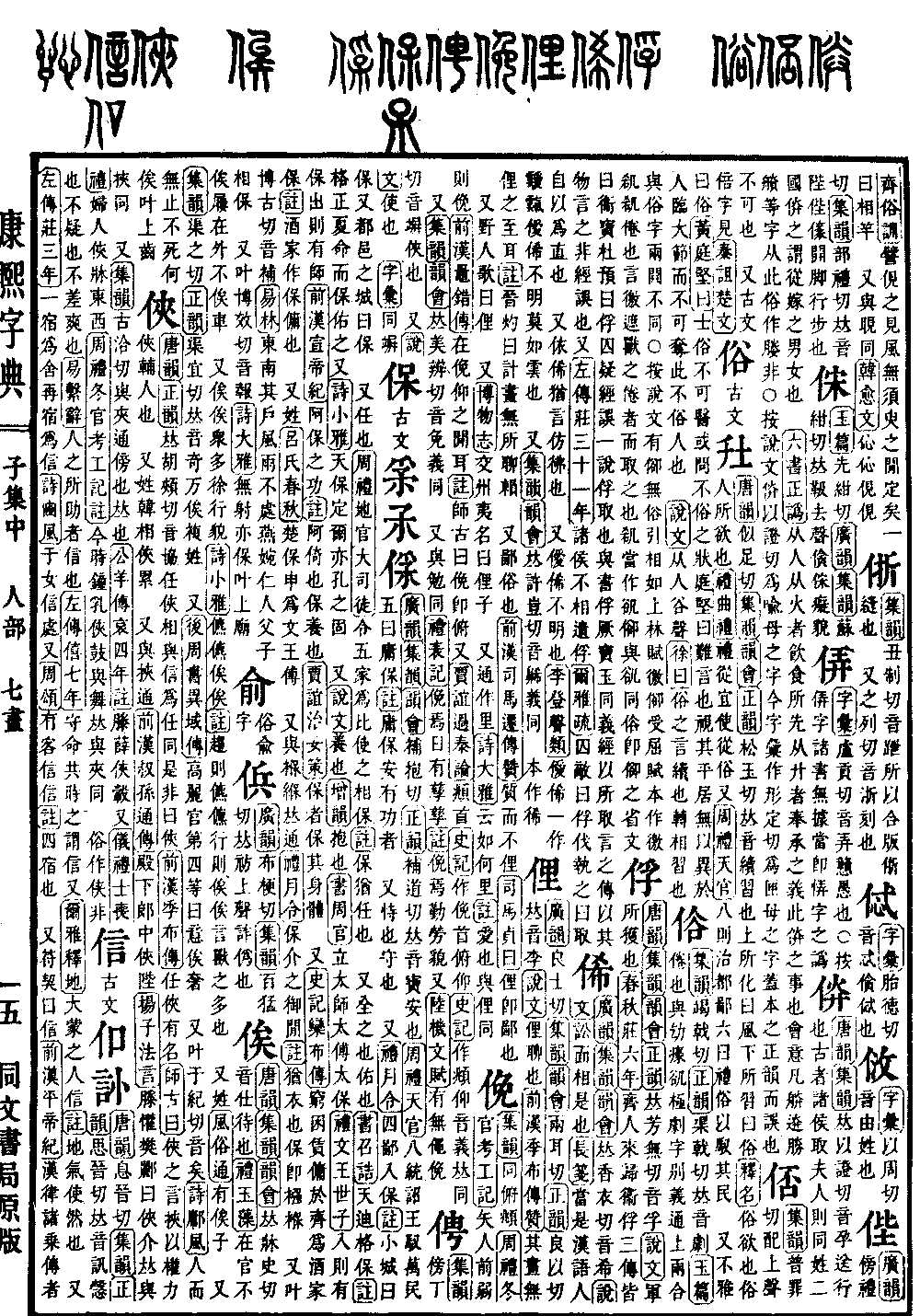
Zi Collection, Middle Volume
Radical: Person (rén)
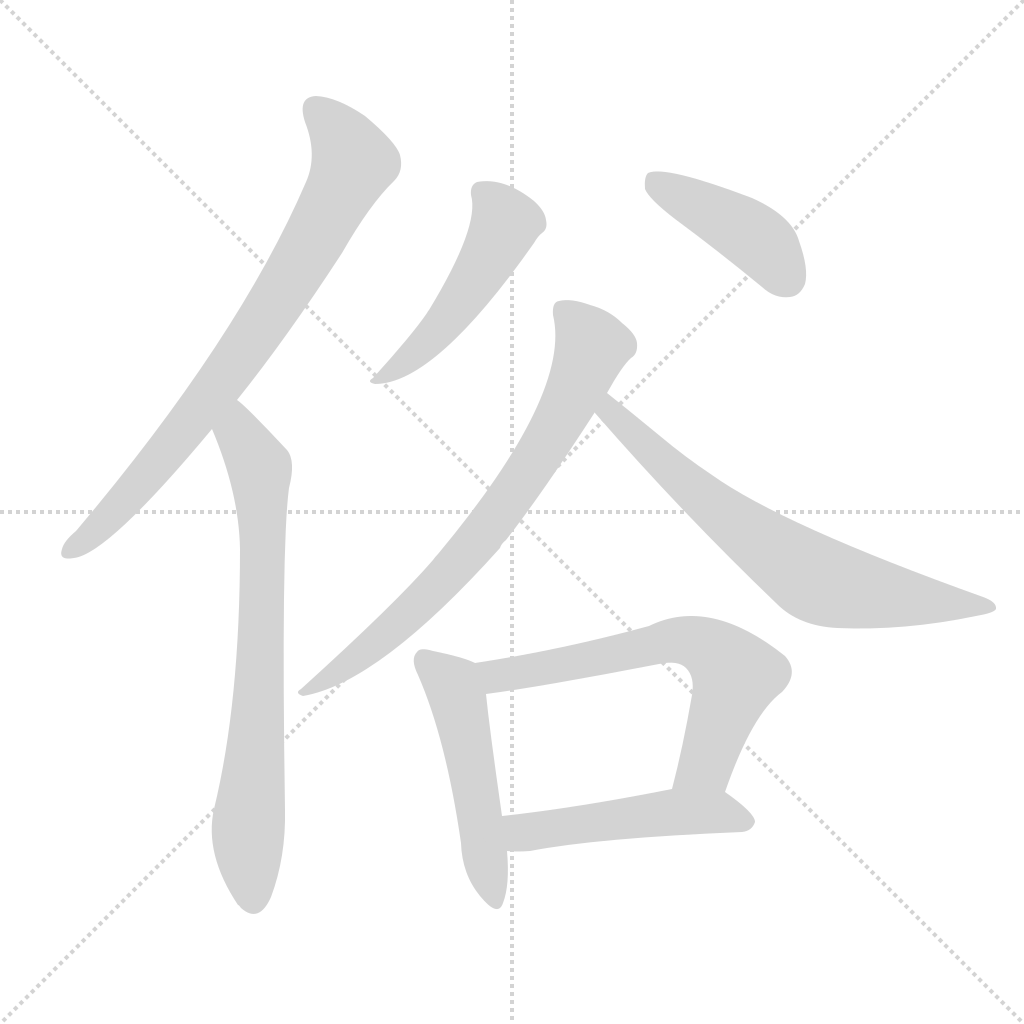
Headword: sú
Kangxi Stroke Count: 9
Page: Page 105, Number 09
Ancient form written as a variant form pronounced qiān.
Tang Dynasty Rhyme (Tangyun): Phonetic combination of si and zu. Collection of Rhymes (Jiyun), Rhyme Meetings (Yunhui), and Correct Rhymes (Zhengyun): Phonetic combination of song and yu. Pronounced the same as xù.
It means a habit or practice. That which is transformed by those above is called wind (fēng); that which is practiced by those below is called custom (sú).
Explanation of Names (Shiming): Custom (sú) means desire (yù); it is what common people desire.
Book of Rites (Liji), Summary of Rules of Propriety (Quli): Rituals follow what is appropriate; envoys follow local customs.
Also, Rites of Zhou (Zhouli), Offices of Heaven (Tianguan): There are eight rules to govern the capitals and borders; the sixth is called ritual customs, used to manage the people.
Also, that which is not elegant is called vulgar.
Huang Tingjian said: If a scholar is vulgar, there is no medicine to cure him. Someone asked what it is like to be refined, and Tingjian replied: It is difficult to describe. Looking at their ordinary life, they are no different from others, yet when facing a great moral crisis they cannot be swayed; such a person is not vulgar.
Explanation of Simple and Compound Characters (Shuowen): Derived from the Person radical, with gǔ as the phonetic element.
Xu said: The word for custom (sú) implies continuity (xù). It refers to practices being passed down and learned from one another.
Textual Criticism: In Sima Xiangru's Rhapsody on the Shanglin Park (Shanglin Fu), where the term jiǎo is constrained. In accordance with the original text, the Rhapsody on the Shanglin Park is corrected to the Rhapsody of Master Vacuous (Zixu Fu).