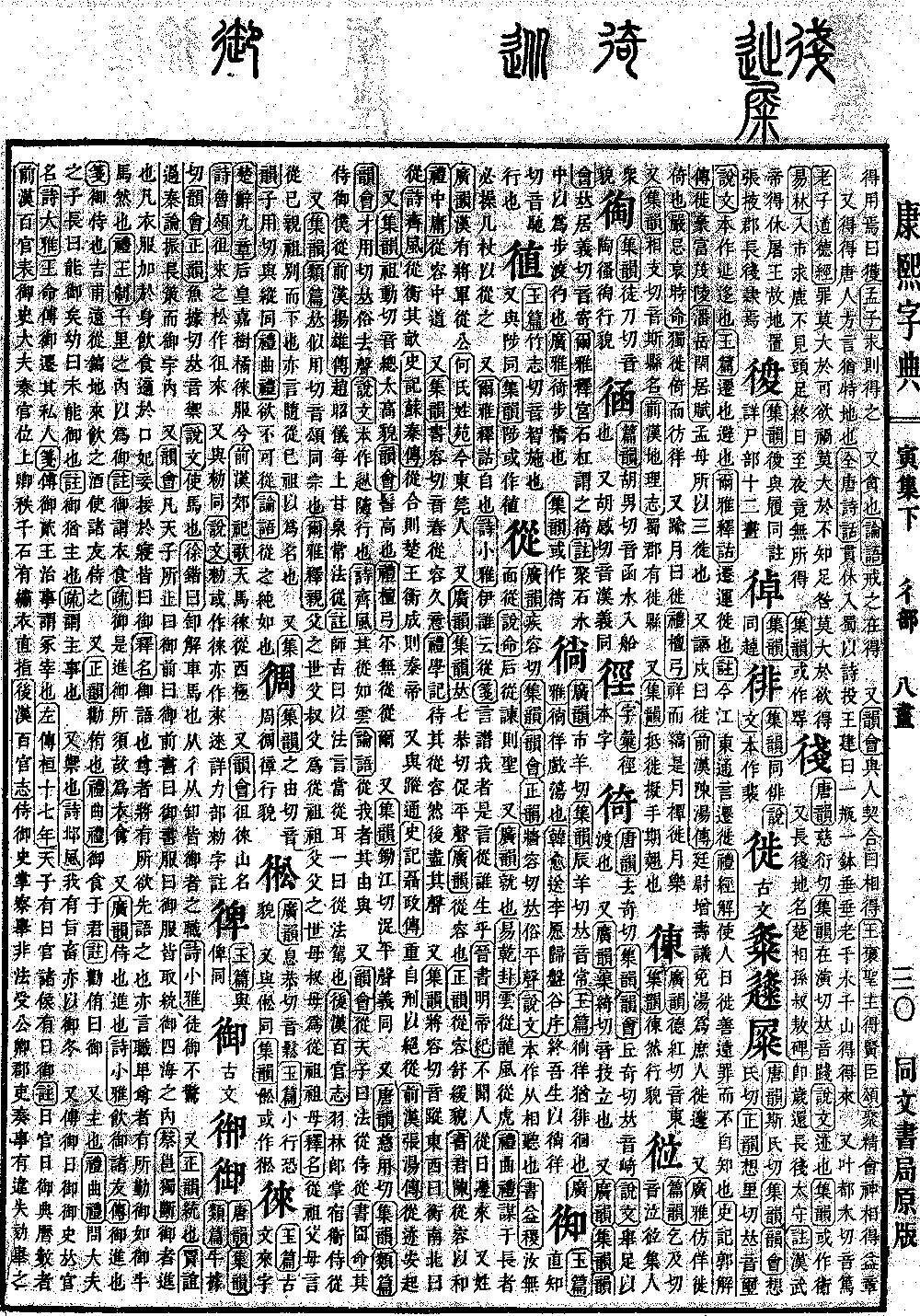
Yin Collection, Lower Volume
Radical: Step (chì)
Kangxi Strokes: 11
Page 368, Entry 23
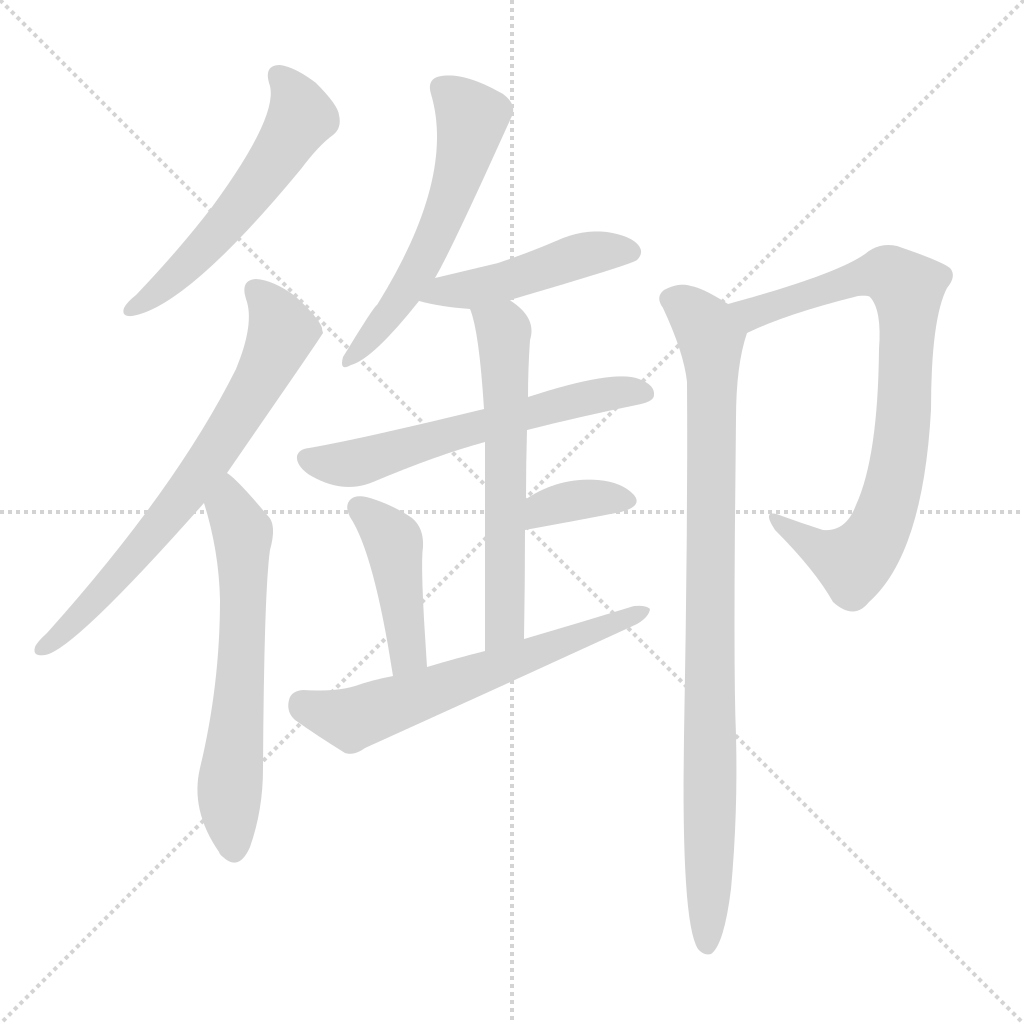
Ancient form. Pronounced yu (falling tone). From Tang Rhymes (Tangyun), Collected Rhymes (Jiyun), and Classified Dictionary (Leipian), combined with Rhyme Meetings (Yunhui) and Correct Rhymes (Zhengyun). In the Seal Script (Shuowen), it means to drive horses. Xu Kai says: It means to unharness or disassemble a carriage and horses. Composed of the radicals for step and unharness; both relate to the duties of a driver. Book of Odes (Shijing), Lesser Odes of the Kingdom (Xiaoya): The footmen and drivers are not startled.
Also, in Correct Rhymes (Zhengyun), it means to govern or control. In Jia Yi’s On Passing Qin (Guo Qin Lun): Wielding the long whip to govern within the universe.
In Rhyme Meetings (Yunhui), everything pertaining to the Emperor is called yu. Before the Emperor is called yu-front, his writings are called yu-writings, and his garments are called yu-garments; all these signify the governance of the four seas.
Cai Yong’s Unique Judgments (Duduan): Yu means to advance. Anything added to the body such as clothing, food or drink entering the mouth, or the attendance of concubines in the bedroom, is called yu.
Explanation of Names (Shiming): Yu means to speak. When a superior desires something, one speaks to them first. It also means duty, as a superior has matters to attend to, just as one drives oxen or horses.
Book of Rites (Liji), Royal Regulations (Wangzhi): Within a thousand li, it is considered yu. The commentary states: Yu refers to clothing and food. The sub-commentary states: Yu is what is served or offered; hence, it refers to clothing and food.
In Extensive Rhymes (Guangyun), it means to attend or to serve. Book of Odes (Shijing), Lesser Odes of the Kingdom (Xiaoya): Serving drinks to all the friends. The commentary states: Yu means to serve. The笺 (jian) note states: Yu means to wait upon. Jifu came from afar from the Hao region to drink wine, and had all his friends wait upon him.
In Correct Rhymes (Zhengyun), it means to urge to eat or drink. Book of Rites (Liji), Summary of Rules (Quli): Serving a meal to the lord. The commentary states: To urge one to eat or drink is called yu.
It also means to take charge. Book of Rites (Liji), Summary of Rules (Quli): When inquiring about the son of a high official, if he is older, it is said he can yu; if young, it is said he cannot yet yu. The commentary states: Yu is like taking charge. The sub-commentary states: This refers to taking charge of affairs.
It also means to resist. Book of Odes (Shijing), Odes of Bei (Beifeng): I have fine stores, and also to resist the winter.
Fu-yu, Ri-yu, and Yushi are titles of officials. Book of Odes (Shijing), Greater Odes of the Kingdom (Daya): The King commanded the Fu-yu to relocate his private staff. The 笺 (jian) note states: The Fu-yu assists the King in administration, referring to the Prime Minister. Zuo Commentary (Zuozhuan), 17th Year of Duke Huan: The Emperor has Sun Officials, and the feudal lords have Sun-yu. The commentary states: Sun officials and Sun-yu are those who record the calendar. In Former Han History (Qian Hanshu), Table of Hundred Officials: The Censor-in-Chief (Yushi Dafu) was an official of the Qin, holding the rank of high minister with a salary of one thousand dan, having the authority to inspect and report directly. In Later Han History (Hou Hanshu), Record of Hundred Officials: The Inspecting Censor (Shiyushi) is responsible for investigating illegalities and receiving reports from ministers and local officials; if there are transgressions, he impeaches them. During suburban sacrifices, temple ceremonies, and court audiences, two such officials supervise the proceedings and impeach any violations.
Also refers to female officials. Rites of Zhou (Zhouli), Heaven Official, Female Attendants (Nuyu): Responsible for organizing attendance in the King’s private chambers. Discourses of Zhou (Zhouyu): The inner officials do not exceed the nine yu.
A surname. In Standard Characters Explained (Zhengzitong): There was a Yu Yang in the Zhou Dynasty.
In Classified Dictionary (Leipian): Pronounced yu (rising tone). To stop. Zuo Commentary (Zuozhuan), 4th Year of Duke Xiang: Ji Sun did not stop. The commentary states: Yu means to stop. The Explanation of Sounds (Shiven) states: Pronounced yu (rising tone).
Also, the name of a town in Lu. Zuo Commentary (Zuozhuan), 22nd Year of Duke Xiang: When the rain passed, [the Duke] met Yu Shu, and Yu Shu was in his town. The commentary states: Yu Shu was a grand official of the Yu town in Lu. The Explanation of Sounds (Shiven) states: Pronounced yu (rising tone).
Yu-long is a compound surname. Records of the Grand Historian (Shiji), Annals of Xia: Liu Lei learned how to tame dragons to serve Kong Jia; Kong Jia bestowed upon him the surname Yu-long.
In Collected Rhymes (Jiyun): Pronounced yu (departing tone). To meet or welcome. Book of Odes (Shijing), Odes of Zhao (Zhaonan): A hundred carriages go to meet her. The 笺 (jian) note states: Yu means to welcome. Book of Rites (Liji), Summary of Rules (Quli): When the lord summons, even for a lowly person, a high official or scholar must personally go to meet them. Collected Rhymes (Jiyun) notes it is also written in a variant form (ya).