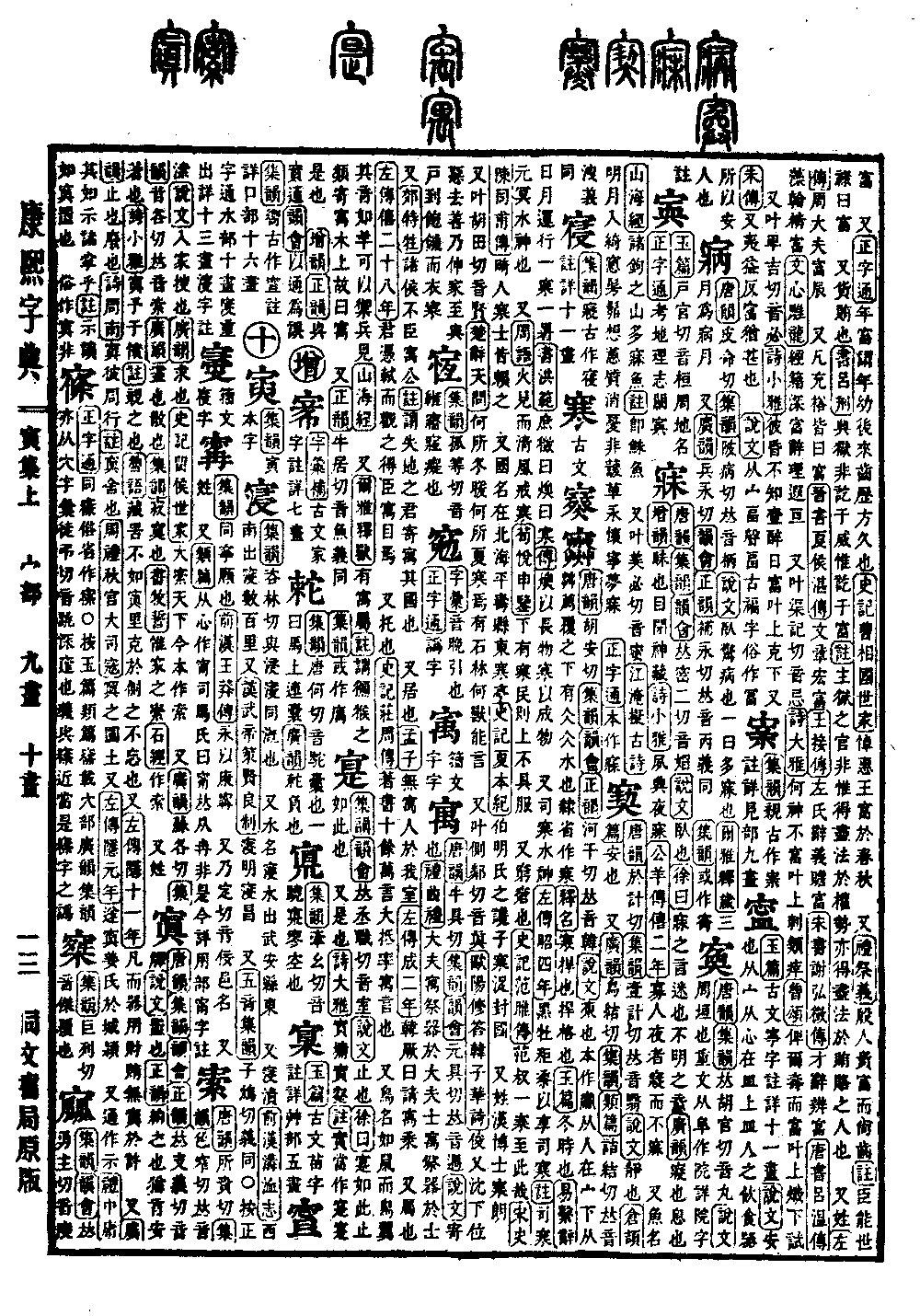
Yin Collection, Upper Volume
Radical: Roof (bù)
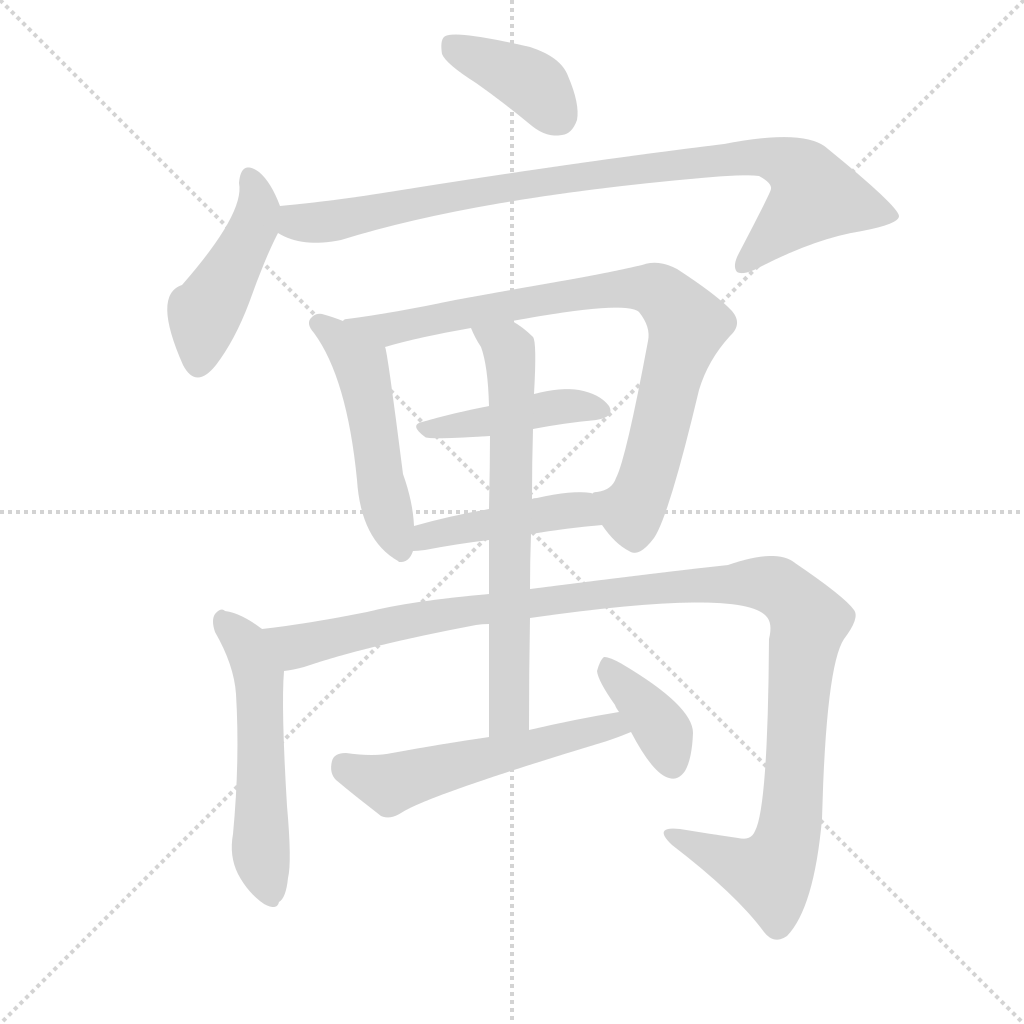
寓; Kangxi stroke count: 12; Page 289, Entry 15
Pronounced yu (falling tone).
In the Shuo Wen Jie Zi (Shuo Wen), it means to lodge.
In the Book of Rites (Liji), specifically the Qu Li section: A grand master lodges sacrificial vessels with another grand master; a scholar lodges sacrificial vessels with another scholar.
Also, in the Jiao Te Sheng section: Feudal lords do not treat a fugitive duke as a subject. The commentary notes that this refers to a ruler who has lost his territory and is lodging in another state.
Also, to dwell. In the Mencius (Mengzi): Do not lodge guests in my chambers. In the Zuo Tradition (Zuo Zhuan), second year of Duke Cheng: Han Jue said: Please allow me to lodge my chariot.
Also, to attach. In the Zuo Tradition (Zuo Zhuan), twenty-eighth year of Duke Xi: The ruler leaned on the crossbar to observe them; I, your servant, and the others merely lodged our eyes upon it.
Also, to entrust. In the Records of the Grand Historian (Shiji), Biography of Zhuang Zhou: He wrote books totaling over one hundred thousand words, mostly consisting of allegorical tales (allegories).
Also, the name of a bird with wings like a fledgling, which sounds like a sheep and can ward off weapons; found in the Classic of Mountains and Seas (Shanhaijing).
Also, in the Er Ya, Explanation of Beasts: There is the yu family. The commentary states that this refers to creatures like macaques. They dwell in trees, hence they are called yu.
Also, pronounced yu (level tone). The meaning is the same.
In the Ji Yun, it is sometimes written in a variant form (yu).
Textual research: In the Zuo Tradition (Zuo Zhuan), twenty-eighth year of Duke Xi, the phrase reads: The ruler leaned on the crossbar to observe them; I, your servant, and the others lodged our eyes upon it. According to the original text, the character for with has been added after the words I, your servant.