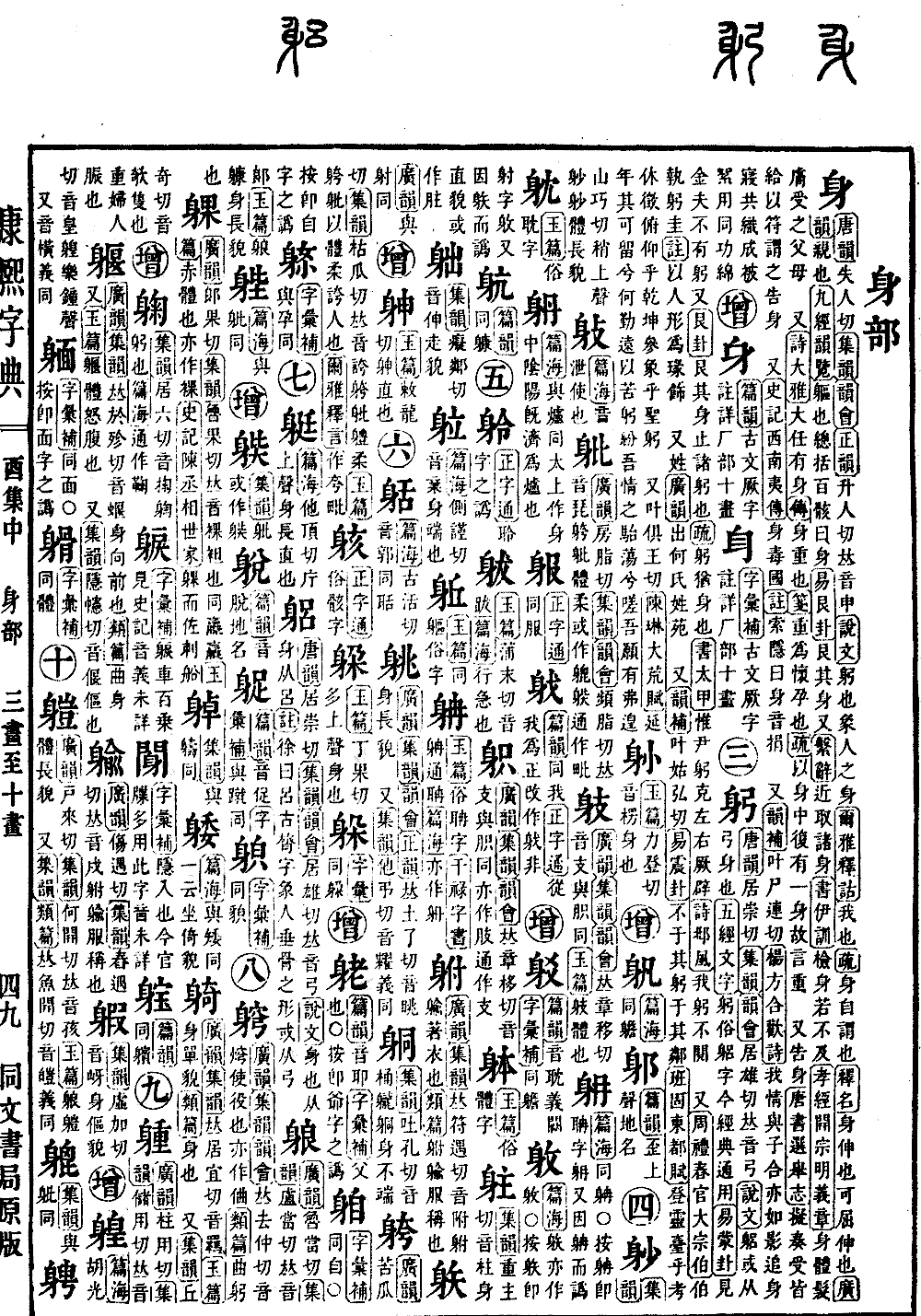
You Collection, Middle Volume
Radical: Body (shēn)
Kangxi Strokes: 10
Page 1237, Entry 04
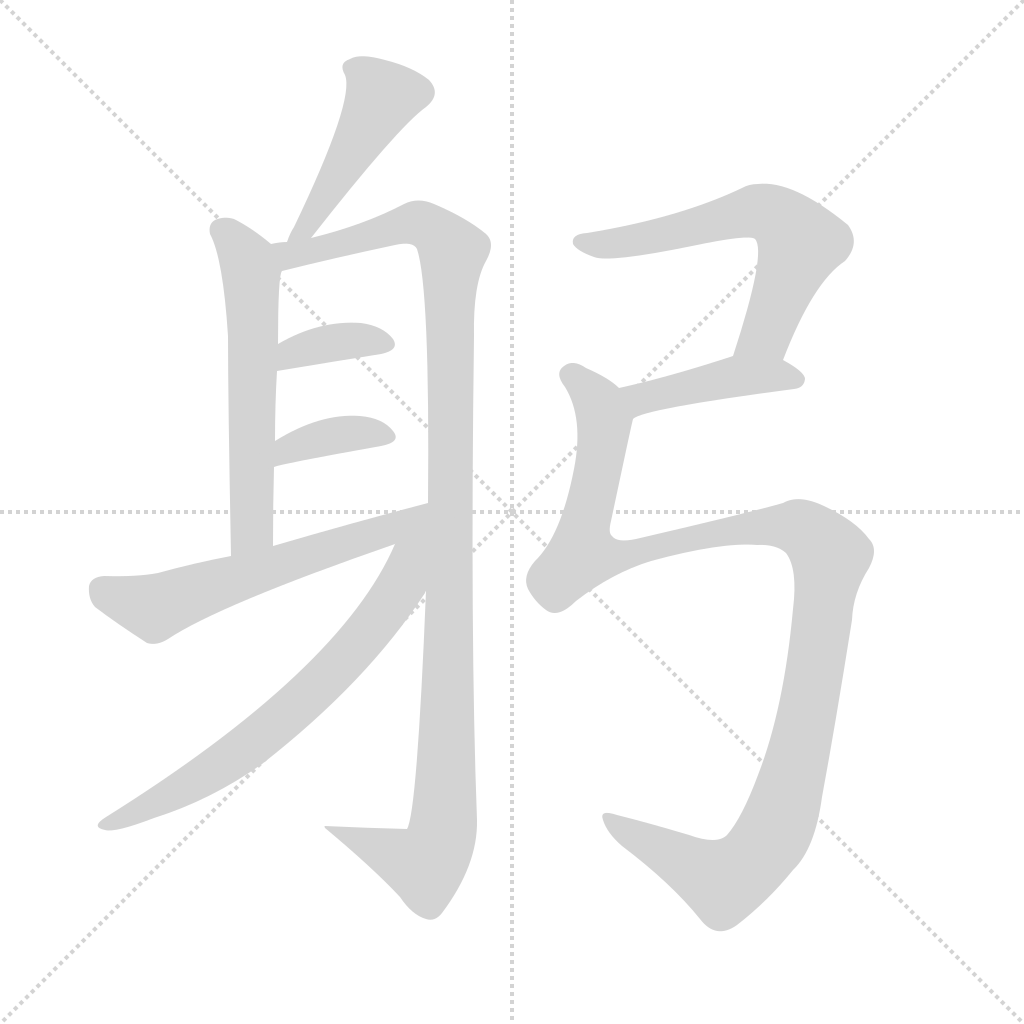
Pronounced gong.
Pronounced gong.
Pronounced gong.
Shuowen Jiezi (Dictionary of Explanations of Characters): The character (gōng) is sometimes written as (gōng), referring to the body.
Wujing Wenzi (Text of the Five Classics): (gōng) is the vulgar form of the character (gōng). Currently, it is widely used in classical literature.
Book of Changes (Yijing), Meng Hexagram: One sees a wealthy man, yet one has no personal gain.
Also, Gen Hexagram: To restrain oneself means to stop one's actions within oneself.
Commentary: (gōng) has the same meaning as (shēn), meaning body.
Book of Documents (Shujing), Taijia: Only Yi Yin was able to personally assist his sovereign.
Book of Odes (Shijing), Beifeng: I cannot even accommodate myself.
Rites of Zhou (Zhouli), Spring Offices, Grand Minister of Rites: The Earl holds the (gōng) jade tablet.
Commentary: Using a human figure as a decorative carving on the jade.
Also used as a surname.
Guangyun (Broad Rhymes): A surname derived from the He Family Registry of Surnames (He Shi Xingyuan).
Also rhyming with gong.
Book of Changes (Yijing), Zhen Hexagram: Not involving one's own self, but involving one's neighbor.
Ban Gu, Eastern Capital Rhapsody (Dongdu Fu): Ascending the spirit terrace to verify auspicious signs, observing heaven and earth, checking against the sage king's own person.
Also rhyming with kuang.
Lin, Great Wilderness Rhapsody (Dahuang Fu): Longevity might perhaps be retained; why labor one's own body to travel to distant places? My sentiments are so agitated, yet alas, my wishes have no time to be fulfilled.
Textual research: Ban Gu, Eastern Capital Rhapsody: Ascending the spirit terrace to verify auspicious signs. Note: According to the original text, the character (hu) was omitted after the character (tai).