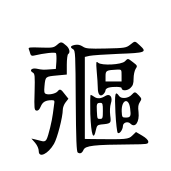
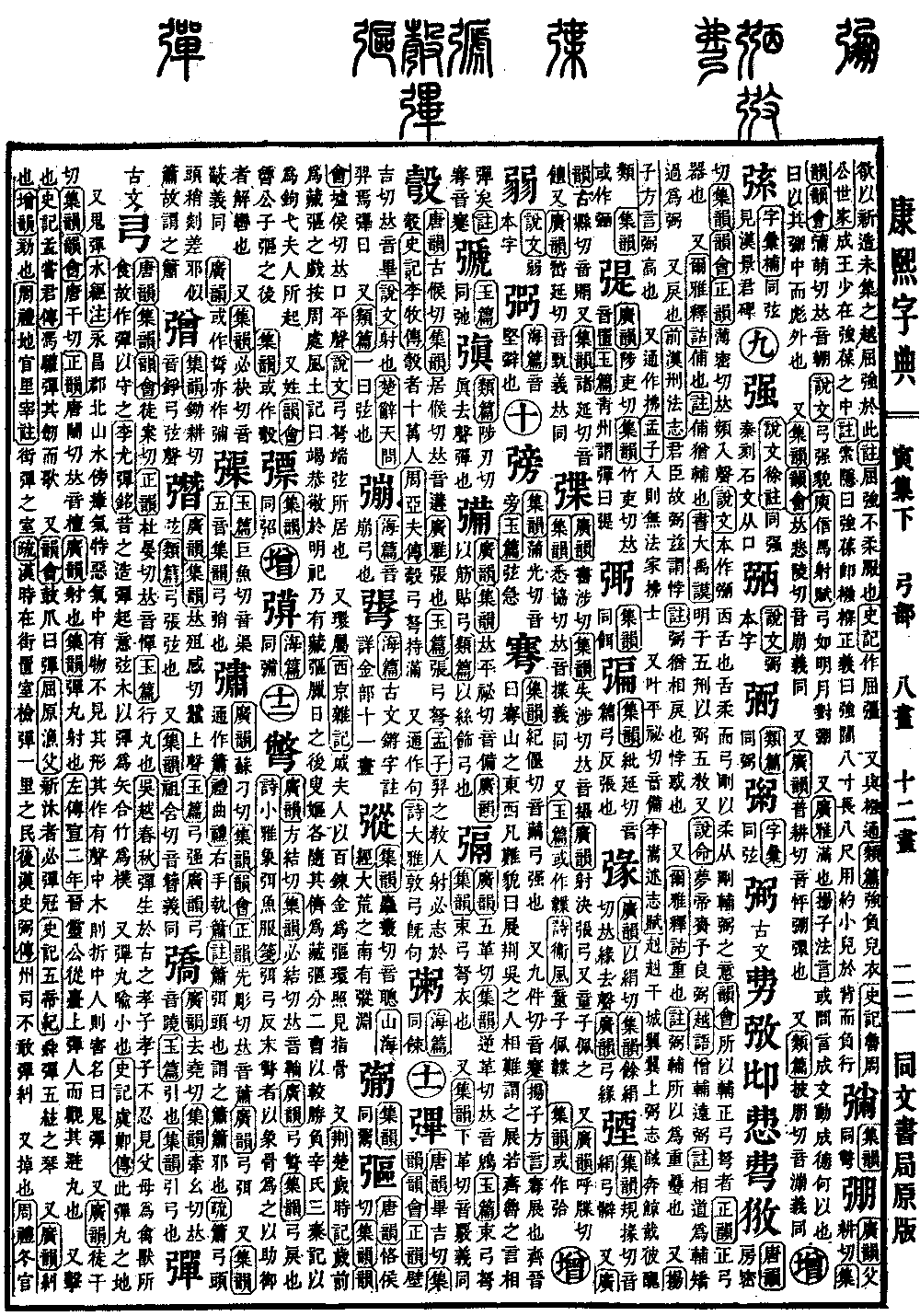
Yin Collection, Lower Volume
Radical: Bow (gōng)
Kangxi Strokes: 14
Page 360, Entry 36
Pronounced kou (level tone).
According to the Explaining Graphs and Analyzing Characters (Shuowen Jiezi), it refers to the parts at both ends of a bow or crossbow where the string is attached. It also refers to ring-shaped objects.
The Miscellaneous Records of the Western Capital (Xijing Zaji) states that Lady Qi used refined gold to create kou-rings, which were capable of revealing the bones of one's fingers.
The Annual Customs of Jing-Chu (Jingchu Suishiji) records that at the end of the year, there was a game called hiding the kou. According to Zhou Chu's Record of Local Customs (Fengtuji), out of reverence for the sacrifices, the game of hiding the kou was established. After the winter sacrifice day (la), the elderly and women would form groups to play the game of hiding the kou, dividing into two sides to compete for victory or defeat. The Record of the Three Qin (Sanqinji) by the Xin family suggests that this was originated by Lady Gouyi.
It is also used as a surname. According to the Collection of Rhymes (Yunhui), these are the descendants of the son of the Duke of Lu, Kou. According to the Collection of Rhymes (Jiyun), it is sometimes written in a variant form (gou).