Zi Collection, Page Position: Upper
Radical: Slash (piě)
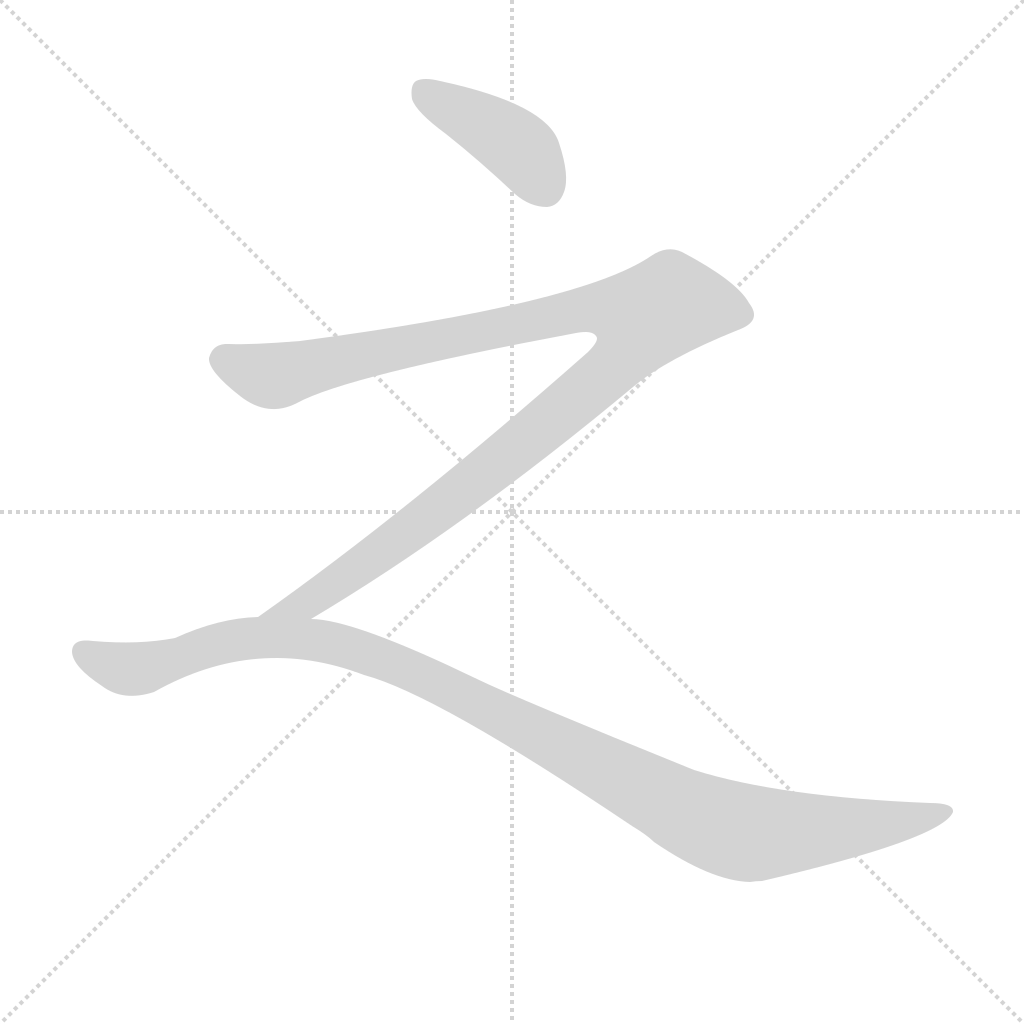
zhi
Kangxi stroke count: 4
Page number: Page 82, Number 04
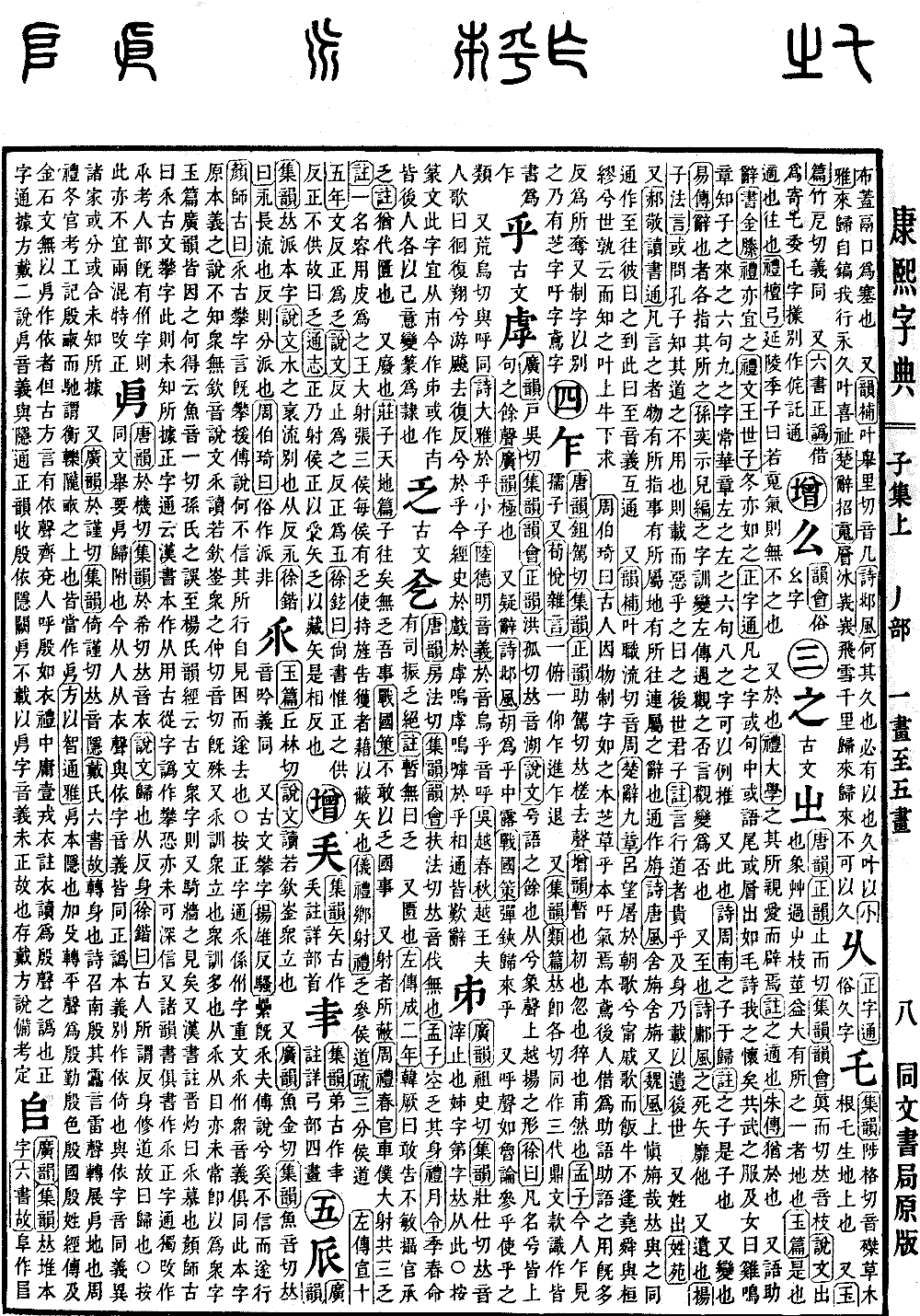
Ancient form
Tang Rhymes (Tangyun) and Correct Rhymes (Zhengyun) provide the phonetic spelling zhi-er; Collected Rhymes (Jiyun) and Rhyme Assembly (Yunhui) provide the phonetic spelling zhen-er; the pronunciation is like the word zhi.
Explaining Graphs and Analyzing Characters (Shuowen Jiezi) states: To go out. It resembles grass growing past its sprout (che), with stems and branches becoming larger and having somewhere to go. The horizontal line represents the earth.
Jade Chapters (Yupian) states: It means this, to go to, or to depart for.
Book of Rites (Liji), Tangong chapter: Jizi of Yanling said, as for the vital energy, there is nowhere it does not go.
Also means at or toward. Great Learning (Daxue) states: In regard to those they love and are close to, people are biased. Commentary: zhi means to go to. Zhu Xi's Commentary: It is like the word at or toward.
Also a grammatical particle. Book of Documents (Shangshu), Metal-bound Coffer (Jinteng) chapter: The ritual was also appropriate for it. Book of Rites (Liji), Heir-son of King Wen (Wenwang Shizi) chapter: In autumn and winter, it was also like this.
Correct Character Mastery (Zhengzitong) states: The character zhi may appear in the middle of a sentence, at the end of a sentence, or repeatedly. For example, in the Mao edition of the Classic of Poetry (Shijing): My heart longs for him, and jointly performing military duties. Also, in the chapter The Lady Says the Cock has Crowed, where it says knowing you are coming, there are nine instances of zhi in six lines. In the Changhua chapter, it says to the left, to the left, with eight instances of zhi in six lines. Other cases follow this pattern.
Also means this. Classic of Poetry (Shijing), Odes of Zhou and the South (Zhounan): This young lady is going to her new home. Commentary: zhi zi means this person.
Also means to change. Commentary on the Book of Changes (Yizhuan) states: The explanations each point toward where they change. Sun Yi’s Lessons for Children (Shier Bian) states: The character zhi is defined as to change. In the Zuo Tradition (Zuozhuan), it says the hexagram Guan changes to the hexagram Pi, meaning Guan changed into Pi.
Also means to reach or until. Classic of Poetry (Shijing), Odes of Yong (Yongfeng): Until death, I swear there will be no other.
Also means to bequeath. Master Yang's Exemplary Sayings (Fayan) states: Someone asked Confucius, if he knew his Way would not be put into practice, then where would he carry it? He replied: I leave it to the gentlemen of future generations. Commentary: This means those who practice the Way value applying it in their own time, but if not possible, they carry it to bequeath it to later generations.
Also a surname. Recorded in the Register of Surnames (Xingyuan).
Also, in Hao Jing's General Study of Characters (Dushutong): Generally, when zhi is used, there is an object pointed to, a matter to which it belongs, or a place to go; it is a connecting word. It is interchangeable with the word zhan. Classic of Poetry (Shijing), Odes of Tang (Tangfeng): Let it be, let it be. Also in the Odes of Wei (Weifeng): You must be cautious of it. It is used the same way as zhi. It is also interchangeable with the word zhi meaning to arrive. Moving toward a place is called zhi as in to go, while arriving here is called zhi as in to arrive; the sounds and meanings are interchangeable.
Also, in the Rhyme Supplement (Yunbu), it rhymes with the phonetic spelling zhi-liu, pronounced like zhou. Songs of the South (Chuci), Nine Cantos (Jiuzhang): Lu Wang was a butcher in Zhaoge, and Ning Qi sang while feeding his oxen. If they had not met Yao, Shun, Duke Huan, or Duke Mu, who in the world would have known them? It rhymes with the word for oxen (niu) above and the word for seek (qiu) below.
Zhou Boqi said: Ancient people created characters based on objects. For example, zhi was originally the character for lingzhi grass, hu was originally exhaled breath, and yan was originally the kite bird. Later people borrowed them as grammatical particles. Because their use as particles became so frequent, the original meanings were taken over, so new characters were created to distinguish them, resulting in the specific characters for lingzhi grass, exhaled breath, and the kite bird.
Textual Research: In the Book of Rites (Liji), Heir-son of King Wen (Wenwang Shizi) chapter, the text formerly read: In winter, it was also like this. This has been corrected to: In autumn and winter, it was also like this, according to the original text.