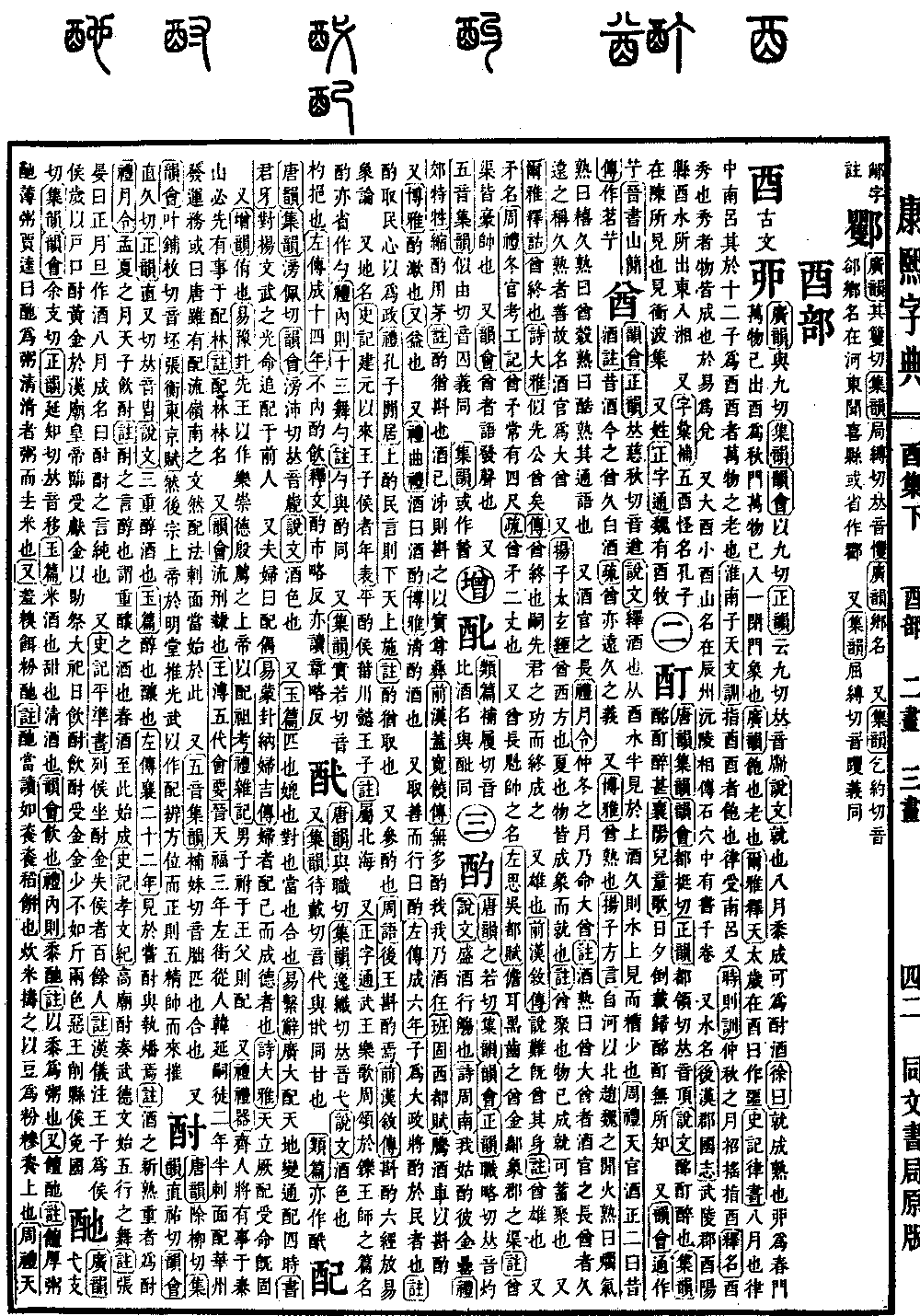
You Collection, Lower Volume
Radical: Wine (yǒu)
Kangxi Strokes: 9
Page 1280, Entry 05
Pronounced qiu.
According to the Explaining Graphs and Analyzing Characters (Shuowen Jiezi), this refers to repeatedly fermented wine. The character is formed by the radical for wine, with the upper portion representing the water surfacing as the wine ferments for a long time and the lees decrease.
In the Rites of Zhou (Zhouli), section on the Office of Heaven, regarding the Wine Master, the commentary on the phrase "Second is aged wine" notes that aged wine is what is now called liquor that has been brewed for a long time. The sub-commentary adds that the term also implies a long duration of time.
According to the Erudite Interpretations (Boya), it refers to being fully ripe. According to the Fangyan by Yang Xiong, in the region north of the Yellow River, encompassing Zhao and Wei, to cook thoroughly over a fire is called lan, to steam thoroughly is called li, to cook until thoroughly ripe over a long duration is called qiu, and for grain to be thoroughly ripe is called ku. The term shu is the general term.
It also refers to the leader of the wine officials. In the Monthly Ordinances (Yueling) of the Book of Rites (Liji), it is written: "In the month of mid-winter, command the Great Chief (Da Qiu)." The commentary explains that when wine is fermented until ripe, it is called qiu. The Great Chief is the leader of the wine officials. Qiu is a term implying long duration. Only wine that has fermented long and well is considered excellent, which is why the wine official is called the Great Chief.
According to the Mystery Classic (Tai Xuan Jing) by Yang Xiong, qiu represents the west and also the summer; all things take on form and tend toward maturity. The commentary notes that qiu implies accumulation. All things are ripe and ready to be stored away.
According to the Erya, a dictionary of classical terms, qiu means to conclude. In the Classic of Poetry (Shijing), Great Odes section: "Resembling the former dukes in completion." The commentary notes that qiu means completion. It signifies inheriting the merits of former lords and bringing them to a conclusion.
It also refers to being robust and powerful. In the Narrative Treatise of the History of the Former Han (Hanshu), it is written: "The discussion on difficulty (Shuonan) having been completed (qiu), his person was then imprisoned (you)." The commentary notes that qiu means robust.
It is also the name of a type of spear. In the Rites of Zhou (Zhouli), section on the Winter Officials, it is written that the chief spear (qiu mao) is always four feet. The sub-commentary states that the chief spear is twenty feet long.
It also refers to a chief or headman. In the Rhapsody on the Capital of Wu (Wu Du Fu) by Zuo Si, it is written: "The chiefs (qiu) of Dan’er and Heichi, the leaders (qu) of Jinlin and Xiangjun." The commentary notes that both qiu and qu refer to powerful leaders.
According to the Collection of Rhymes (Yunhui), the character qiu is sometimes used as an initial particle in a sentence.
According to the Five Sounds Collection of Rhymes (Wuyin Jiyun), pronounced qiu. The meaning is the same. According to the Collection of Rhymes (Jiyun), it is sometimes written in a variant form (you).
Correction: Regarding the cited text from the Narrative Treatise of the History of the Former Han, the original text states "his person was then imprisoned" (qi shen nai qiu) as a single clause; the two characters "nai qiu" cannot be omitted. Per the original text, the two characters "nai qiu" have been added after "his person."