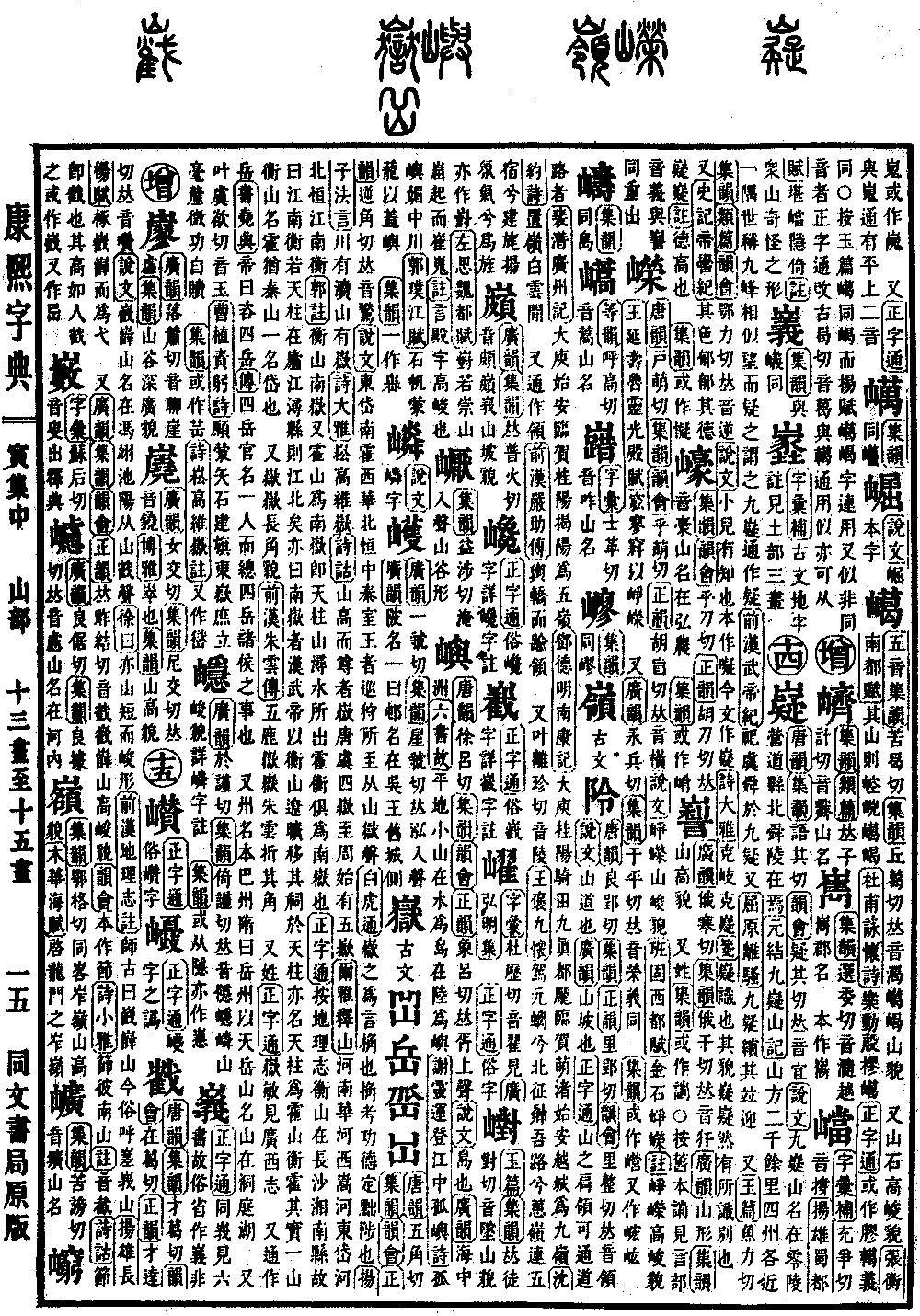
Yin Collection, Middle Volume
Radical: Mountain (shān)
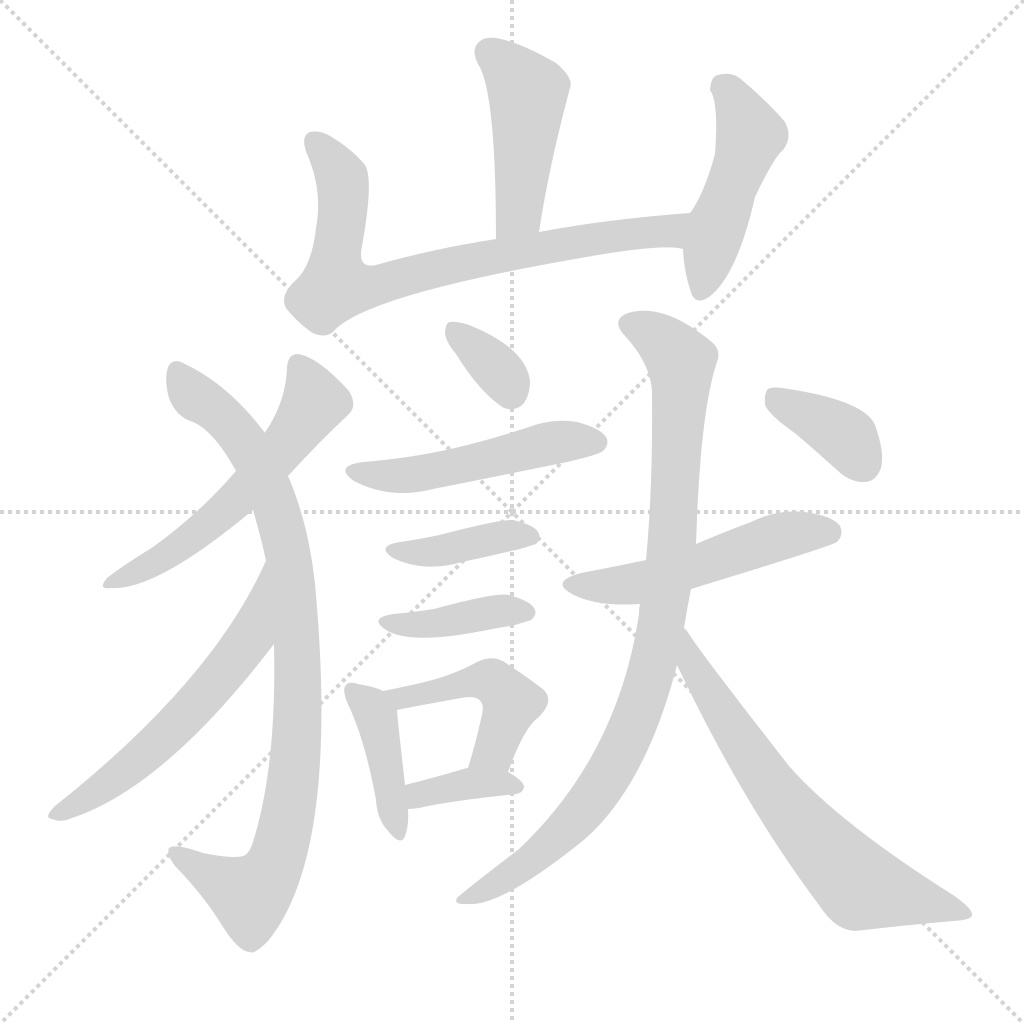
嶽; Kangxi stroke count: 17; Page 321, Entry 28
Ancient character form for the character for mountain (yuè).
Pronounced yuè.
In the work Origin of Chinese Characters (Shuowen), it is noted that the Eastern Dai, Southern Huo, Western Hua, Northern Heng, and Central Taishi mountains are where kings visit during royal tours. Composed of the radical for mountain and the phonetic component for prison.
In the work White Tiger Hall Discussions (Baihu tong), it is stated that the term for mountain peak implies a measuring beam. It is a beam used to examine merits and determine promotions or demotions.
In the work Model Sayings (Fayan) by Yang Xiong, it is written that rivers have channels, and mountains have peaks.
In the Book of Odes (Shijing), Great Odes of the Kingdom, it is written that the great mountain is a peak.
In the Commentary on the Book of Odes (Shigu), it is stated that mountains that are high and honored are called peaks. In the eras of Tang and Yu, there were four peaks, and by the Zhou dynasty, there were five.
In the work Literary Expositor (Erya), section on mountains, it is noted: south of the river is Hua, west of the river is the peak, east of the river is Dai, north of the river is Heng, and south of the Yangtze is Heng.
The commentator Guo notes: Mount Heng is the southern peak. Furthermore, Mount Huo is the southern peak, also known as Mount Tianzhu, where the Xun River originates. Huo and Heng are both considered the southern peak.
In the work Correct Meaning of Characters (Zhengzitong), it is noted: According to the Treatise on Geography, Mount Heng is in Xiangnan County, Changsha, hence it is called the southern Heng of the Yangtze region. If Mount Tianzhu is in Xun County, Lujiang, then it is north of the Yangtze. It is also called the southern peak because Emperor Wu of the Han dynasty, finding Mount Heng too vast, moved the sacrificial rites to Mount Tianzhu, also naming Mount Tianzhu as Mount Huo. Heng and Huo are in fact the same mountain; Mount Heng is named Huo, just as Mount Tai is also named Dai.
Also, the term describing long horns. In the Biography of Zhu Yun in the History of the Former Han Dynasty (Qianhan shu), it is written that Wulu had a towering appearance, and Zhu Yun broke his horns.
Also a surname. In the work Correct Meaning of Characters (Zhengzitong), it is noted: Yue Min. Found in the Records of Guangxi.
Also used interchangeably with the character for mountain peak. In the Book of Documents (Shangshu), Canon of Yao, it is written: The Emperor said, alas, Four Peaks. The commentary states: Four Peaks is an official title, referring to one person who oversees the affairs of all the feudal lords of the four peaks.
Also the name of a prefecture. Originally named Ba Prefecture, it was renamed Yue Prefecture during the Sui dynasty after Mount Tianyue, which is located in Dongting Lake.
Also pronounced yù. In the poem Responsibility for Self by Cao Zhi, it is written: Willing to suffer arrows and stones, planting flags on the Eastern Peak. Hoping to establish a tiny bit of minor merit to redeem myself.
In the work Collection of Rhymes (Jiyun), it is sometimes written as another character. In the commentary to the Great Odes of the Kingdom, it is also written as another character.
The original character was written with the character for mountain underneath.
Textual research: In the Literary Expositor, section on mountains, the text mentions Henan Hua and Hexi Song. Following the original text, Song has been corrected to Yue.