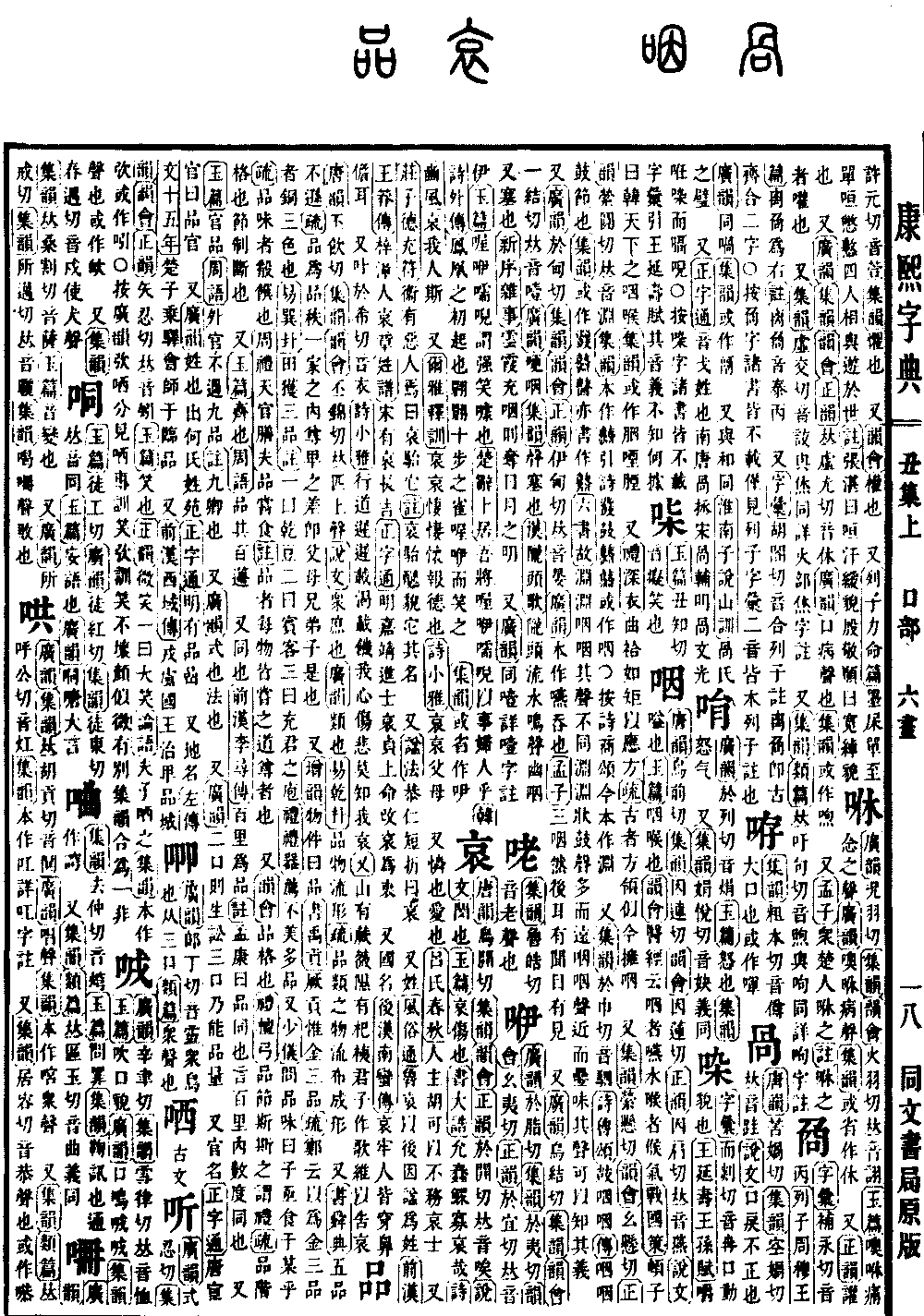
Chou Collection, Upper Volume
Radical: Mouth (kǒu)
Character: ai
Kangxi stroke count: 9
Page 188, Entry 11
Pronounced ai.
Shuowen Jiezi (Dictionary of Explanations of Characters): Pity.
Yupian (Jade Chapters): To be sorrowful or distressed.
Book of Documents (Shangshu): Truly, the wailing of the widowed and solitary is mournful indeed.
Book of Odes (Shijing): Pity us, our people.
Also, Erya (Approaching Elegance): The term ai-ai qi-qi expresses the feeling of longing to repay a virtue.
Book of Odes (Shijing): Alas, my father and mother.
Also, to have compassion for, to love.
Lüshi Chunqiu (Master Lü's Spring and Autumn Annals): How can a ruler not strive to cherish his scholars?
Also, Zhuangzi (Book of Master Zhuang): In the state of Wei, there was an ugly man named Aitai Tuo. Note: Aitai refers to an ugly appearance, and Tuo is his given name.
Also, Posthumous Name System: One who is respectful, benevolent, but dies young is given the posthumous name Ai.
Also, a surname.
Fengsu Tong (Comprehensive Meaning of Customs): Descendants of Duke Ai of Lu adopted his posthumous name as their surname.
History of the Former Han (Qianshu): Ai Zhang from Zitong.
Xingpu (Genealogy of Surnames): In the Song dynasty, there was Ai Changji.
Zhengzitong (True Meaning Thoroughly Explained): During the Jiajing reign of the Ming dynasty, the scholar Ai Zhen was ordered by the Emperor to change his surname from Ai to Zhong.
Also, the name of a state.
Book of the Later Han (Hou Hanshu): The people of Ailao all pierce their noses and have pendulous ears.
Also, rhyming with the sound yi.
Book of Odes (Shijing): The road is long and slow, I am thirsty and hungry. My heart is full of sadness, no one knows my sorrow.
Also: On the hills grow the ferns and vetch, in the lowlands grow the pear trees. The gentleman composes a song to make known his sorrow.