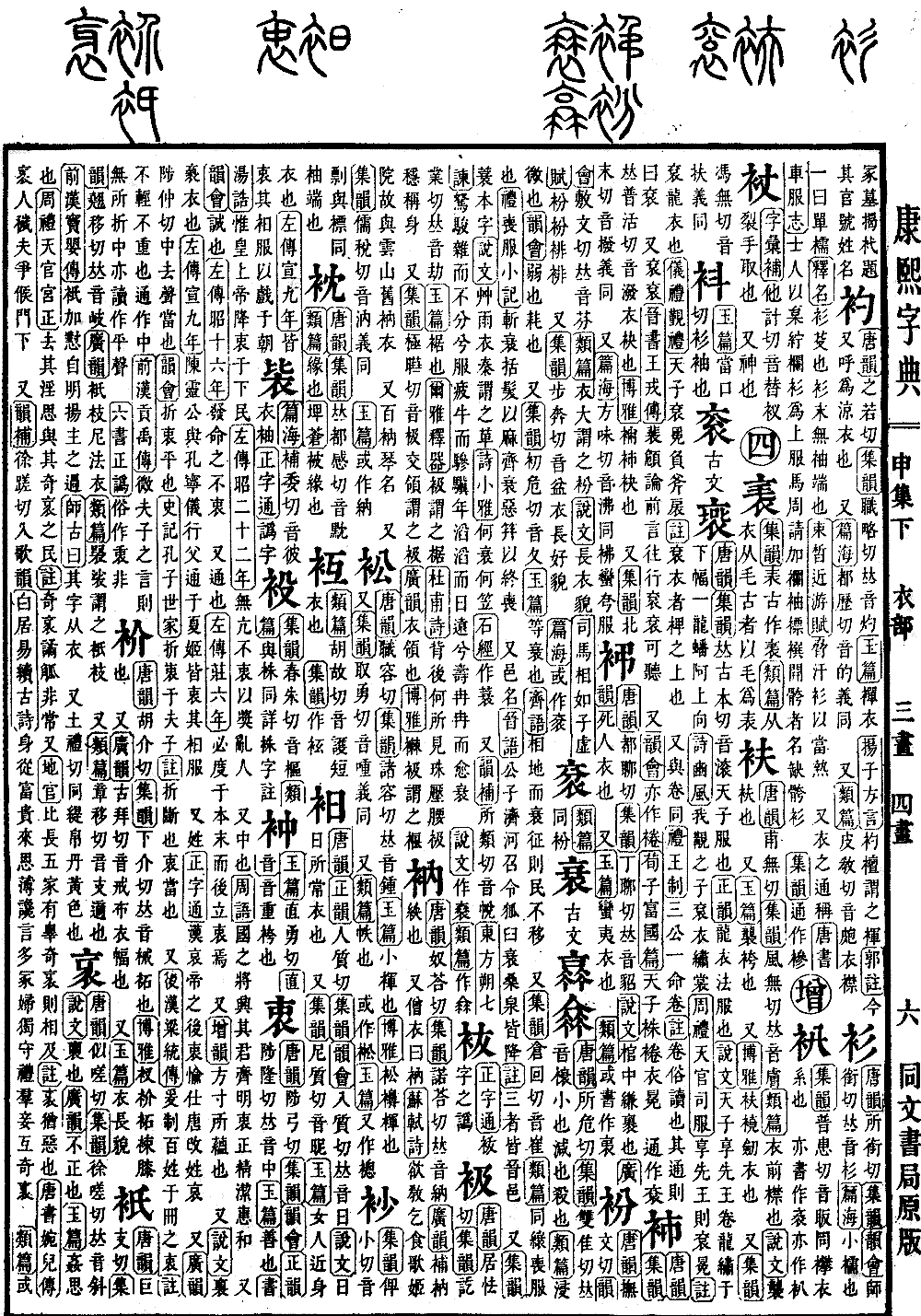
Shen Collection, Lower Volume
Radical: Clothing (yī)
Kangxi Strokes: 10
Page 1112, Entry 14
According to the Tang Rhymes (Tangyun), the pronunciation is shuai. According to the Collection of Rhymes (Jiyun), the pronunciation is shuai. It means small, to decrease, or to weaken. The Categorized Compilation (Leipian) explains it as gradually becoming feeble. The Rhyme Collection (Yunhui) explains it as weak or exhausted. Also, according to the Collection of Rhymes (Jiyun), the pronunciation is sui. The Jade Chapter (Yupian) explains it as a difference in rank. The Discourses of Qi (Qiyu) records: Based on the quality of land, taxes are levied in grades, so the people will not migrate. Also, according to the Collection of Rhymes (Jiyun), the pronunciation is cui. The Categorized Compilation (Leipian) notes it is the same as the character for mourning garments (cui). The Book of Rites (Liji), specifically the section Small Record of Mourning Garments (Sangfu Xiaoji), records: For the highest grade of mourning, use hemp to bind the hair; for the second grade, use a coarse hairpin until the end of the mourning period. It is also a place name. The Discourses of Jin (Jinyu) records: The prince crossed the Yellow River and ordered Linghu, Jiu, Shuai, and Sangquan to all surrender. The commentary notes: These three places were cities of the Jin state. Also, according to the Collection of Rhymes (Jiyun), it is the original form of the character for a straw raincoat (suo). The Explaining Graphs and Analyzing Characters (Shuowen Jiezi) defines it as a raincoat made of grass. In the Qin region, it is called bi. The Book of Odes (Shijing), in the section Small Odes (Xiaoya), records: What raincoat, what conical hat. The Stone Classics (Shijing) writes it as suo. Also, according to the Supplement to Rhymes (Yunbu), the pronunciation is shui. Dongfang Shuo's Seven Remonstrances (Qi Jian) records: Inferior horses and noble horses are mixed indiscriminately, letting the weary ox pull the carriage while the noble horse is used as an outrunner. As the years pass by, life grows longer but increasingly weak. The Explaining Graphs and Analyzing Characters (Shuowen Jiezi) writes it as the form with the variant, and the Categorized Compilation (Leipian) writes it as another variant form.