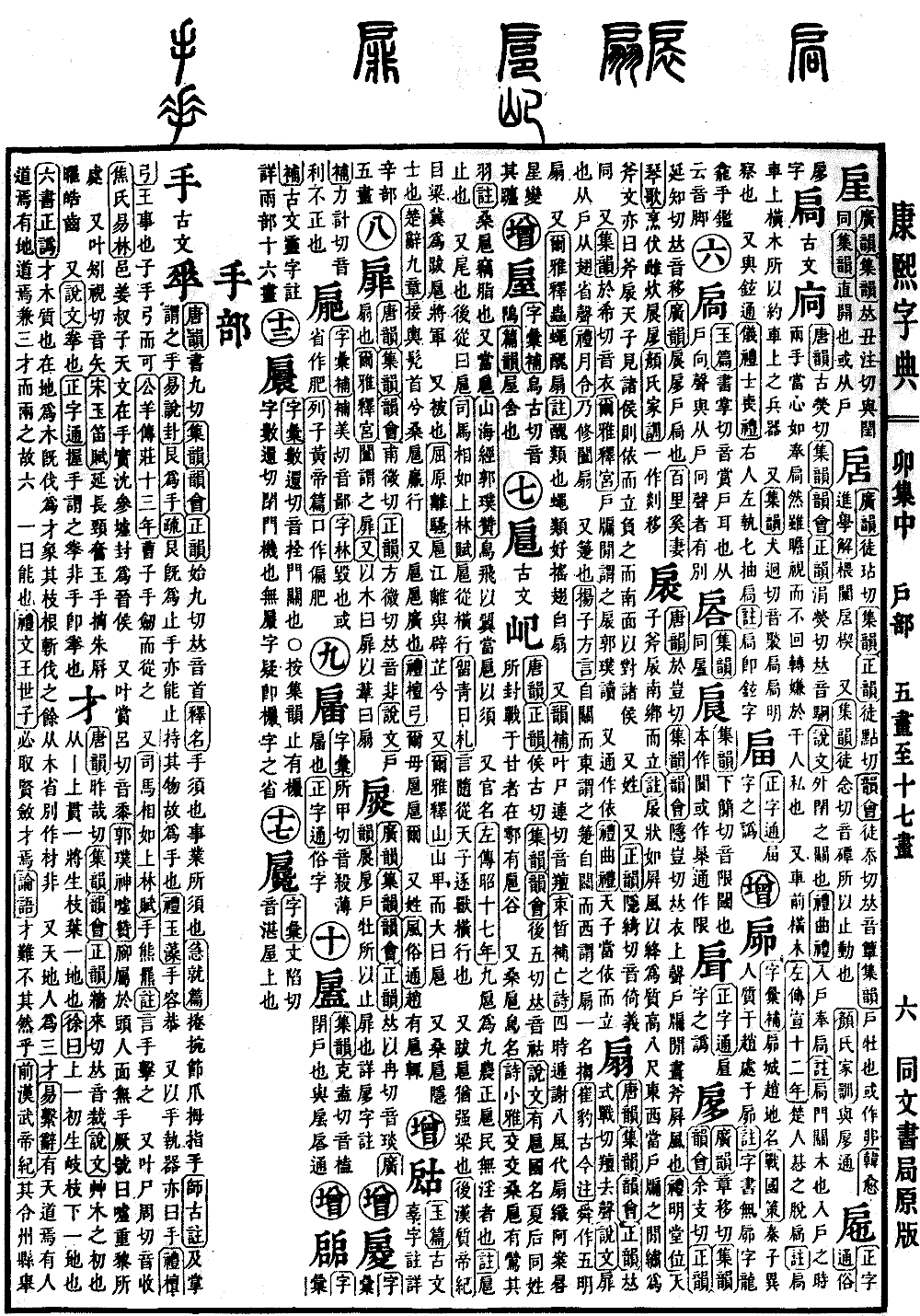
Mao Collection, Middle Volume. Radical: Door (hù). Kangxi stroke count: 10. Page 416, Entry 13.
Pronounced yi (rising tone). Refers to a screen with axe-shaped patterns painted between doors and windows. Book of Rites (Liji), Bright Hall Status (Ming tang wei): The Son of Heaven stands facing south with an axe-patterned screen (yi) behind him. Detailed Commentary on the Song of Rites (Qu li): The form of the yi is like a screen, made with a dark red fabric base, eight feet high, with a width corresponding to the space between doors and windows, embroidered with axe-shaped patterns; it is also called an axe-screen. When the Son of Heaven received the feudal lords, he stood with his back to it, facing south to address them. Also used as a surname.
Also pronounced yi (falling-rising tone). The meaning is the same.
Also pronounced yi. Book of Literary Equivalents (Erya), Explanation of Palaces (Shi gong): The space between doors and windows is called an yi. Guo Pu pronounces it this way.
Also used as a phonetic loan for the word meaning to rely on (yi). Book of Rites (Liji), Song of Rites (Qu li): The Son of Heaven stands with his back relying on a screen.
Textual research: Book of Rites (Liji), Bright Hall Status (Ming tang wei): The Son of Heaven stands with an axe-screen (yi) facing south. Note: The shape of the yi is like a screen. We have carefully added the word "back" before "axe-screen" according to the original text. Also note: "The shape of the yi is like a screen" is commentary from the Detailed Commentary on the Song of Rites (Qu li), not from the Bright Hall Status (Ming tang wei); this has been corrected to refer to the Detailed Commentary on the Song of Rites (Qu li).