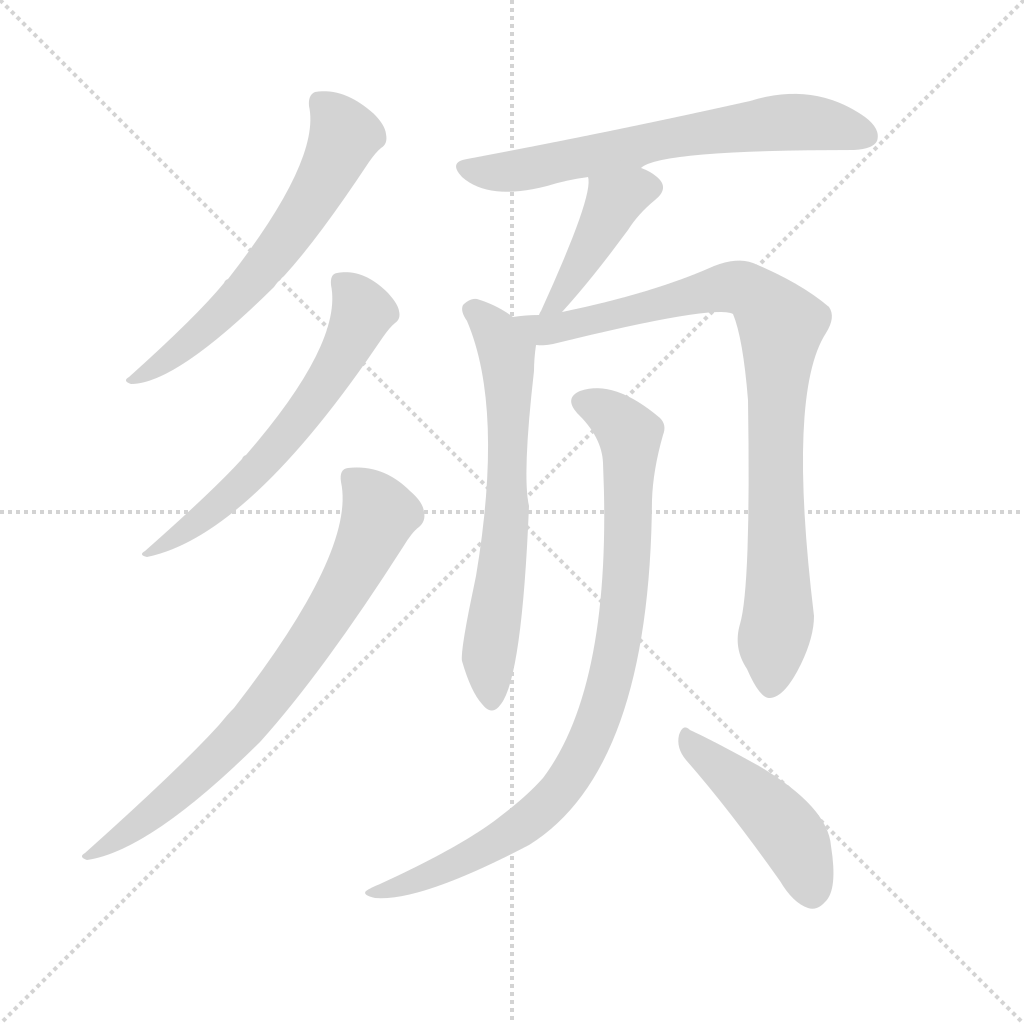
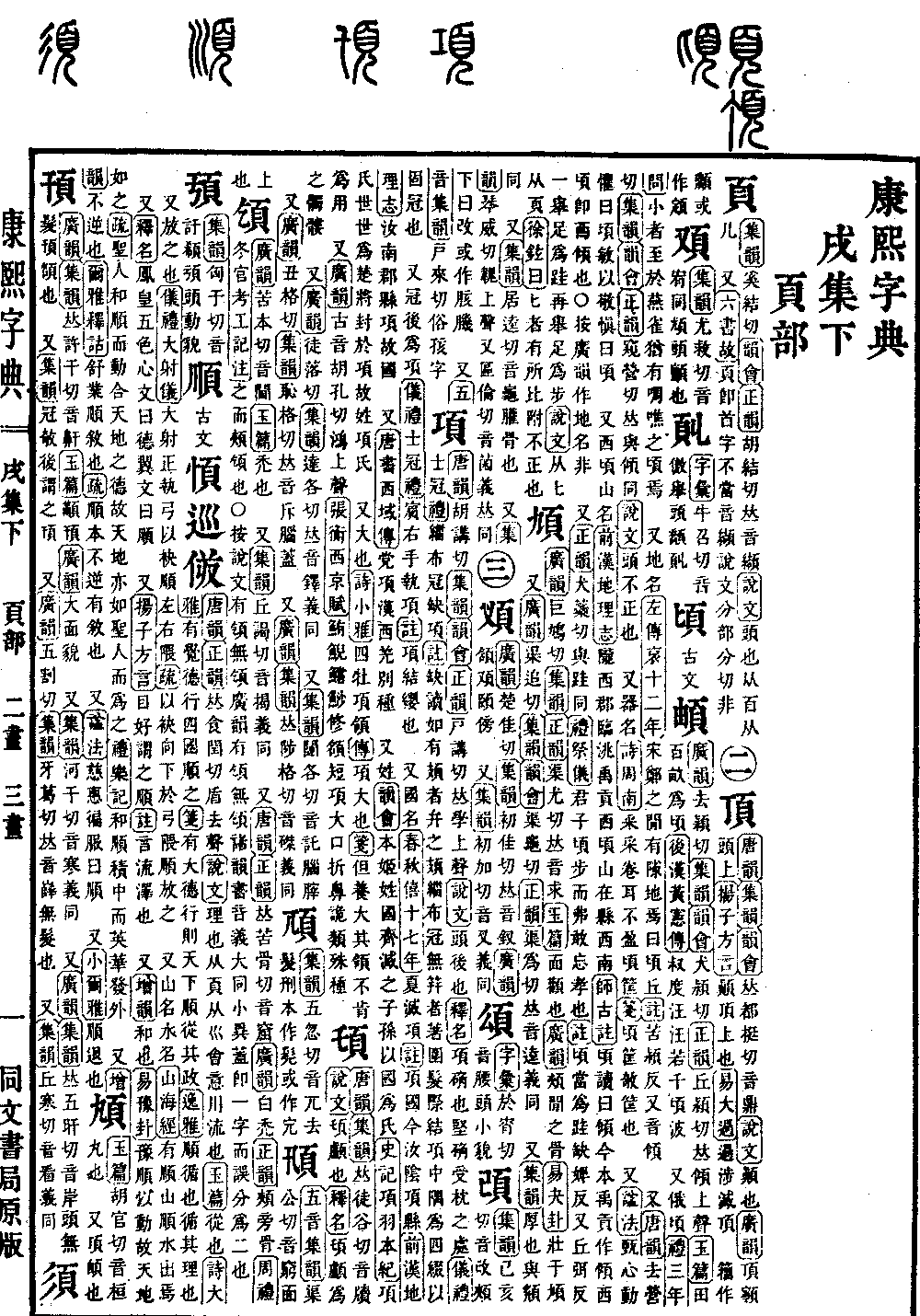
Xu Collection, Lower Volume
Radical: Head (yè)
Kangxi Strokes: 12
Page 1399, Entry 01
Pronounced xu.
According to the Analytical Dictionary of Characters (Shuowen Jiezi), it refers to the hair on the face.
Book of Changes (Yijing), Hexagram of Ornament (Bi): Adorn its beard.
Commentary: The beard is something attached to the upper part.
Sub-commentary: The beard is attached to the upper part of the face.
Explanation of Names (Shiming): Below the chin is called the beard. The beard is elegance. It is written as a variant form. Commonly written as a character with the radical for hair.
Also, it means to wait.
Book of Changes (Yijing), Hexagram of the Marrying Maiden (Guimei): The marrying maiden waits.
Book of Odes (Shijing), Odes of Bei: People cross but I do not, I wait for my friend.
Also interchangeable with the character for waiting.
Zuo Tradition (Zuo Zhuan), 12th year of Duke Cheng: The sun is setting, my lord waits.
Approaching Elegance (Erya), Explanation of Words: The character for waiting means to wait.
Also means to provide or to use. Interchangeable with the character for needing.
Approaching Elegance (Erya), Explanation of Animals: For animals it is called shedding, for humans it is called tensing, for fish it is called beard, for birds it is called gui.
Sub-commentary: These all refer to states where qi is exhausted and the body is weary, which is what is needed, hence the title regarding the beard.
Also, a brief moment, similar to a short duration of time.
Record of Rites (Liji), Record of Music (Yueji): Rites and music cannot be left for a single moment.
Also, slow or lagging.
Zuo Tradition (Zuo Zhuan), 2nd year of Duke Cheng: If you do not wait a moment, the masses will be exhausted.
History of the Later Han (Hou Hanshu), Biography of Prince Xiao of Qinghe: Furthermore, one must wait to stay.
Commentary: In the Eastern Observations (Dongguan Ji), wait to stay is written as lodge and stay.
Also, the Weaving Maid (Xu Nu), the name of a star.
Records of the Grand Historian (Shiji), Treatise on the Celestial Offices, Commentary on the Weaving Maid: The orthodox meaning is: The Weaving Maid consists of four stars. It is also the Weaving Maid, the Celestial Minor Treasury. The Weaving Maid is a term for a lowly concubine, one who performs the duties of a woman.
Also, the name of a state.
Spring and Autumn Annals (Chunqiu), 22nd year of Duke Xi: The Duke attacked Zhu and took Xuju.
Gongyang Tradition (Gongyang Zhuan): Written as Xuju.
History of the Former Han (Qian Hanshu), Treatise on Geography: In Dong Commandery, there is Xuchang County, which was the former Xuju state.
Also, Zuo Tradition (Zuo Zhuan), 4th year of Duke Ding: Distributed the drums of Mixu to Tang Shu.
Records of the Grand Historian (Shiji), Annals of Zhou: King Wen attacked Mixu.
Commentary: The Mixu clan, a state of the Ji surname. Today it is An'ding's Yinmi County.
Also, the name of a settlement.
Book of Odes (Shijing), Odes of Bei: Thinking of Xu and Cao.
Commentary: Xu and Cao are cities in the state of Wei.
Also, History of the Later Han (Hou Hanshu), Treatise on Administrative Divisions: In Nanyang Commandery, Shunyang has a Xu settlement.
Also, the name of a vegetable.
Approaching Elegance (Erya), Explanation of Grasses: The name of a plant.
Sub-commentary: In the Book of Odes (Shijing), Gufeng chapter, it mentions gathering mustard greens and gathering sowthistle. The commentary says the mustard green is the xu plant. Earlier scholars considered the xu plant to correspond to this. Sun Yan says: Xu is another name for the mustard greens.
Also, the name of a grass.
Approaching Elegance (Erya), Explanation of Grasses: Tai is also called fuxu.
Sub-commentary: Tai is another name for fuxu. It is sedge grass.
Also, the name of a bird.
Approaching Elegance (Erya), Explanation of Birds: The crested grebe is called xuying.
Sub-commentary: The crested grebe is also called xuying.
Also, a weapon.
Explanation of Names (Shiming): The xudun shield originated in Shu. Xu refers to that which is held.
Also, Master Yang's Dialect (Fangyan): Xu means to fail or be defeated. In southern Chu, when people are poor and their clothing is ugly and tattered, it is called xujie.
Also, a surname.
Zuo Tradition (Zuo Zhuan), 17th year of Duke Zhuang: There was the Xusui clan.
Strategies of the Warring States (Zhanguo Ce): Wei Minister Xujia.
Also, a person's name.
Zuo Tradition (Zuo Zhuan), 24th year of Duke Xi: The Jin ruler's servant Touxu, who guarded the treasury.
Also, Lu Si, Rhapsody on the Capital of Wu: Fish beard on a flag.
Commentary: Using fish beard to make the pole of a flag.
Also, according to the Collected Rhymes (Jiyun), pronounced ban. It means spotted.
Record of Rites (Liji), Jade Pattern (Yuzao): Regarding the tablet, high officials use fish beard to decorate the bamboo.
Explanation of Characters: Cui says: Using decorative bamboo and fish spots. Hidden meaning says: Decorating the edge of the bamboo with fish beard. Xu is pronounced ban.
Also, rhyme to the sound xiu.
In the Rhapsody of Xi Fu Gong: Alas, if it is like this, what is there to stay for, stroking the divine dragon and clutching its beard.
Lu Yun, Nine Laments: Life has an end, in quiet words why would I need anything. I will rise lightly and view from afar, looking into the distant celestial path and roaming high.
Commentary: Xu here means to seek.
Xu's commentary on the Analytical Dictionary of Characters (Shuowen Jiezi): This originally refers to the beard on the face. The character for head is the radical. The three strokes represent hair decoration. It is borrowed for the meaning of needing. The vulgar writing uses the water radical, which is incorrect. Master Mao says: The beard for hair is different from the character for needing. The character for needing is pronounced with the fire radical, meaning to rot.