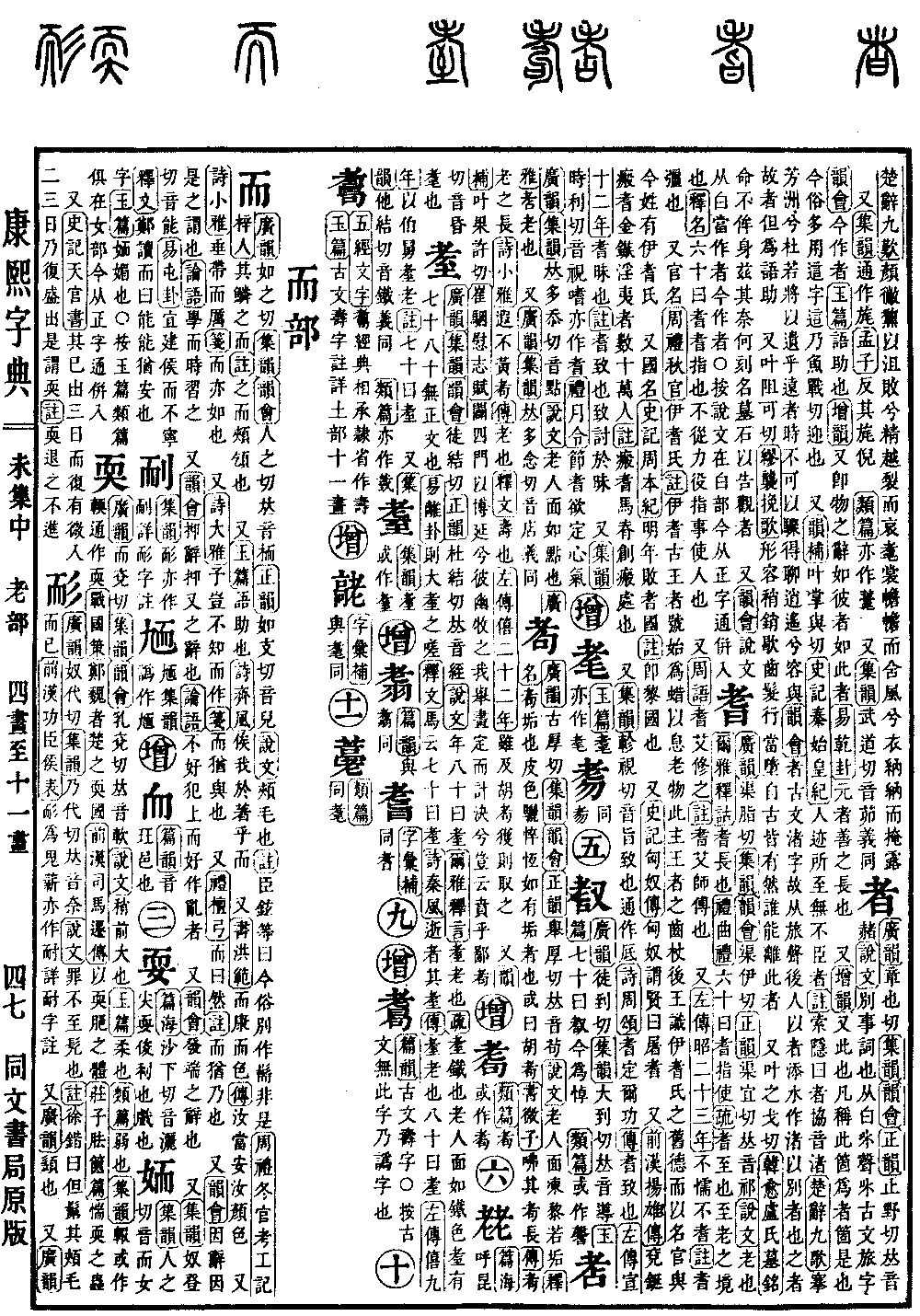
Wei Collection, Middle Volume
Radical: Beard (ér)
Page 961, Entry 25
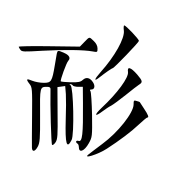
Pronounced nai (falling tone). According to the Extensive Dictionary of Sounds and Meanings (Guangyun) and the Compilation of Rhymes (Jiyun), the pronunciation is the same as the character nai. According to the Explaining Graphs and Analyzing Characters (Shuowen), it refers to a punishment that does not reach the severity of head-shaving. Xu Kai explains that it refers only to shaving the whiskers from the cheeks. In the Table of Meritorious Officials and Marquises of the Former Han (Qianhan Gongchen Houbiao), it refers to the penalty of serving forced labor gathering wood, also written as the character nai. See the detailed entry for the character nai. Also, according to the Extensive Dictionary of Sounds and Meanings (Guangyun), it carries the meaning of the word also.
Pronounced er (level tone). According to the Jade Chapter (Yupian), it refers to the whiskers on the cheeks. According to the Definitions of Names (Shiming), it signifies the hair beside the ears. The ear is a whole, attached to both sides, with hair growing densely. In the Annals of Emperor Zhang of the Later Han (Houhan Zhangdiji), the phrase describes hair and whiskers that are thick, obscuring the face. It is also a surname. In the Zuo Tradition (Zuozhuan), during the tenth year of Duke Wen, there was a man named Er Ban who served as the charioteer for Huangfu Chongshi. According to the Jade Chapter (Yupian), it is also written as the character er. It refers to the thick hair of a wild beast.
Textual verification: According to the Definitions of Names (Shiming), it says it is the hair by the ear. Based on the original text, the redundant character for the term itself before the word ear has been removed.