Shen Collection, Middle Volume
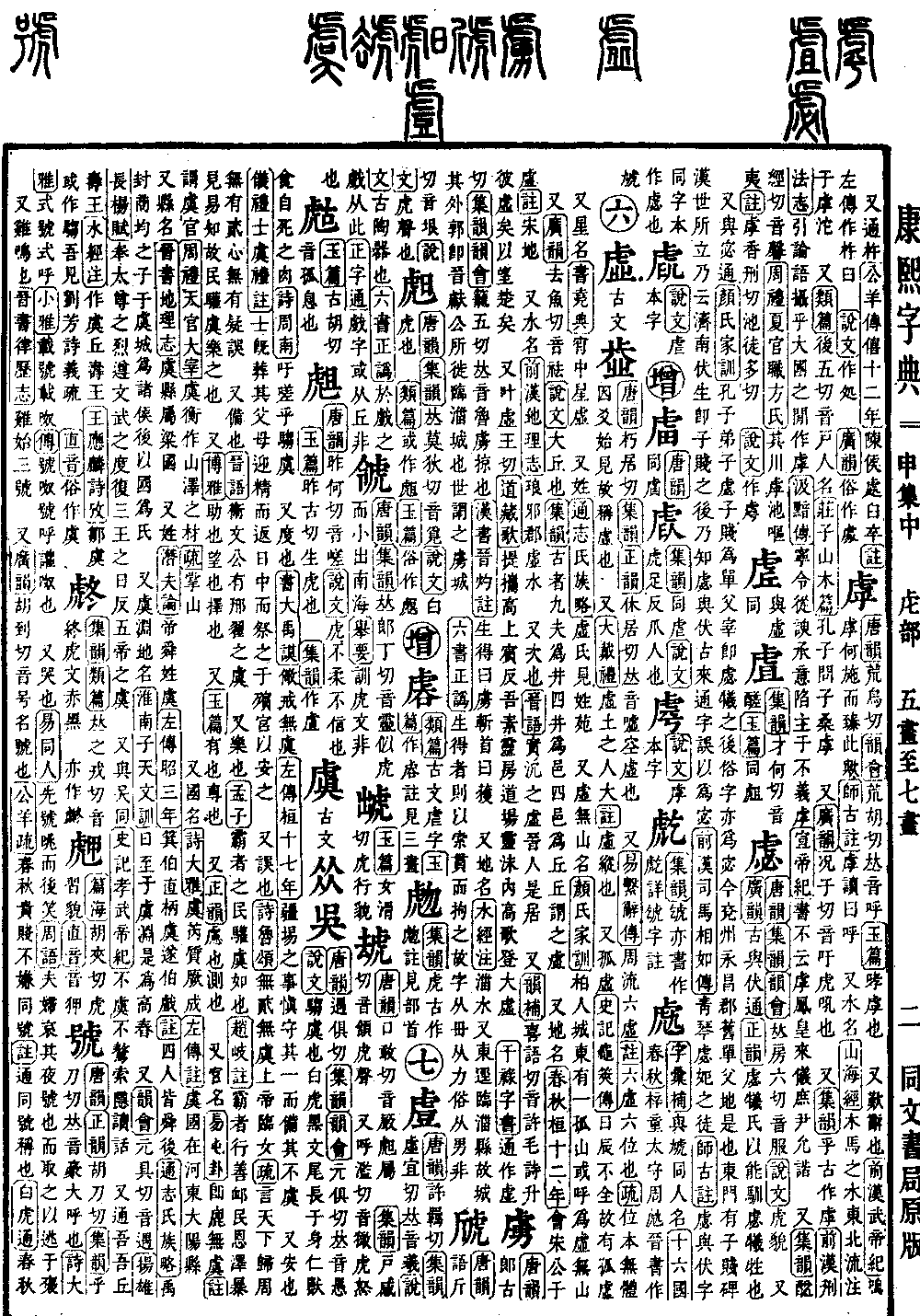
Radical: Tiger (hǔ)
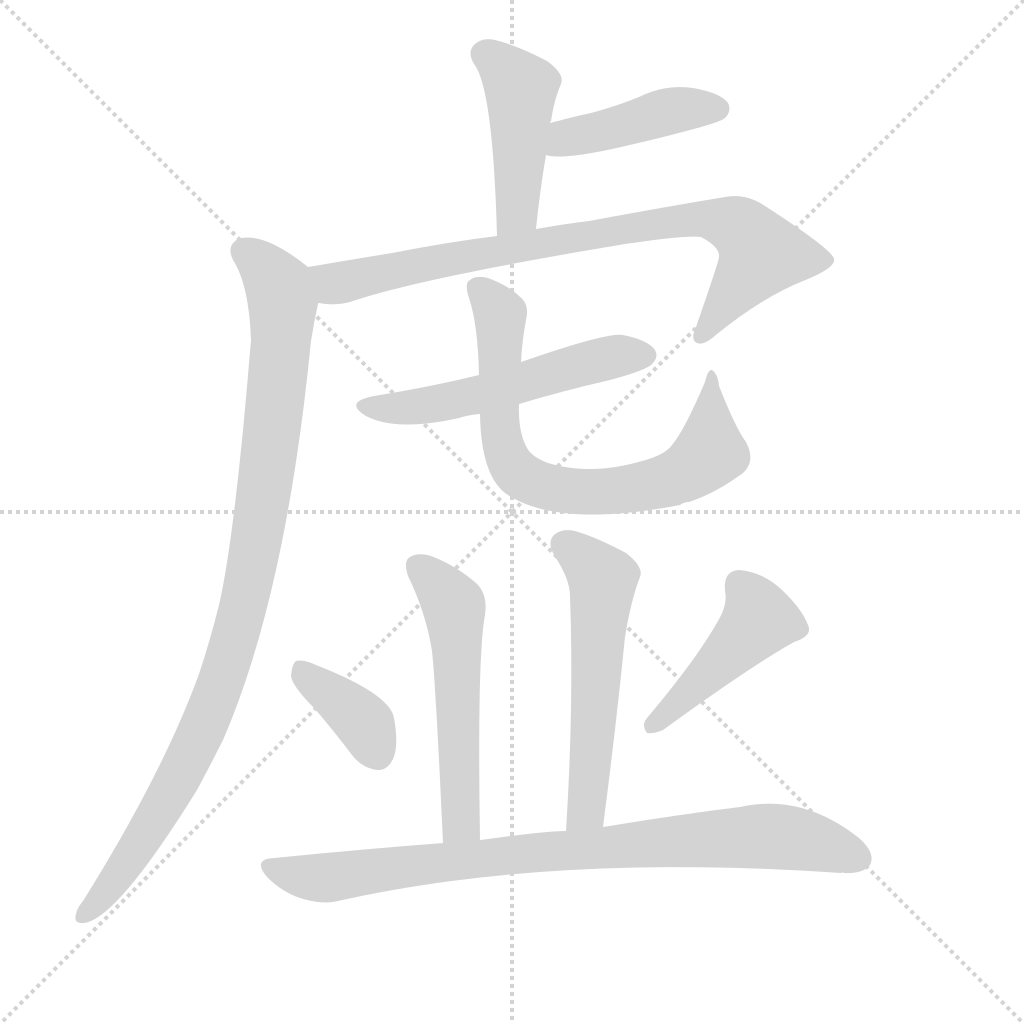
虛
Kangxi stroke count: 12
Page 1074, Entry 10
Ancient literature records: Pronounced xiu. Pronounced xiu. Pronounced xu. It means empty or void.
Also, Book of Changes (Yijing), Commentary on the Appended Phrases mentions the term flowing through the six voids. The commentary explains that the six voids are the six positions. The sub-commentary explains that the positions themselves lack substance and only manifest through the appearance of the lines, thus they are called void.
Also, Record of Rites by Dai the Elder (Da Dai Liji) records that the people of the void lands are large. The commentary defines void as indulgence.
There is also the term lone void. Records of the Grand Historian (Shiji), Treatise on Tortoise and Milfoil Divination records that because the days and hours are incomplete, there is the concept of the lone void.
It is also the name of a star constellation. Book of Documents (Shangshu), Canon of Yao records that the Void star is visible when the sky reaches its zenith at night.
It is also a surname. Comprehensive Treatise on Clans (Tongzhi Shizu Lue) records the Void clan. Found in the Garden of Surnames (Xingyuan).
There is also Void-Nothingness, which is the name of a mountain. Yan Family Instructions (Yan Shi Jiaxun) records that east of Bo'ren city there is an isolated mountain, which some call Void-Nothingness Mountain.
Also, in the Rhymed Dictionary (Guangyun), it is pronounced qu. Explaining Writing and Analysis of Characters (Shuowen Jiezi) defines it as a great mound. The Collected Rhymes (Jiyun) explains that in ancient times nine households made a jing, four jing made an yi, four yi made a qiu, and the qiu was referred to as a void.
It is also a place name. Spring and Autumn Annals (Chunqiu), 12th Year of Duke Huan of Lu records a meeting with the Duke of Song at the place called Xu. The commentary notes that Xu is a location in the State of Song.
It is also the name of a river. History of the Former Han (Qianhan Shu), Treatise on Geography records that there is a Void River in Langya Commandery.
It also indicates order. Discourses of the States (Guoyu), Discourses of Jin records the void of Shenchen, which is the land inhabited by the people of Jin.
Also, in the Rhyme Supplements (Yunbu), it is pronounced xu. The Book of Odes (Shijing) contains the line, Ascending that void, to look toward Chu.
Also, rhymed as wang. The Daoist Canon Songs (Daozang Ge) writes, Leading the high honored guests, returning to my primeval spirit chamber. Within the spiritual foam of the Daoist altar, singing loudly to ascend the Great Void.
The Manual of Standard Characters (Ganlu Zishu) records that this character is also written in a variant form.