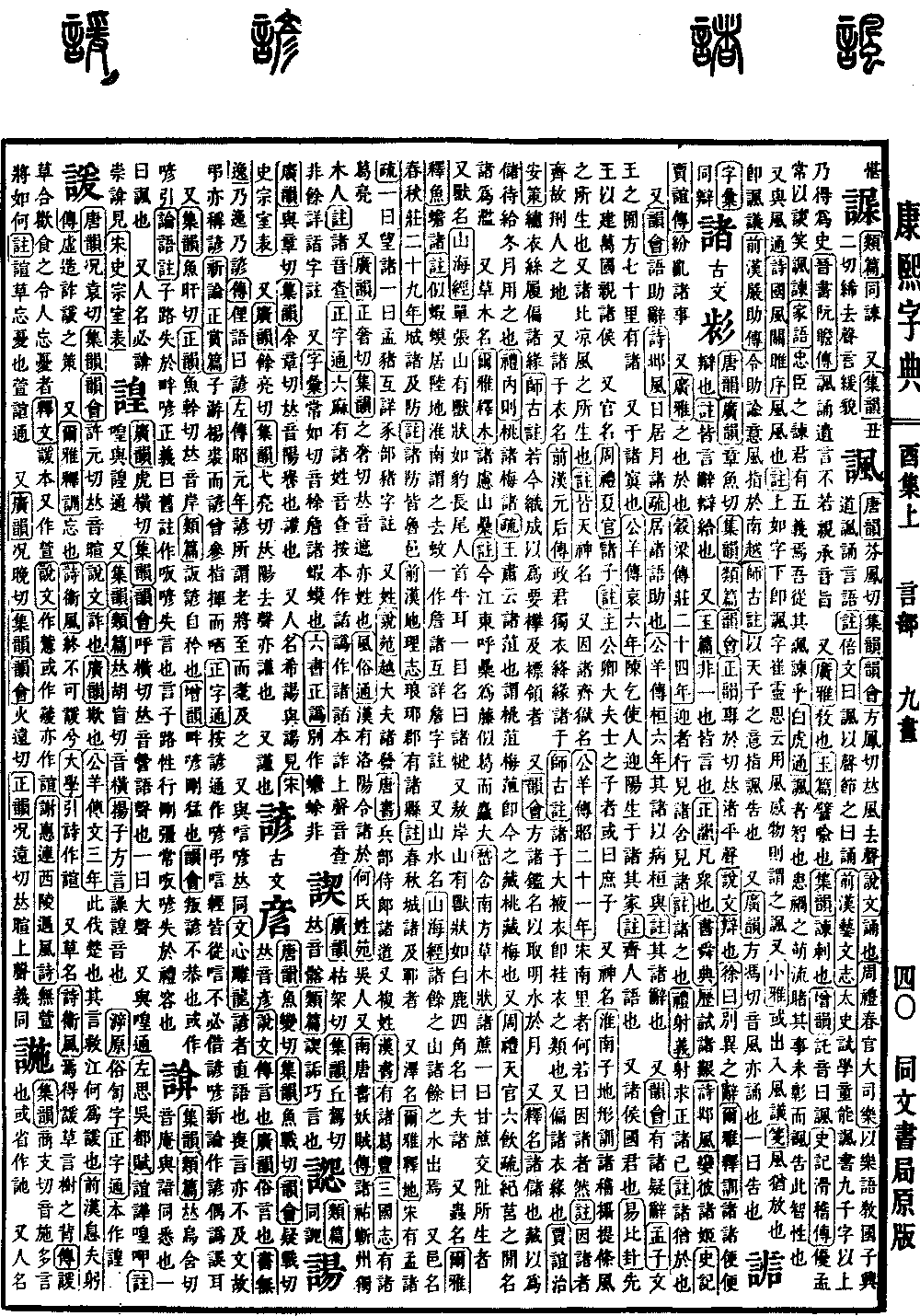
You Collection, Upper Volume
Radical: Speech (yán)
Kangxi stroke count: 16
Page 1172, Entry 01
Pronounced yan (falling tone).
According to the Explaining Graphs and Analyzing Characters (Shuowen Jiezi), it means to transmit words.
According to the Extensive Dictionary of Rhymes (Guangyun), it refers to common speech.
In the Book of Documents (Shangshu), section No Ease (Wuyi), it is written: Thus they indulge in ease, thus they use common speech.
The commentary states: Colloquial sayings are called proverbs.
In the Zuo Tradition (Zuo Zhuan), first year of Duke Zhao, it is written: As the proverb says, when an old general knows, he reaches the age of senility.
Also written interchangeably with the characters pronounced yan (falling tone) and yan (falling tone).
In the Literary Mind and the Carving of Dragons (Wenxin Diaolong), it states: A proverb is a direct statement. Words of mourning are also not concerned with literary style, so expressions of condolence are also called proverbs.
In the New Discourses (Xinlun), chapter on Correct Rewards, it mentions: Ziyou wore a lambskin garment and spoke bluntly, while Zeng Shen gestured and smiled.
According to the Correct Character Guide (Zhengzitong): I note that the character for proverb is commonly written as the variant pronounced yan (falling tone). In the classics, condolences are all written with the character pronounced yan (falling tone); there is no need to borrow the character for proverb. The instance in New Discourses where it is written as the character for proverb is a coincidental error.
Pronounced an (falling tone).
According to the Classified Dictionary (Leipian), it means self-pride.
According to the Expanded Rhymes (Zengyun), the term pan-an refers to being rigid and fierce.
According to the Collection of Rhymes (Yunhui), the term pan-an refers to being disrespectful. Sometimes written as the variant pronounced yan (falling tone).
Citing the Commentary on the Analects (Lunyu Zhu): Zilu was flawed by being rigid and fierce. The Correct Meaning states: The old commentary uses the variant pronounced yan (falling tone), meaning to lose one's words. It implies that Zilu's nature and conduct were rigid and strong, and he was often rigid and flawed in his ritual decorum.
Textual research: In the Zuo Tradition, first year of Duke Zhao, the text says: As the proverb says, when an old general is about to arrive, he reaches the age of senility. Based on the original text, I have corrected the character for know to the character for arrive.