You Collection, Upper Volume
Radical: Speech (yán)
Kangxi Strokes: 12
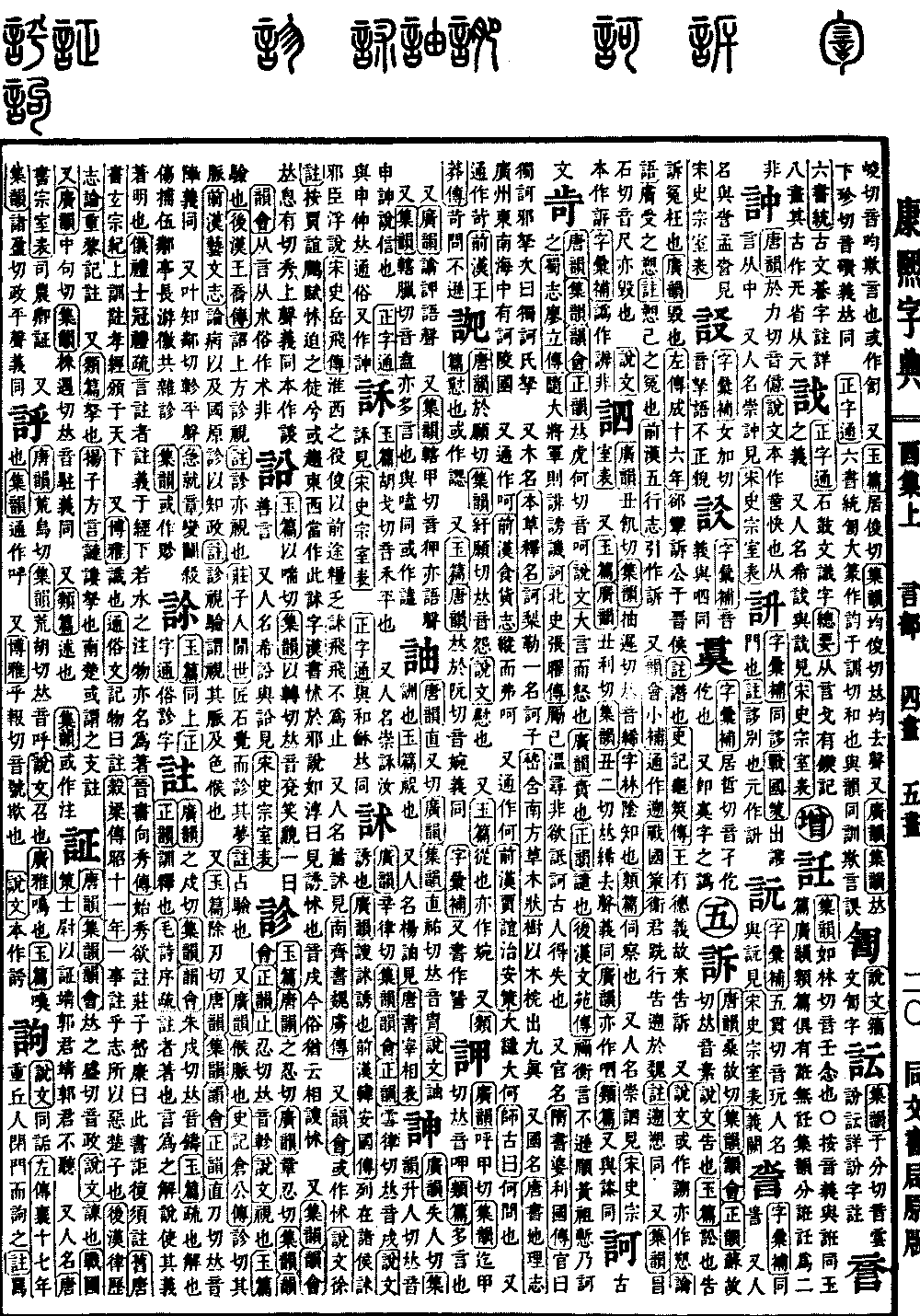
Page 1152, Entry 01
Jade Chapters (Yupian) and Tang Rhymes (Tangyun) state it is pronounced zhen (third tone). Extensive Rhymes (Guangyun) state it is pronounced zhen (third tone). Collected Rhymes (Jiyun), Rhyme Compilation (Yunhui), and Orthodox Rhymes (Zhengyun) state it is pronounced zhen (third tone). The pronunciation is the same as the character zhen (third tone).
Explaining Graphs and Analyzing Characters (Shuowen) states it means to look at or examine. Jade Chapters (Yupian) states it means to verify or validate. In the Biography of Wang Qiao in the History of the Later Han (Hou Hanshu), it is written that the Emperor commanded the imperial physician to examine the illness. The commentary states that zhen also means to observe. In the Human World chapter of the Zhuangzi, it states that the master craftsman Shi woke up and verified his dream. The commentary states this means to divine and verify.
Furthermore, Extensive Rhymes (Guangyun) states it refers to the pulse condition. In the Biography of Master Cang in the Records of the Grand Historian (Shiji), it states to press and examine the pulse. In the Treatise on Literature and Arts in the History of the Former Han (Qian Hanshu), it states that by discussing illnesses one can infer the state of the nation, and by probing diagnoses one can understand political affairs. The commentary states that zhen means to observe and verify, referring to the observation of pulse and complexion.
Additionally, Jade Chapters (Yupian) states it is pronounced zhen (fourth tone). Tang Rhymes (Tangyun), Collected Rhymes (Jiyun), Rhyme Compilation (Yunhui), and Orthodox Rhymes (Zhengyun) state it is pronounced zhen (fourth tone). The meaning is the same.
It is also used as a rhyming particle pronounced zhen (first tone), with a level tone, matching the level tone pronunciation of zhen. In the Quick Study of Characters (Jijiu Zhang), it states that for cases of fighting and wounding, arrest the members of the same squad and neighbors, and let the pavilion chief and the roving inspector together examine the case. Collected Rhymes (Jiyun) notes that it is sometimes written in a variant form.