Si Collection, Lower Volume
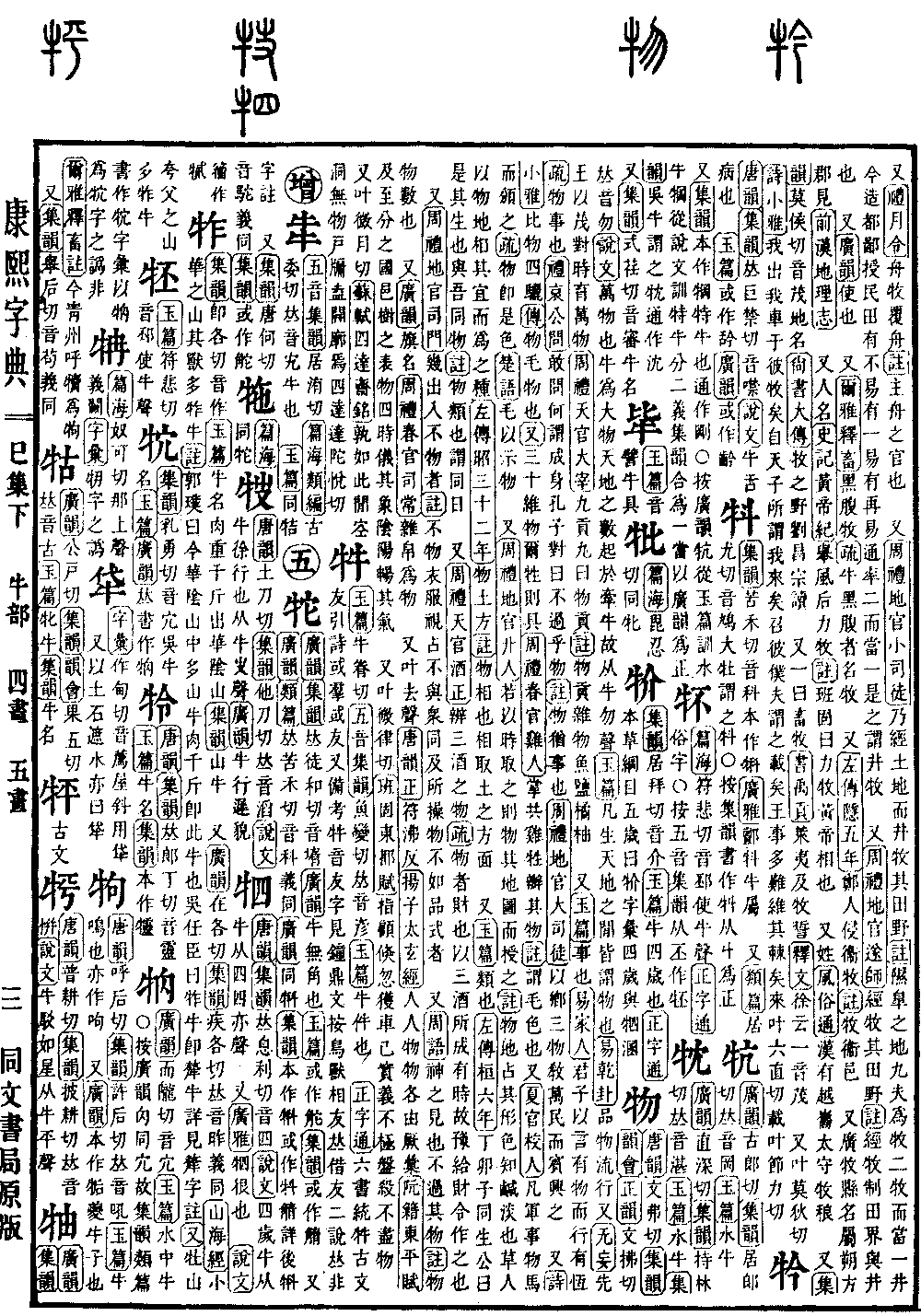
Radical: Cow (niú)
Page 699, Entry 09
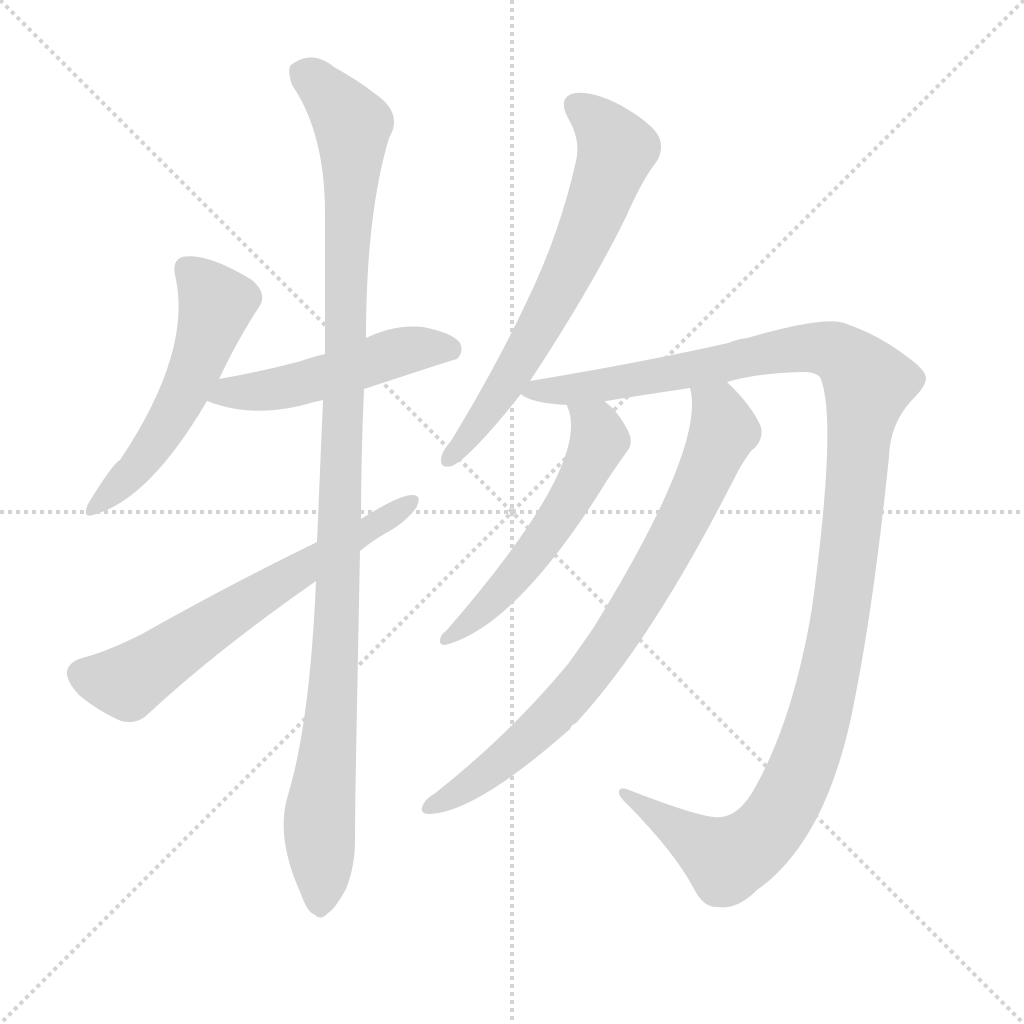
Pronounced wù.
According to the Explaining Graphs and Analyzing Characters (Shuowen jiezi), it refers to the myriad things. The cow is a great creature. The numbers of Heaven and Earth begin with the leading cow, thus it is derived from the cow, with wù providing the sound.
According to the Jade Chapters (Yupian), anything that grows between Heaven and Earth is called a thing.
Book of Changes (Yijing), Hexagram Qian: All types of things flow and take form.
Also, Hexagram Wuwang: The former kings used this great virtue to harmonize with the seasons and nourish all things.
Rites of Zhou (Zhouli), Office of Heaven, Grand Minister: The nine types of tribute; the ninth is the tribute of things. Commentary: The tribute of things refers to various miscellaneous goods, such as fish, salt, tangerines, and pomelos.
According to the Jade Chapters (Yupian), it also means matter or affair.
Book of Changes (Yijing), Hexagram Jiaren: The gentleman acts so that his words have facts and his conduct has constancy. Commentary: Things means affairs.
Book of Rites (Liji), The Questions of Duke Ai: May I ask what is meant by cultivating the self? Confucius replied: Do not exceed the duty of the thing. Commentary: Things is like saying affairs.
Rites of Zhou (Zhouli), Office of Earth, Grand Minister of Instruction: Educate the masses using the three subjects of village learning, and select and recommend them.
Book of Odes (Shijing), Lesser Odes: Matching the four black horses by their color. Commentary: Things refers to the color of the fur.
Also: Thirty animals of various colors, and your sacrificial victims will be complete.
Rites of Zhou (Zhouli), Office of Spring, Chicken Keeper: In charge of supplying chickens for sacrifices, distinguishing their colors. Commentary: This refers to the color of the fur.
Also, Office of Summer, Master of Horses: For all military actions, select horses of uniform color and distribute them. Commentary: Things means color.
Discourses of the States (Guoyu): Use the color of the fur to display the categories of things.
Rites of Zhou (Zhouli), Office of Earth, Miner: If mining is done according to the season, one must observe the land and draw maps to hand over to the miners. Commentary: To observe the land (wù dì) is to observe its shape and color to know its salinity.
The Grass Official: Based on the condition of the land, observe its suitability and decide which crops to plant.
Zuo Tradition (Zuozhuan), 32nd Year of Duke Zhao: Measuring the direction of the land. Commentary: Things means to observe, to observe and select the direction of the land.
According to the Jade Chapters (Yupian), it also means category.
Zuo Tradition (Zuozhuan), 6th Year of Duke Huan: On the day dingmao, Zhitong was born. Duke Huan said: The birth of this child is of the same category (wù) as me. Commentary: Things means category; it refers to being born on the same day.
Rites of Zhou (Zhouli), Office of Heaven, Wine Administrator: Distinguish the categories of the three types of wine. Commentary: Things refers to the materials. Because the brewing of the three wines requires time, the materials are supplied in advance for people to produce them.
Rites of Zhou (Zhouli), Office of Earth, Gate Keeper: Inspect those entering and leaving who are irregular in person or thing. Commentary: Not of the thing refers to clothing and appearance differing from the masses, or carrying items that do not conform to standards.
Discourses of the States (Guoyu), Discourses of Zhou: When spirits manifest, they do not exceed the count of that thing. Commentary: Things refers to the number of things.
According to the Extensive Dictionary of Characters (Guangyun), it is a name for a flag.
Rites of Zhou (Zhouli), Office of Spring, Master of Standards: A flag made of multicolored silk is called a thing.
Also pronounced in the departing tone.
Correction of the Tang Rhymes (Tangyun zheng): Pronounced fú.
Yang Xiong, Great Mystery (Taixuan jing): Men, things, and affairs, each follows its own category.
Ruan Ji, Rhapsody on Dongping (Dongping fu): When the kingdoms were divided and banners erected, the four seasons displayed their scenes, and the yin and yang circulated their breath.
Also pronounced wéi.
Ban Gu, Rhapsody on the Eastern Capital (Dongdu fu): Within the span of a finger's movement or a glance, the hunting vehicles are already full. Joy does not reach the extreme of extravagant touring, and the slaughter does not exhaust all living things.
Also pronounced yuè.
Su Shi, Inscription for the Four Directions Study (Sida zhai ming): How could it be like here, empty and without things? Why not open the doors and windows, expansive and accessible in all directions.