Si Collection, Lower Volume
Radical: Dog (quǎn)
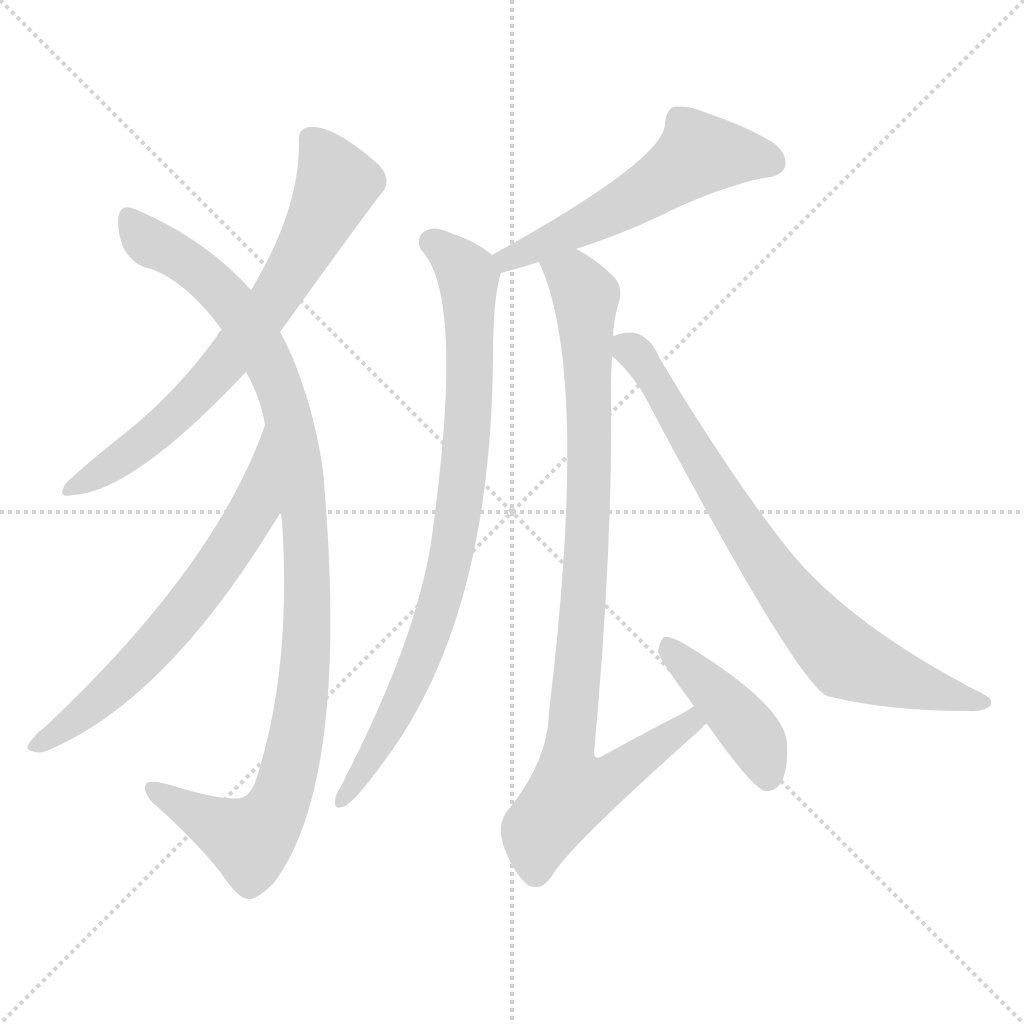
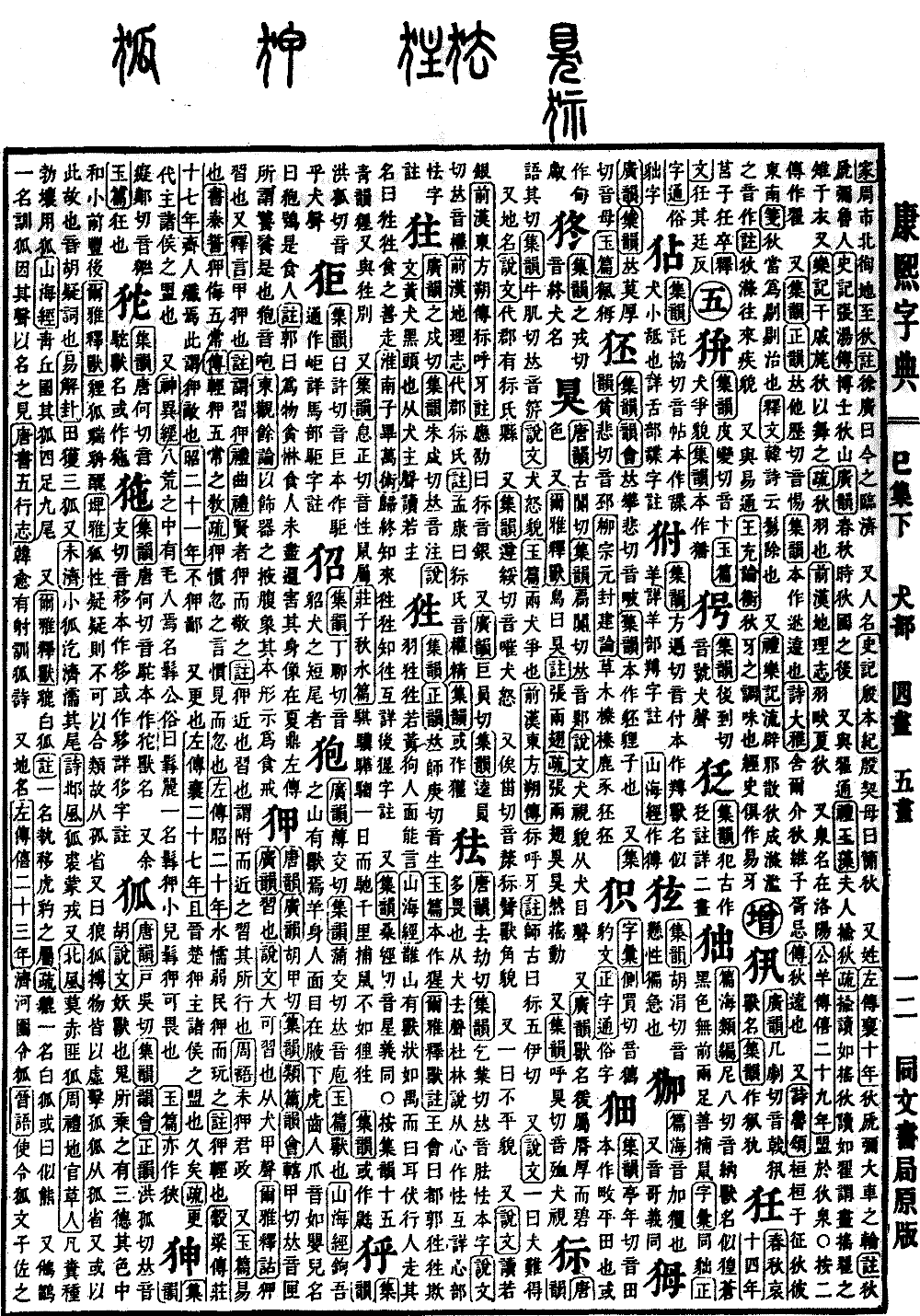
狐
Kangxi Stroke Count: 9
Page 708, Entry 29
Pronounced hu.
Shuowen Jiezi (Shuowen): A demonic beast, ridden by ghosts. It possesses three virtues, its color is harmonious, small at the front and large at the rear.
Erya: Explanation of Beasts (Erya Shishou): The raccoon dog, fox, badger, and tanuki are of the same class.
Piya: The fox is by nature suspicious; being suspicious, it cannot align with its own kind, thus the character is derived from the simplified form of lonely (gu). Another theory: Wolves and foxes hunt by attacking the isolated, thus it is derived from the simplified form of lonely. Perhaps for this reason, the sound is hu, which is a word denoting doubt.
Book of Changes (Yijing), Xie hexagram: Hunting, three foxes were caught.
Also, in the Weiji hexagram: The small fox is about to cross, yet wets its tail.
Book of Odes (Shijing), Beifeng: Fox furs worn in wild disorder.
Also, in Beifeng: None that is not a red fox.
Rites of Zhou (Zhouli), Earth Officer, Grass Official: All fertilizers for seeds in loose soil use fox.
Classic of Mountains and Seas (Shanhaijing): The Country of Green Hills, its foxes have four legs and nine tails.
Also, Erya: Explanation of Beasts: The piji is a white fox. Commentary: Another name is zhiyi, belonging to the tiger and leopard family. Sub-commentary: The piji is also called a white fox. Some say it resembles a bear.
Also, the scops owl is also called the xunhu. It is named after its cry. See History of Tang (Tangshu), Treatise on the Five Elements. Han Yu wrote a poem about shooting a xunhu.
Also, a place name. Zuo Tradition (Zuo Zhuan), 23rd Year of Duke Xi: Crossed the river and besieged Linghu. Discourses of Jin (Jinyu): Sent Linghu Wenze to assist him. Commentary: Linghu is the name of a town.
Also, Records of the Grand Historian (Shiji), House of Zhao: Qin attacked us, reaching Yanghu.
Also, Annals of Emperor Xiaowen: The army reached Feihu. Commentary: Ru Chun stated: It is in Dai Commandery. Su Lin stated: It is in Shangdang.
Also, a surname. Guangyun: In the State of Jin there was the Hu clan, who served generation after generation as ministers. Discourses of Jin (Jinyu): The Hu clan descended from Tang Shu.
Also, Linghu, a double-character surname.