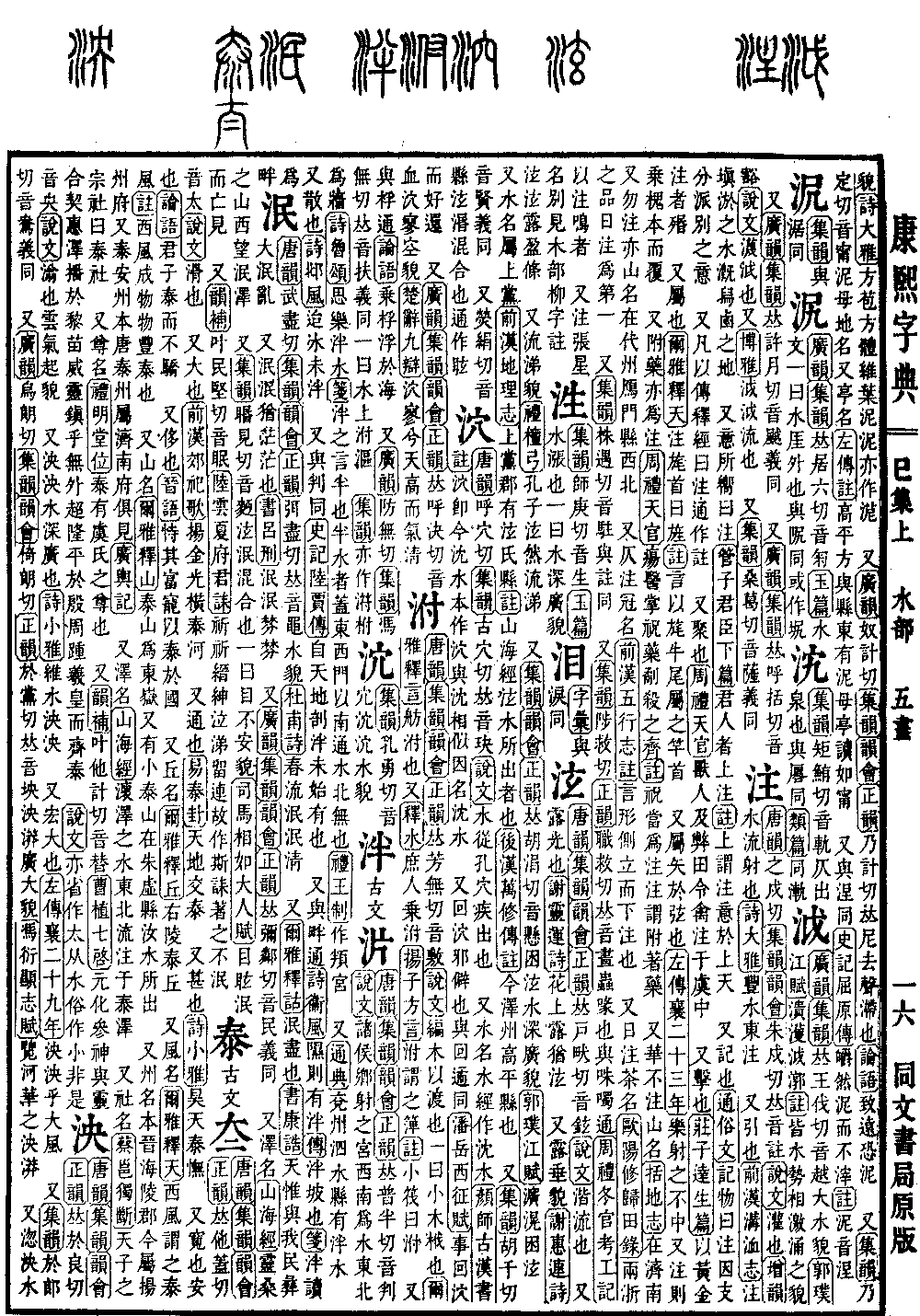
Si Collection, Upper Volume
Radical: Water (shuǐ)
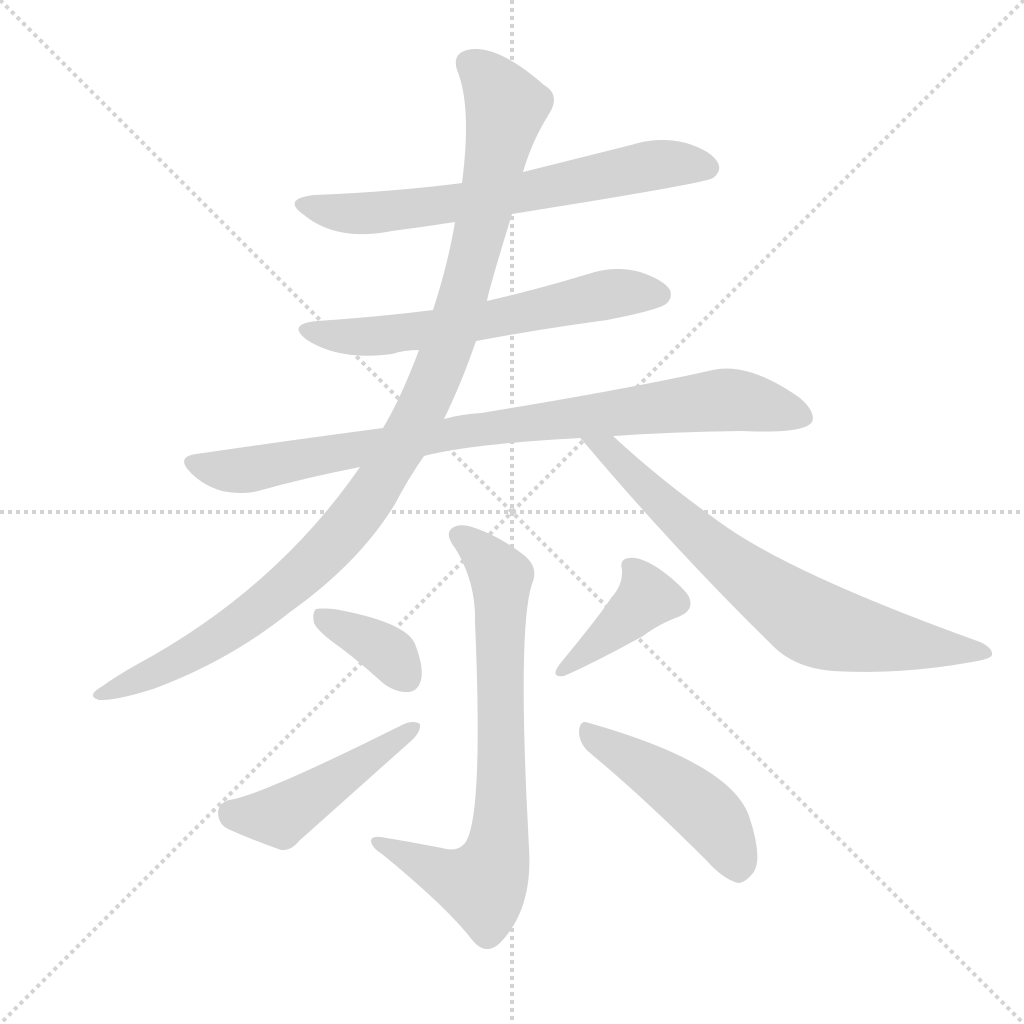
Tai
Kangxi strokes: 9
Page 618, Entry 15
Ancient form: Tai
Tang Rhyme (Tangyun), Collection Rhyme (Jiyun), Rhyme Meetings (Yunhui), Correct Rhymes (Zhengyun): Pronounced tai.
Explaining Graphs and Analyzing Characters (Shuowen): Slippery. Also signifies vast and expansive.
Former Han (Qianhan), Songs of Suburban Sacrifices (Jiaosige): Raising up golden light, traversing across the great river.
Also means to penetrate or reach. Book of Changes (Yijing), Tai Hexagram: Heaven and earth interact and join, all things are fully developed and at peace.
Also indicates extreme intensity. Book of Odes (Shijing), Lesser Odes (Xiaoya): The upper heavens are excessively negligent.
Also refers to abundance or peace. Analects (Lunyu): The superior man is composed and at ease, without being arrogant.
Also refers to extravagance. Discourses of the States (Jinyu): Relying on wealth and favor to live extravagantly within the state.
Also refers to a mountain hill. Literary Expositor (Erya), Explaining Hills (Shiqiu): The mountain mound on the right is called Tai Hill.
Also refers to a wind. Literary Expositor (Erya), Explaining Heaven (Shitian): The western wind is called the Tai wind. Annotation: The western wind causes crops to ripen, and products to become abundant and peaceful.
Also refers to a mountain. Literary Expositor (Erya), Explaining Mountains (Shishan): Mount Tai is the Eastern Peak. There is also a Lesser Mount Tai located in Zhuxu County, which is the source of the Wen River.
Also refers to a prefecture. Originally Hai Ling Commandery during the Jin Dynasty, now it belongs to Yangzhou Prefecture. There is also Tai'an Prefecture, originally Tai Prefecture of the Tang Dynasty, belonging to Jinan Prefecture. Both are recorded in the Records of the Broadened World (Guangyuji).
Also refers to a lake. Classic of Mountains and Seas (Shanhaijing): The water from Huai Marsh flows northeast and enters Tai Marsh.
Also refers to a sacrificial altar. Cai Yong, Sole Determinations (Duduan): The ancestral temple and altars of the Son of Heaven are called the Tai altars.
Also refers to a wine vessel. Book of Rites (Liji), Hall of Distinction (Mingtangwei): Tai is a wine vessel of the Yu clan.
Rhyme Supplements (Yunbu): Rhymes with ti. Cao Zhi, Seven Inspirations (Qiqi): Creation and transformation are mysterious, in accord with spiritual nature. Favors are bestowed upon the common people, and divine power guards the boundless lands. Surpassing the peaceful eras of the Shang and Zhou, following Fuxi to reach the same level of peace.
Explaining Graphs and Analyzing Characters (Shuowen): Also simply written as tai. Radical: Water. The common version written with an additional stroke is incorrect.
Textual Research: There is a Lesser Mount Tai in Zhuxu County, where the Wen River originates. Note: The previous annotation for the Wen character cited the Commentary on the Classic of Water (Shuijing) stating the Wen River originates from Tai Mountain in Zhuxu County. Li Daoyuan's annotation states the Wen River originates from Wushan Mountain, east of the county, and the mountain is east of Lesser Mount Tai. Based on this, the character ru has been corrected to the character wen.