Wu Collection, Lower Volume
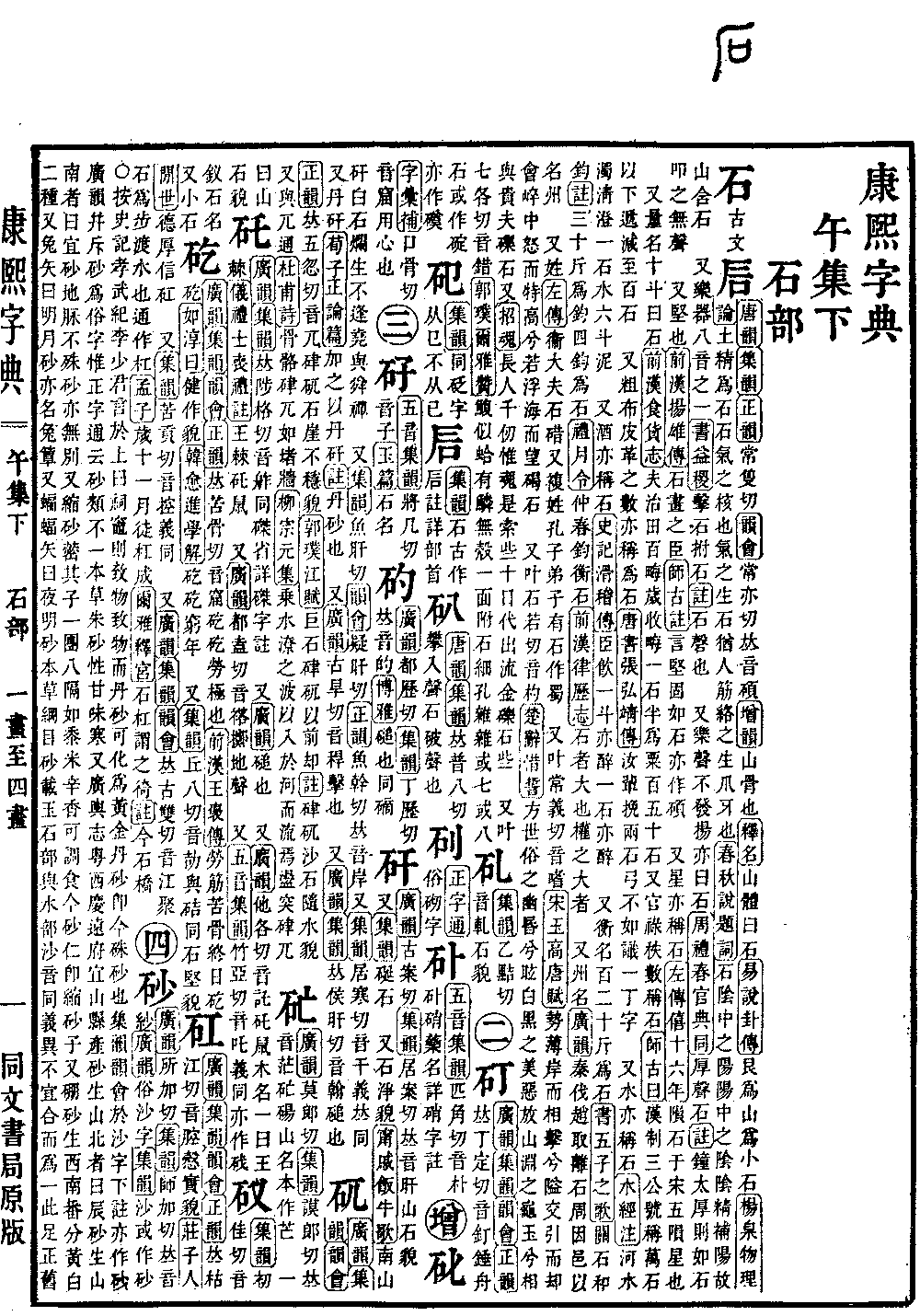
Radical: Stone (shí)
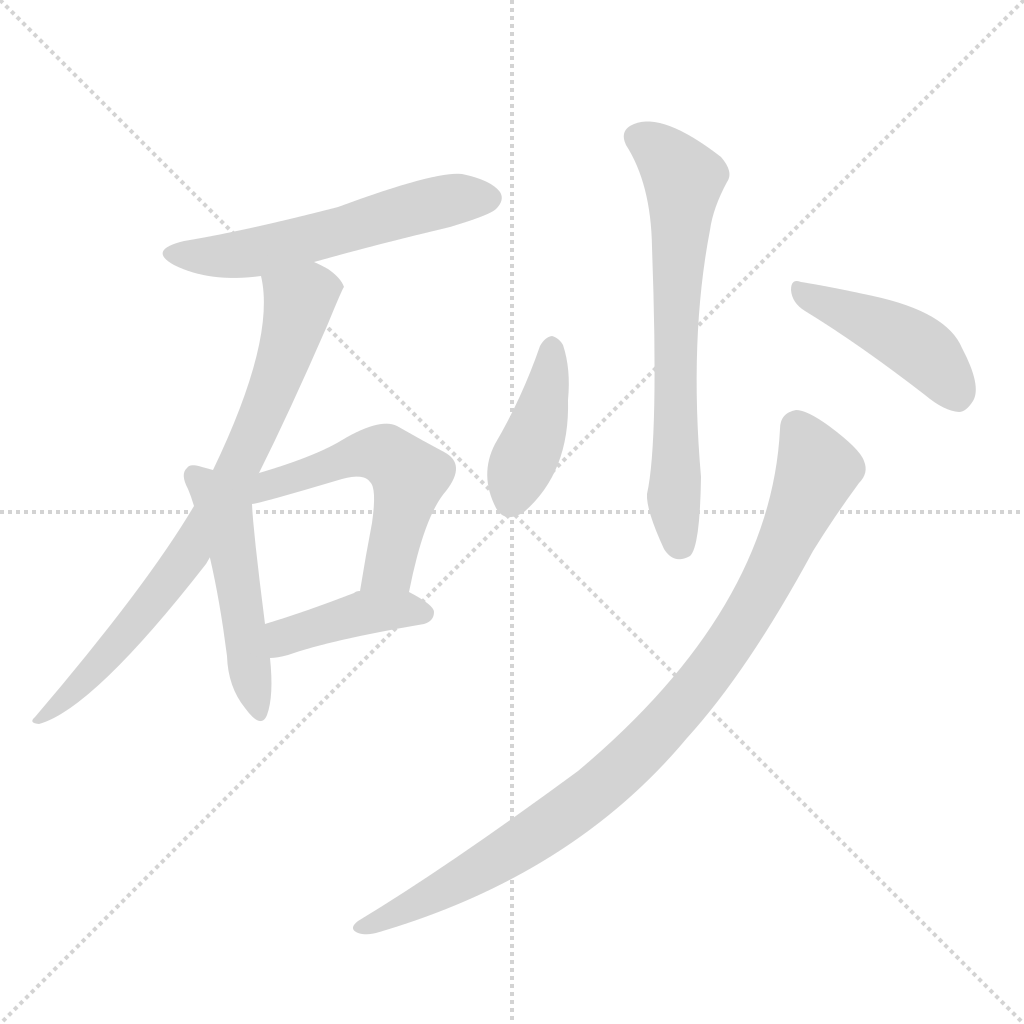
Sha
Kangxi Stroke Count: 9
Page 827, Entry 20
Pronounced sha.
According to the Broad Rhymes (Guangyun), this is a common variant of the character for sand. According to the Collection of Rhymes (Jiyun), it is sometimes written as sha.
Note: The Records of the Grand Historian (Shiji), Biography of Emperor Wu, states that Li Shaojun told the Emperor that a stove could summon divine objects, and once summoned, cinnabar could be refined into gold. Cinnabar is modern-day vermilion. The Collection of Rhymes (Jiyun) and the Collection of Rhymes and Pronunciations (Yunhui) note under the entry for sand that it is also written as sha, while the Broad Rhymes (Guangyun) explicitly labels sha as a common, non-standard form. Only the Compilation of Standard Characters (Zhengzitong) states that there is more than one type of sha. The Compendium of Materia Medica (Bencao) records that cinnabar has a sweet taste and cold nature.
Furthermore, the Record of Broad Geography (Guangyuzhi) states that in Yishan County, Qingyuan Prefecture in Western Guangdong, sha is produced; that produced on the north side of the mountain is called chensha, and that on the south side is called yisha, though the earth veins do not differ and the sha is fundamentally the same.
Also, suosha-mi; its fruit has eight compartments like millet, is pungent and fragrant, and can be used as a seasoning. Modern-day sharen refers to the seeds of this plant.
Also, borax, produced in the southwestern foreign territories, comes in yellow and white varieties.
Also, rabbit excrement is called mingyuesha, also known as rudian.
Also, bat excrement is called yemingsha. The Compendium of Materia Medica (Bencao Gangmu) lists sha under the jade and stone category, noting that although it shares the same pronunciation as the character for sand in the water category, their meanings differ and they should not be conflated, which is sufficient to correct errors in older accounts.
Also pronounced suo.
A poem by Bai Juyi: Their youthful beauty has not yet faded, but their love and affection have suddenly faltered. How could the jade upon the palm be transformed into sand within the eyes?