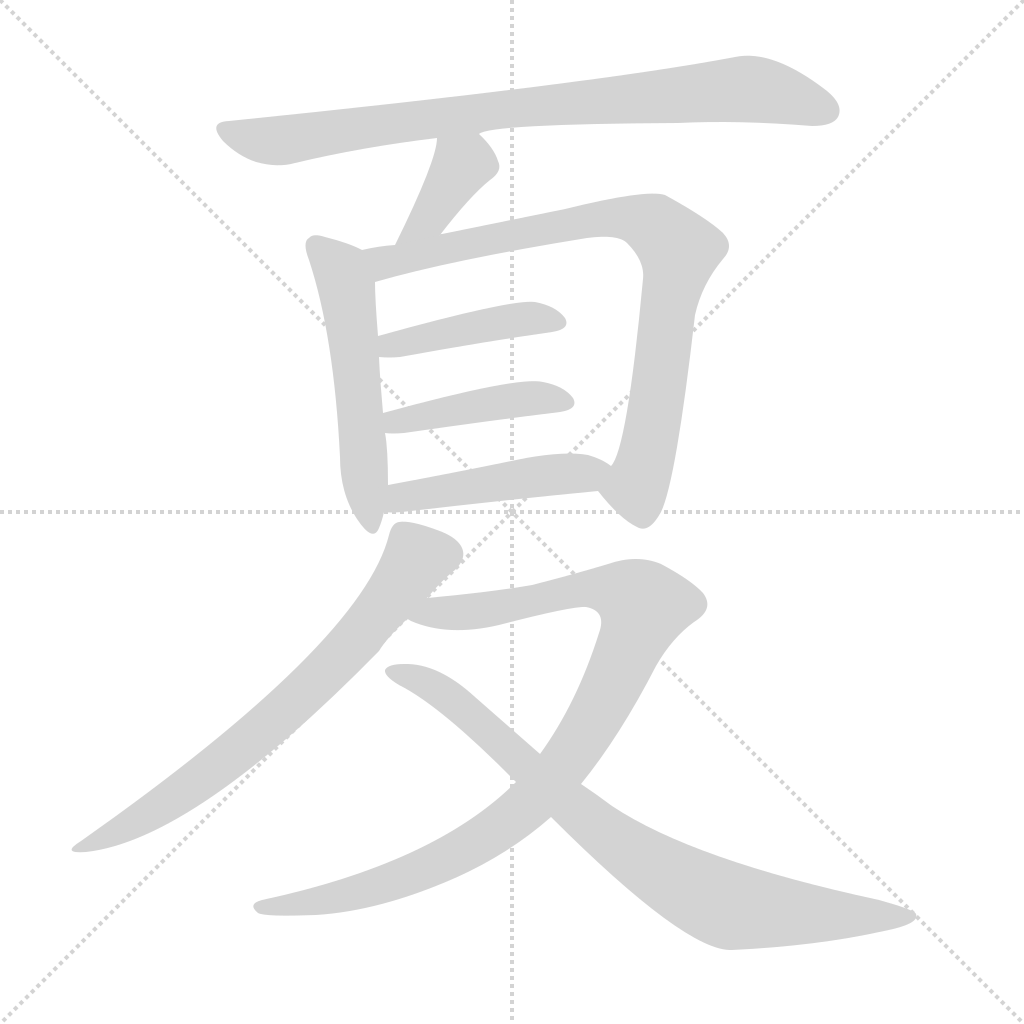
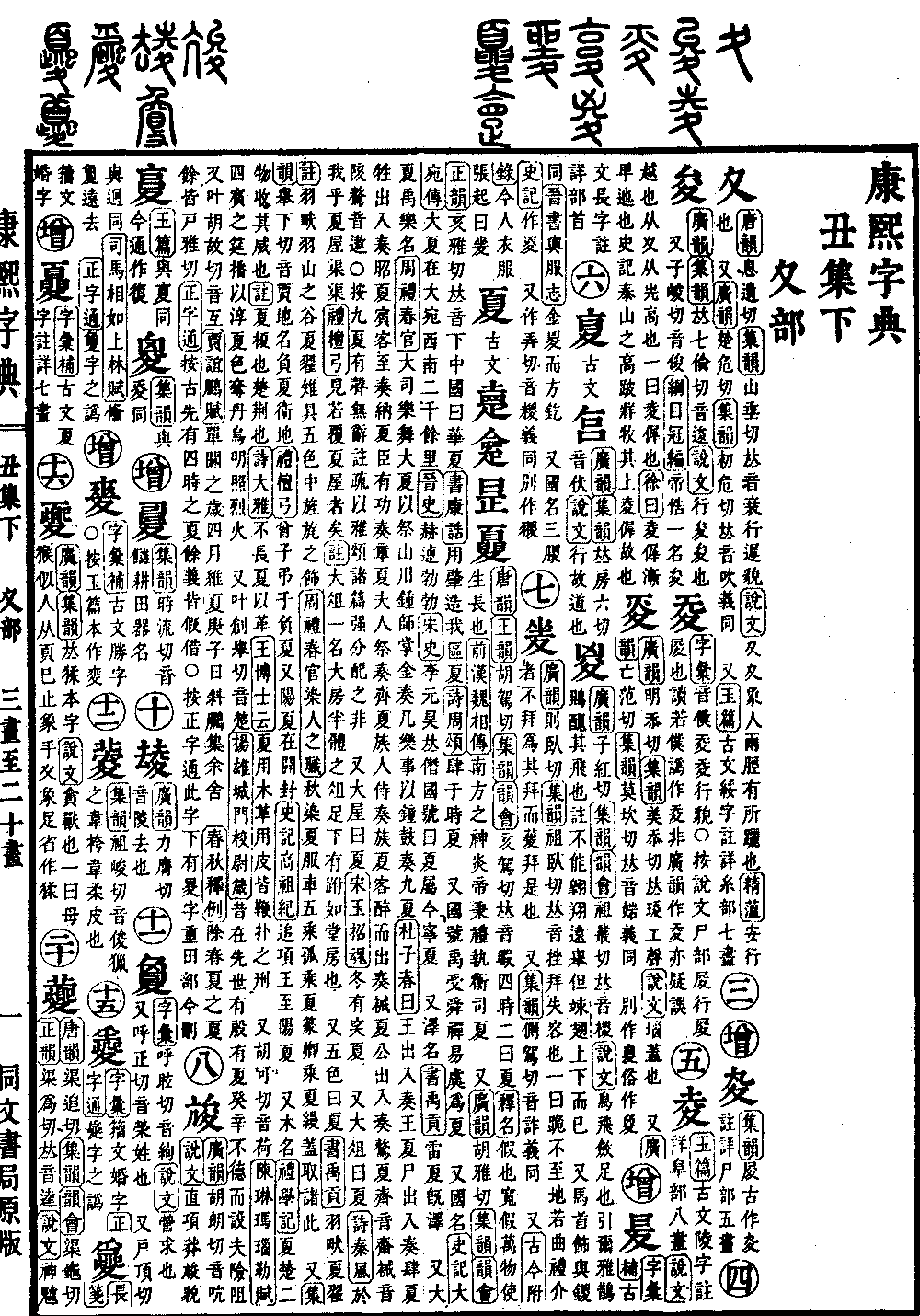
Chou Collection, Lower Volume
Radical: Slow walk (suī)
Kangxi Strokes: 10
Page 245, Entry 12
Ancient form written as (shi). Pronounced jia. Pronounced jia. Pronounced xia. The second of the four seasons is called summer. Interpretation of Scriptures (Shiming) explains it as假 (jia), meaning to provide leeway for all things to grow. History of the Former Han (Qian Hanshu), Biography of Wei Xiang, records that the southern deity is the Flame Emperor (Yandi), who oversees etiquette, manages balances, and governs summer.
Also, pronounced ya. Pronounced ya. Pronounced ya. Pronounced ya. Pronounced xia. China is known as Huaxia. Book of Documents (Shangshu), Kanggao chapter, records: used to initiate our Huaxia region. Book of Odes (Shijing), Zhou Song, records: thus it flourished in this Huaxia.
Also, a dynastic title. Great Yu accepted the abdication of Shun and changed the name of his realm from Yu to Xia.
Also, a state name. Records of the Grand Historian (Shiji), Biography of Dayuan, records: the State of Daxia, located over two thousand li southwest of Dayuan. History of Jin (Jinshi) records Helian Bobo. History of Song (Songshi) records Li Yuanhao, who exceeded his status to establish a state called Xia, located in present-day Ningxia.
Also, the name of a marsh. Book of Documents (Shangshu), Tribute of Yu (Yugong), records: Leixia has already formed into a marsh.
Also, Daxia, the name of a dance from the time of Great Yu. Rites of Zhou (Zhouli), Spring Officials, records: the Grand Director of Music oversees the Daxia dance, used for sacrificing to mountains and rivers. The Bell Master manages the playing of metal instruments, and for all musical occasions, uses bells and drums to perform the Nine Xias. The commentary of Du Zichun says: performed as Wangxia when the King exits or enters, performed as Sixia when the impersonator of the deceased (shi) enters or exits for sacrifices, performed as Zhaoxia when sacrificial animals enter or exit, performed as Naxia when guests arrive, performed as Zhangxia when officials have merits, performed as Qixia when the Queen conducts sacrifices, performed as Zuxia when clan members serve, performed as Gaixia when guests finish drinking and depart, performed as Aoxia when Dukes and Marquises enter or exit. Qi is pronounced like zhai. Gai is pronounced like gai. Ao is pronounced like ao. Note: The Nine Xias are instrumental pieces without lyrics; the commentaries that force the assignment of chapters from the Classic of Poetry (Shijing) are incorrect.
Also refers to a large house. Song Yu, Summoning of the Soul (Zhaohun), records: in winter there are deep, large houses.
Also refers to a large sacrificial stand (zu). Book of Odes (Shijing), Qin Feng, records: for me, the large sacrificial vessel is very tall. Book of Rites (Liji), Tangong, records: seeing something like a large house covering it. The commentary explains: a large sacrificial stand, also called a large room, is a vessel for holding half a carcass, with a base beneath its feet, resembling a hall or side chamber.
Also, five-colored are called Xia. Book of Documents (Shangshu), Tribute of Yu (Yugong), records: the valleys of Yushan have Xiazhai. Commentary: Yujian refers to the valleys of Yushan. Xiazhai refers to pheasant feathers with five colors, used for the decoration of banners. Rites of Zhou (Zhouli), Spring Officials, Duties of the Carriage Master, records: autumn and summer. There are five grades of carriages used; the Lone (official title) rides in a carriage with five-colored carvings, and the Minister rides in a carriage with five-colored patterns; this is likely the origin of the term.
Also, pronounced jia. A place name. Fuxia, a place in the State of Wei. Book of Rites (Liji), Tangong, records: Zengzi traveled to Fuxia to offer condolences. There is also Yangxia, located in Kaifeng. Records of the Grand Historian (Shiji), Annals of Gaozu, records: pursued King Xiang to Yangxia.
Also, a tree name. Book of Rites (Liji), Record on Education (Xueji), records: Xia and Chu are two things used to cultivate students' decorum. Commentary: Xia refers to the jia tree (a type of catalpa). Chu refers to the chaste tree (vitex). Book of Odes (Shijing), Daya, records: do not grow the jia tree but use leather (for punishment instruments). Master Wang says: Xia is wood, leather is hide; both are instruments of whipping.
Also, pronounced he. Chen Lin, Rhapsody on the Agate Le (Manaole fu), records: the banquets of guests from all directions use the rich Xia music to spread. Its color surpasses that of the red crow, bright and shining like a raging fire.
Also, pronounced chu. Yang Xiong, Admonition to the Gate Captain (Chengmen xiaowei zhen), records: in the past, in previous dynasties, there was the Yin dynasty and the Xia dynasty. Gui and Xin (referring to the tyrants Jie of Xia and Zhou of Shang) lacked virtue, yet they established those strategic passes.
Also, pronounced hu. Jia Yi, Rhapsody on the Owl (Fuiniao fu), records: in the year of Dan'e, the fourth month was summer. On the Gengzi day the sun slanted, and the owl gathered at my dwelling.
Spring and Autumn Interpretations (Chunqiu shili) states: except for the Xia in "spring and summer," all others are pronounced ya.
Correcting Orthography (Zhengzitong) notes: in ancient times, there was first the Xia representing the four seasons; all other meanings are borrowings.
Note: The Correcting Orthography includes a character under this one that repeats the field radical, which has now been deleted.