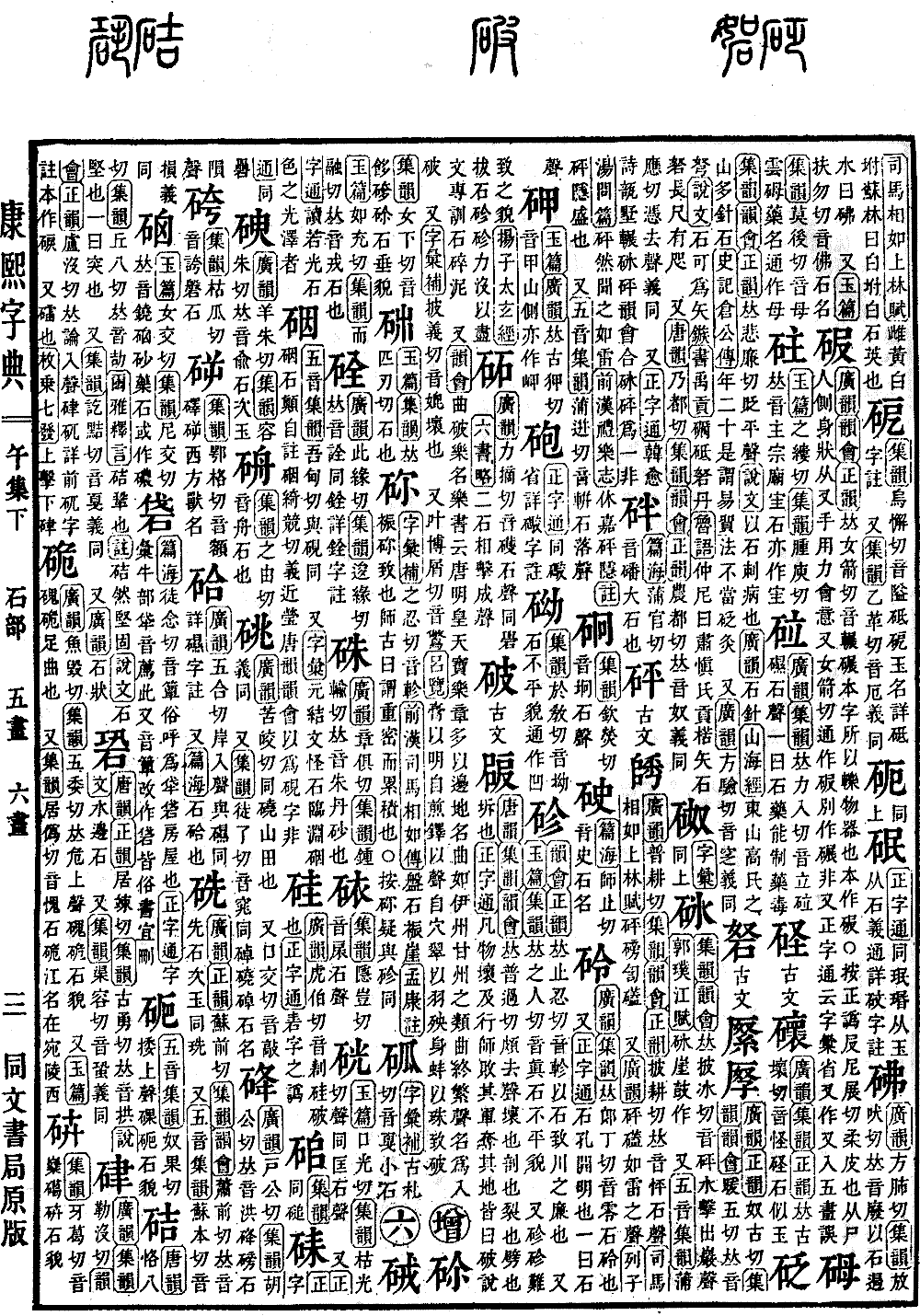
Wu Collection, Lower Volume
Radical: Stone (shí)
Character: Break
Kangxi Stroke Count: 10
Page 829, Entry 28
Ancient text. Pronounced po (falling tone). To ruin, to split, to crack, to cleave, to burst. According to the Correct Meaning Dictionary (Zhengzitong), any damage to an object, or the defeat of an enemy in battle to seize territory, is called breaking. The Explanation of Simple and Compound Characters (Shuowen Jiezi) interprets this strictly as stone shattering, but this interpretation is too rigid. Also, according to the Rhyme Compendium (Yunhui), qupo is a type of musical composition. The Records of Music (Yueshu) states: During the Tianbao era of Emperor Xuanzong of Tang, musical movements were often named after border regions, such as Yizhou or Ganzhou. The complex tonal structure at the conclusion of such musical pieces is called rupo. Also, according to the Supplement to the Collection of Characters (Zihuibu), pronounced pi (falling tone), meaning to destroy. Also, pronounced bie (entering tone). In the Annals of Master Lu (Lülan): Animal fat consumes itself because it can provide light; bells cause themselves to be drilled because they can produce sound; the kingfisher invites disaster because of its feathers; the mussel is split open because of its pearls.