Shen Collection, Upper Volume
Radical: Grass (cǎo)
Kangxi Strokes: 23
Page 1070
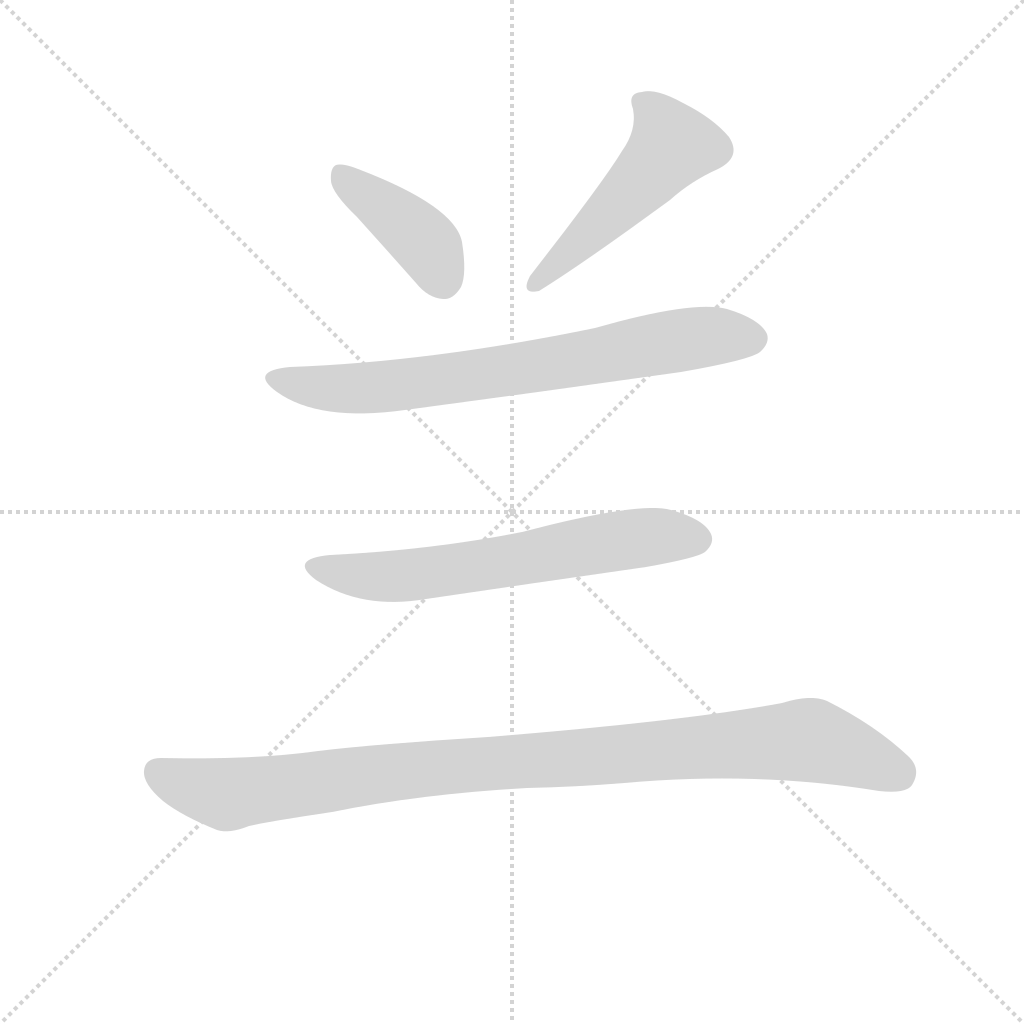
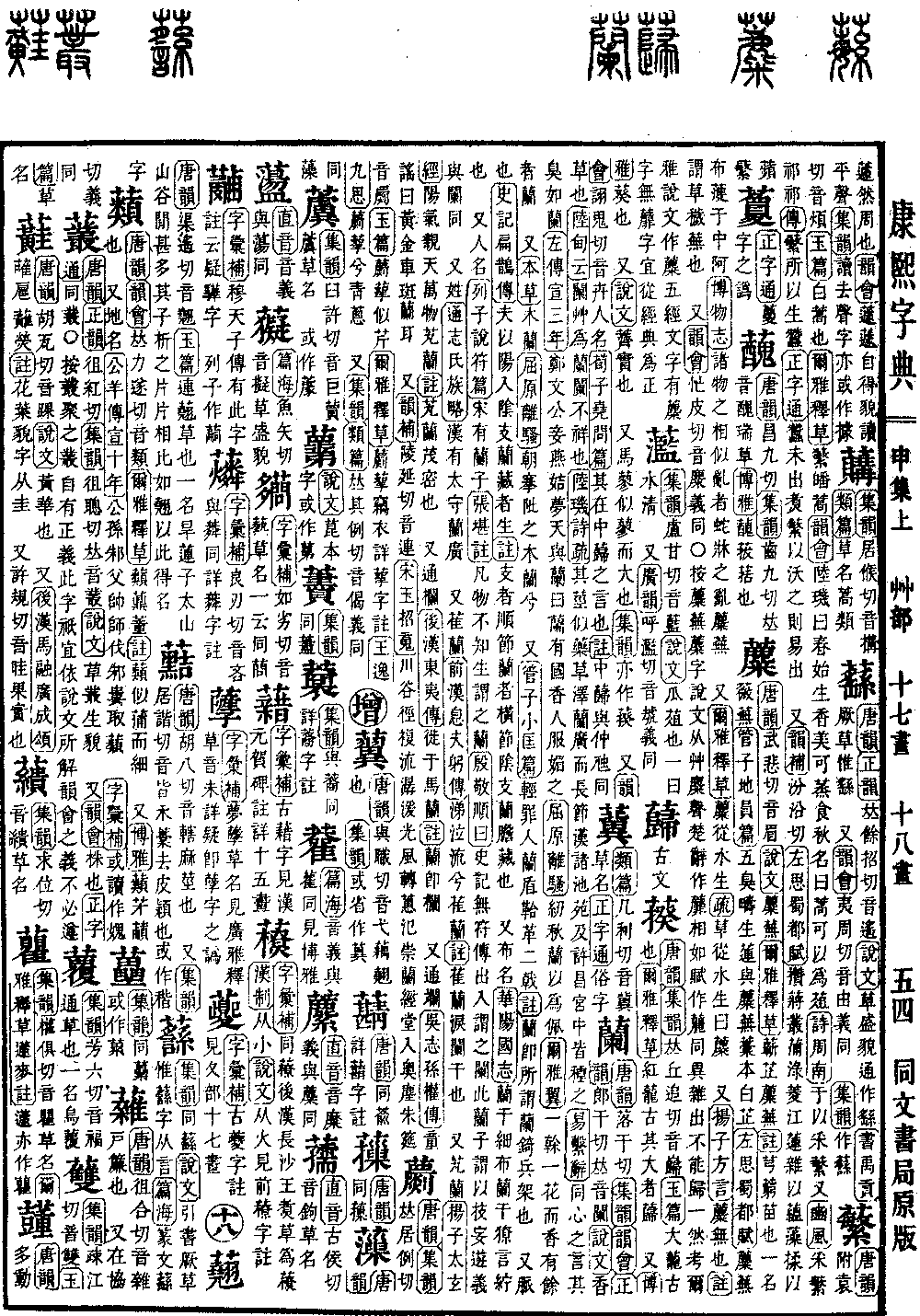
According to Tang Rhymes, the pronunciation is luò gān qiè. According to Jiyun, Yunhui, and Zhengyn, the pronunciation is láng gān qiè, sounding like lán.
Shuowen: A fragrant herb.
Lu Dian said: "Lán" grass refers to lán, and lán signifies inauspiciousness.
Lu Ji's Commentary on the Book of Odes: Its stem resembles the medicinal herb zélán (boneset), broad with long joints. It was cultivated in various ponds and gardens of the Han dynasty and in the Xu-chang palace.
Book of Changes (Yijing), Xi Ci: Words from a united heart, their fragrance is like orchid.
Zuo Commentary (Zuozhuan), Duke Xuan, Third Year: Zheng Wengong's concubine Yan Ji dreamt that Heaven bestowed an orchid, saying: The orchid possesses the fragrance of the state, and people wear it to become alluring.
Li Sao (Lisao): I string autumn orchids to make a pendant.
Er Ya Yi (Erya Yi): That which has one stem and one flower, yet its fragrance is abundant, is called lán.
Also, Bencao: Magnolia (mùlán).
Li Sao: In the morning, I pluck the magnolia from the hills.
Also, Guanzi (Guanzi), Xiao Kuang chapter: For minor offenses, contribute lán shields, two leather breastplates, and two halberds. The commentary states: Lán refers to the so-called lánqǐ (weapons rack), a weapons stand.
Also, a pulse. Shiji (Shiji), Biography of Bian Que: One whose yang enters yin, whose zhī and lán are concealed, lives. The commentary states: Zhī refers to the longitudinal vessels, lán to the transverse vessels. Yin zhī lán refers to the gallbladder.
Also, a type of cloth. Huayang Guo Zhi (Huayang Guo Zhi): Lángān fine cloth. Lángān is what the Liao people call zhù (ramie).
Also, a personal name. Liezi (Liezi), Shuo Fu chapter: In Song, there was a Master Lán. Zhang Kan's commentary states: Any object whose origin is unknown is called lán. Yin Jingshun said: In the Shiji, one who enters and exits without a tally or credential is called lán. This Master Lán refers to one who wanders without purpose using his skills; its meaning is the same as lán (unauthorized).
Also, a surname. Tongzhi (Tongzhi), Clan Records: During the Han dynasty, there was Grand Administrator Lán Guǎng.
Also, huánlán. Former Han History (Hanshu), Biography of Xi Fúgōng: Tears stream down, huánlán. The commentary states: Huánlán means tears flowing profusely (lèi lángān).
Also, wánlán. Yangzi (Yangzi), Taixuanjing (Taixuanjing): Yang energy approaches Heaven, and all things are wánlán. The commentary states: Wánlán means lush and dense.
Also, interchangeable with lán (barrier). Later Han History (Hou Hanshu), Records of the Eastern Barbarians: Moved to Málán. The commentary states: Lán here is the same as lán (barrier).
Also, interchangeable with lán (spotted). Records of the Three Kingdoms (Sanguozhi), Records of Wu, Biography of Sun Quan: A children's rhyme says: Golden carriage, spotted lán ears.
Also, according to Yunbu (Rhyme Supplement), the pronunciation is líng yán qiè, sounding like lián. Song Yu, Zhao Hun (Zhao Hun): The streams and valleys repeatedly flow with trickling sounds, bright breezes turn the fragrant herbs and spread the noble orchids, passing through halls and entering depths, settling on vermilion mats.