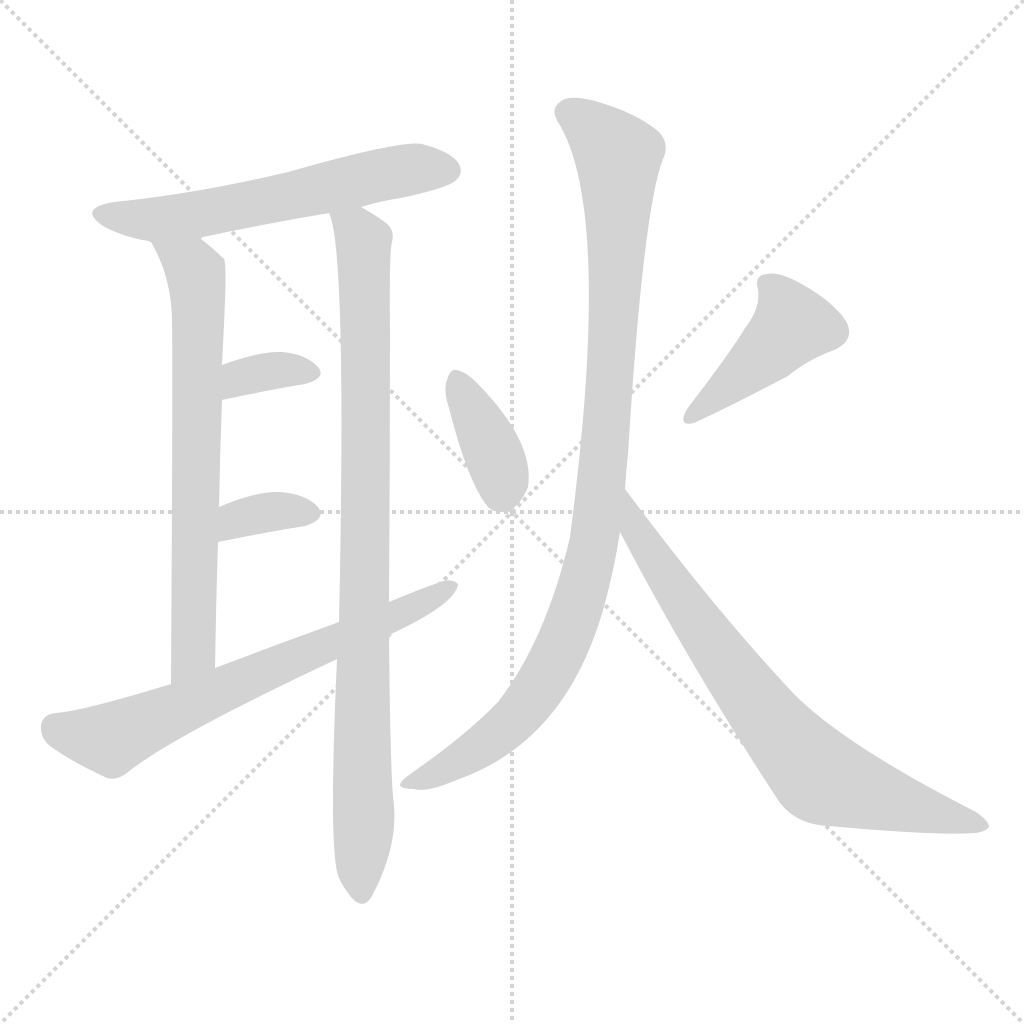
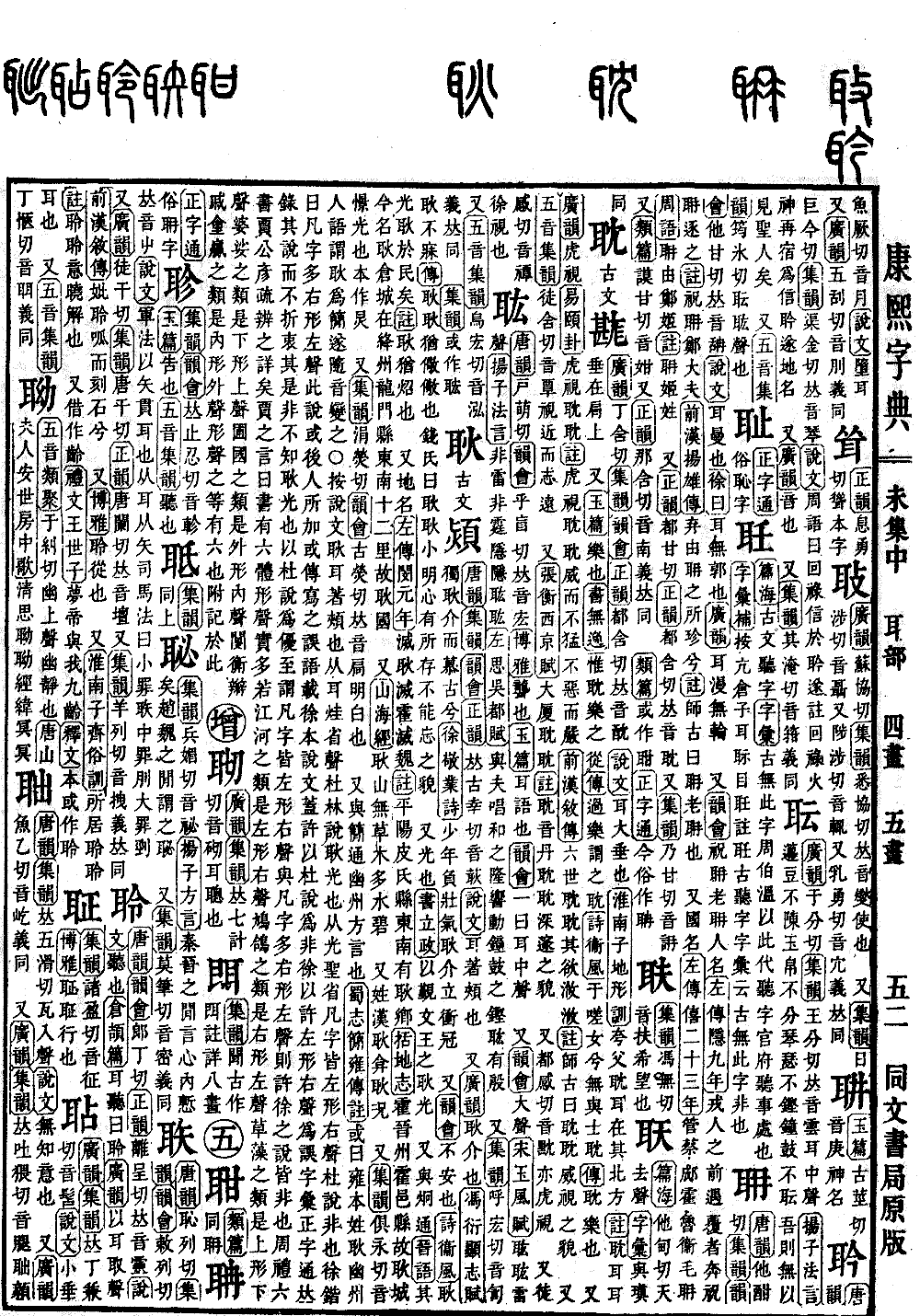
Wei Collection, Middle Volume. Radical: Ear (ěr). Kangxi stroke count: 10. Page 966, Entry 14.
Ancient form is written as (jiong).
Pronounced geng.
Explains: Ears lying flat against the cheeks.
Also, explains: Upright, possessing integrity.
Book: Manifesting Aspirations (Xianzhi Fu) by Feng Yan — Maintaining integrity alone while admiring the ancients.
Poem by Xu Jingye — In youth, harboring heroic ambitions, standing upright, with hair lifting the hat.
Also, explains: Heart not at peace.
Book of Odes (Shijing), Weifeng — The heart is uneasy, unable to sleep.
Commentary: Genggeng implies a state of vigilance. Mr. Qian says: Genggeng refers to a faint light, a state where the heart has attachments and cannot forget.
Also, explains: Brightness.
Classic of History (Shangshu), Lizheng — To manifest the brilliance of King Wen.
Also, interchangeable with the character (jiong).
Discourses of the States (Guoyu), Jinyu — His radiance shines upon the people.
Note: Geng is like the meaning of shining.
Also, a place name.
Zuo Commentary (Zuozhuan), First Year of Duke Min — Extinguished the State of Geng, extinguished the State of Huo, extinguished the State of Wei.
Note: Southeast of Pishi County in Pingyang is Geng Township.
Geography Records (Kuodizhi): Huo in Jinyu Prefecture, Huoyi County, is the former Geng City, currently called Gengcang City, located twelve li southeast of Longmen County in Jiangzhou; it is the former State of Geng.
Also, Classic of Mountains and Seas (Shanhaijing) records: Mount Geng has no vegetation and contains much blue jade (shuibi).
Also, a surname. In the Han Dynasty, there were Geng Yan and Geng Kuang.
Also, pronounced jing. Meaning: Brightness. The original character is (jiong).
Also, pronounced jiong. Meaning: To understand.
Also, interchangeable with the character (yōng). This is a dialect of the Youzhou region.
Records of the Three Kingdoms (Sanguozhi), Shu Annals, Biography of Yong, Note: Someone says that Yong was originally surnamed Geng; people in Youzhou pronounced Geng as (yōng), so the surname changed following the speech pattern.
Analysis: According to the Explanation of Writing and Analysis of Characters (Shuowen Jiezi), Geng means ears lying flat against the cheeks; the character shape is derived from Ear (ěr), using a truncated form of (wei) as the phonetic component. Du Lin's view is that Geng means brightness; the character shape is derived from Light (guang), using a truncated form of (sheng) as the phonetic component. In all phono-semantic characters, the left is the signific and the right is the phonetic; Du Lin's theory is incorrect. Xu Kai says: In most phono-semantic characters, the right is the signific and the left is the phonetic; Xu Shen's statement may have been an addition by later generations or a transcription error; these words are recorded in Xu Kai's edition of the Explanation of Writing and Analysis of Characters. It seems Xu Shen believed Du Lin's theory was wrong, while Xu Kai believed Xu Shen's claim of "left signific, right phonetic" was wrong. The Lexicon (Zihui) and the Comprehensive Character Guide (Zhengzitong) record their arguments without judging who is right or wrong, failing to acknowledge that Geng possesses the meaning of brightness. They consider Du Lin's view better. As for the claim that all phono-semantic characters are left-signific/right-phonetic, or the counter-claim that most are right-signific/left-phonetic, both Xu Shen and Xu Kai are incorrect. Jia Gongyan's commentary on the Rites of Zhou (Zhouli) regarding the Six Scripts provides a detailed analysis. Jia Gongyan's words state: There are six methods of character creation, and phono-semantic characters are indeed numerous. Characters like Jiang (river) and He (river) are left-signific and right-phonetic. Characters like Jiu (pigeon) and Ge (pigeon) are right-signific and left-phonetic. Characters like Cao (grass) and Zao (algae) are top-signific and bottom-phonetic. Characters like Po (old woman) and Suo (dancing) are bottom-signific and top-phonetic. Characters like Pu (nursery) and Guo (state) are external-signific and internal-phonetic. Characters like Men (hear) and Bian (braid) are internal-signific and external-phonetic. These six types of phono-semantic characters are appended here.