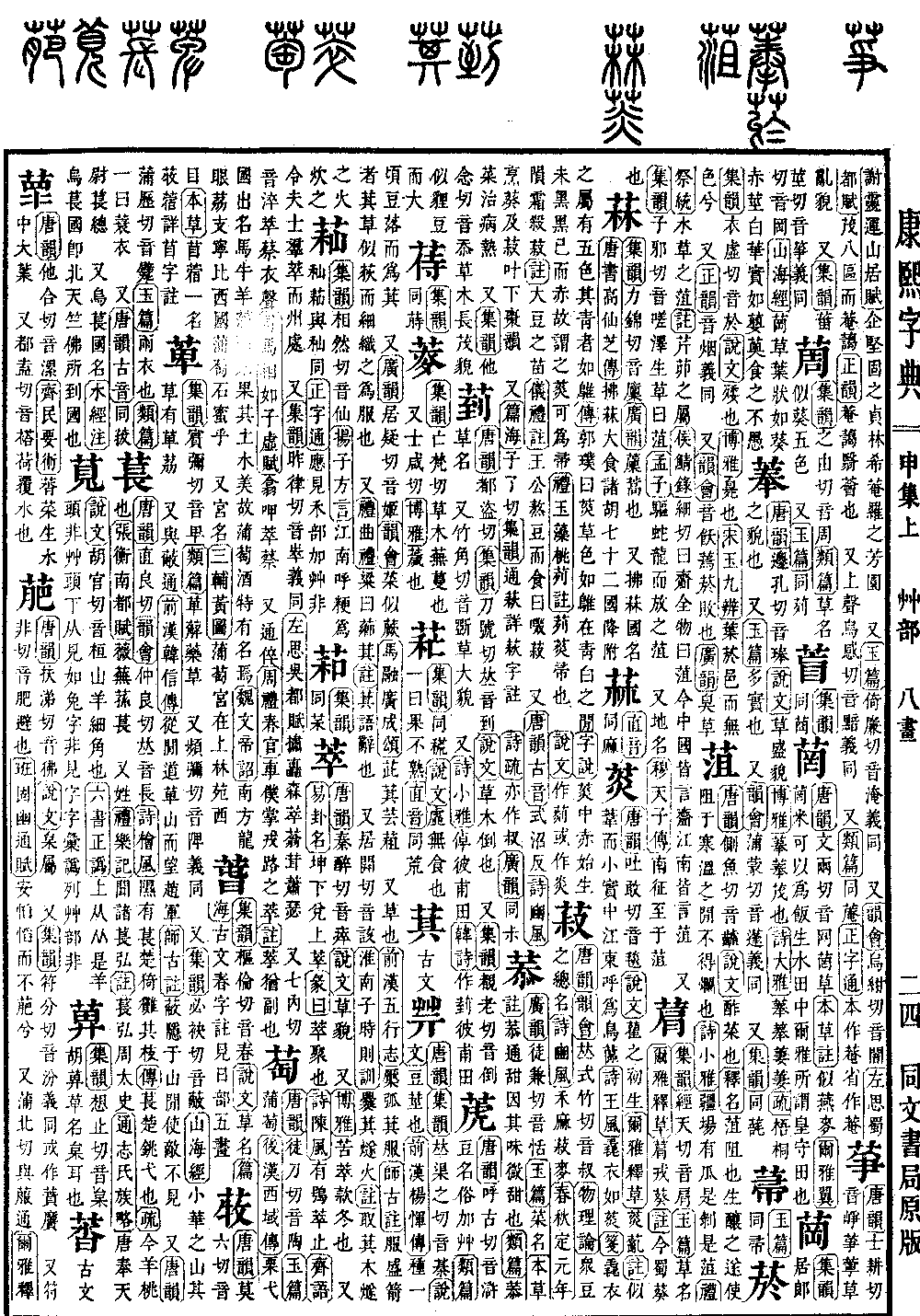
Shen Collection, Upper Volume
Radical: Grass (cǎo)
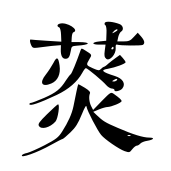
Tan
Kangxi strokes: 14
Page 1040, Entry 13
Pronounced tan (rising tone).
Shuowen Jiezi (Explaining Single-component Characters and Analyzing Compound Characters): The initial stage of reed growth.
Erya (Approaching Elegance), Interpretation of Grasses: Tan is wan.
Annotation: It resembles a reed but is smaller with a solid stem; in the Jiangdong region, it is called wuqiu.
Book of Odes (Shijing), Odes of Wang: Fur garments are the color of tan.
Jian (commentary): Fur garments of this type come in five colors, of which the blue-green resembles the color of the turtledove.
Zhuan (commentary): Guo Pu states that the color of tan grass resembles a turtledove, being between blue-green and white.
Zishuo (Discourse on Characters): Tan is red in the center; when it first grows it has not yet turned black, and after turning black it turns red again, which is why it is called tan; it can be used to make brooms.
Book of Rites (Liji), Jade Beads: Tao lie (peach-wood broom) annotation: Lie-tan is a broom.
Shuowen Jiezi: Written as the character with the grass radical. Sometimes also written in a variant form (yán).
Textual Research: Erya, Interpretation of Grasses, Annotation: In the Jiangdong region it is called niaoqiu. According to the original text, this has been corrected to wuqiu.