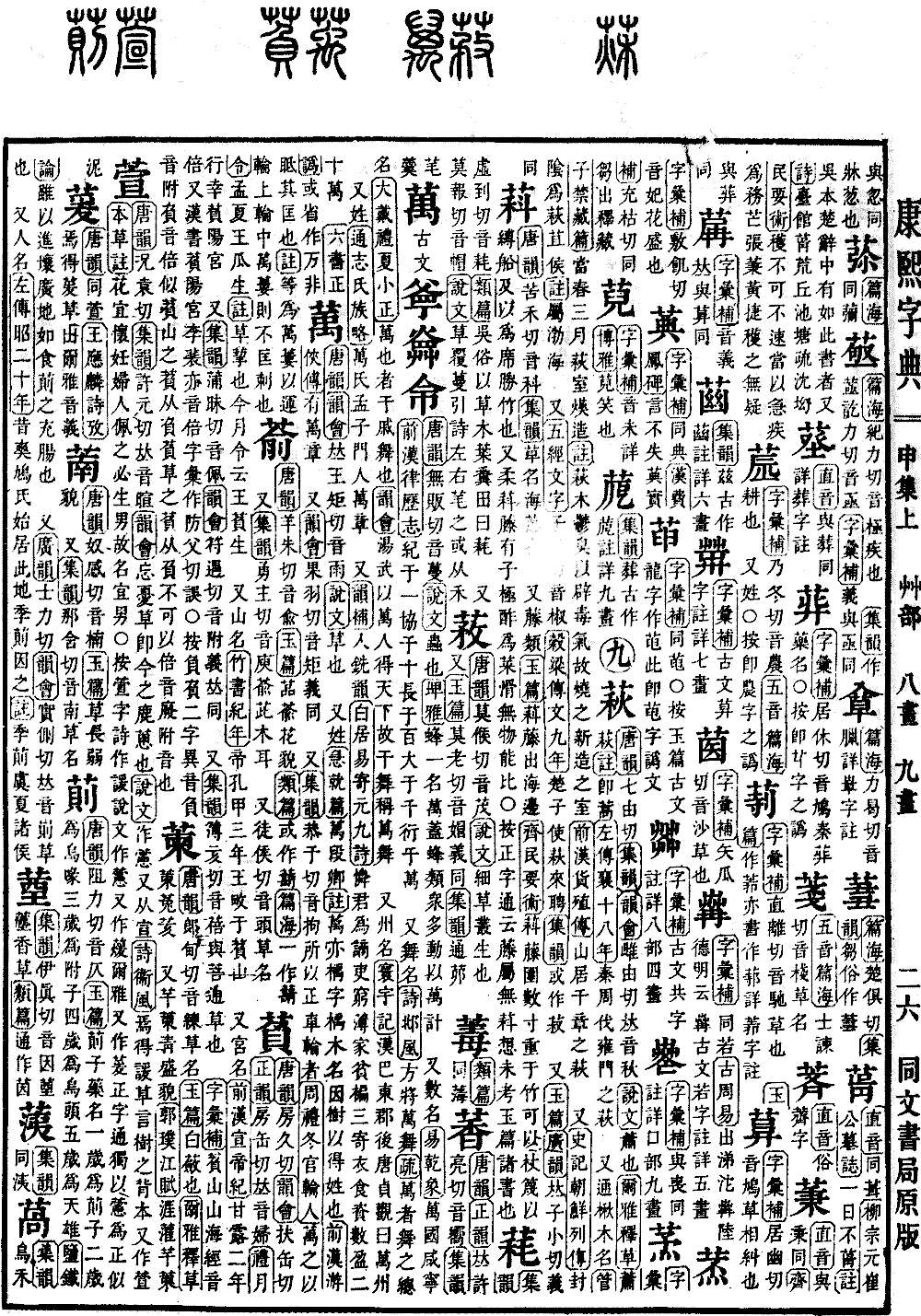
Shen Collection, Upper Volume
Radical: Grass (cǎo)
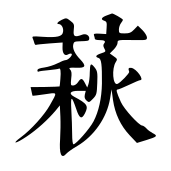
Qiu; Kangxi stroke count: 15; Page 1042, Entry 27
Pronounced qiu
Shuowen Jiezi (Dictionary of Explaining Graphs): Artemisia.
Erya (Approaching Elegance), Explanations of Grasses: Xiao (a type of artemisia) is qiu. Note: This refers to hao (wormwood).
Zuo Zhuan (Chronicle of Zuo), 18th Year of Duke Xiang: And the states of Qin and Zhou attacked the qiu at Yongmen.
Also used interchangeably with qiu (catalpa tree), the name of a tree.
Guanzi (The Book of Master Guan), Chapter on Prohibited Stores: In the third month of spring, dry the qiu-wood in newly constructed rooms. Note: The wood of the qiu tree has a strong odor and can ward off poisonous vapors; therefore, it is burned in newly built rooms.
Book of Han (Hanshu), Account of Commodity Markets: Dwelling in the mountains with a thousand stems of qiu.
Also in Records of the Grand Historian (Shiji), Account of Joseon: Yin was enfeoffed as the Marquis of Qiuju. Note: Located in the Bohai region.
Also in Wujing Wenzi (Text of the Five Classics), pronounced jiao.
Guliang Zhuan (Guliang's Commentary), 9th Year of Duke Wen: The Viscount of Chu sent Qiu to visit.
Jiyun (Compendium of Rhymes): Sometimes written as shu.
Also in Yupian (Jade Chapters) and Guangyun (Expanded Rhymes), pronounced xiao. The meaning is the same.
Textual Research: Zuo Zhuan, 18th Year of Duke Xiang: Qin and Zhou attacked the qiu at Yongmen. According to the original text, the character ji has been added before Qin and Zhou.