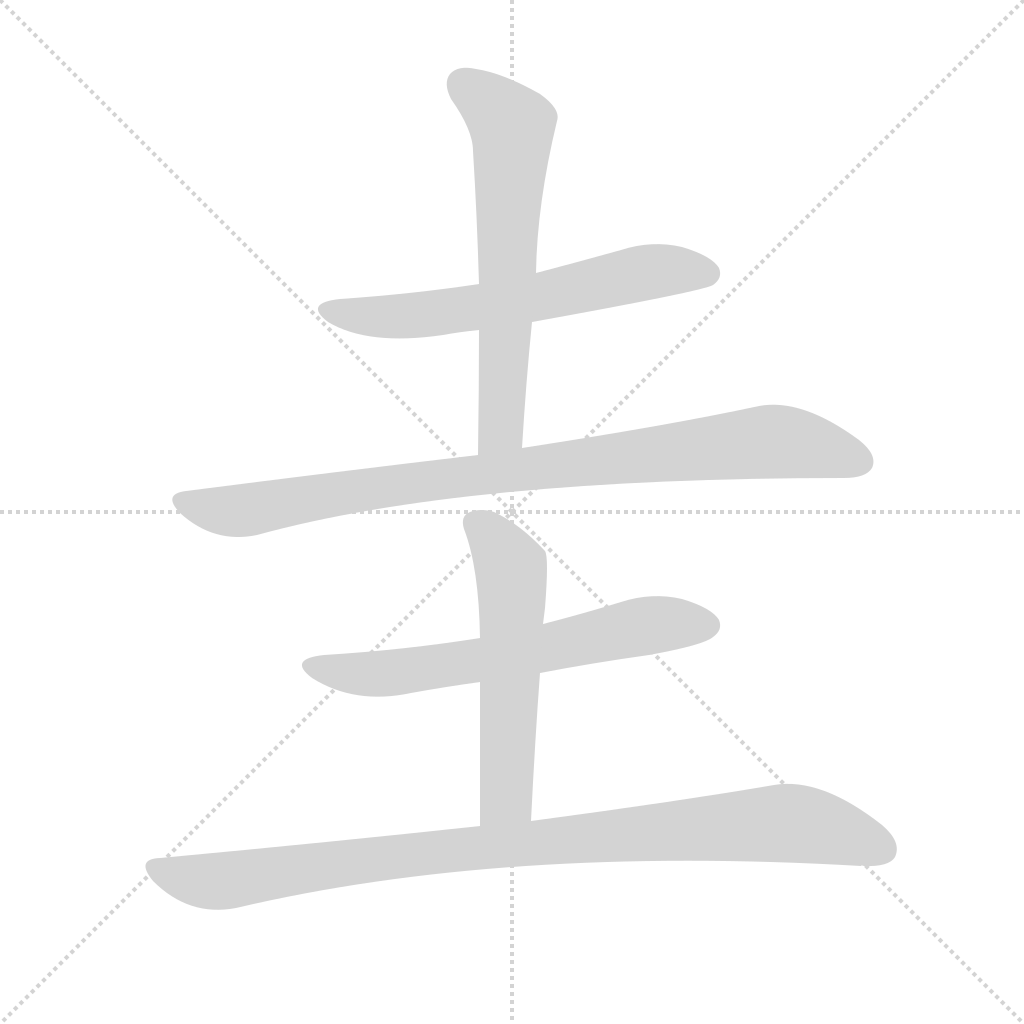
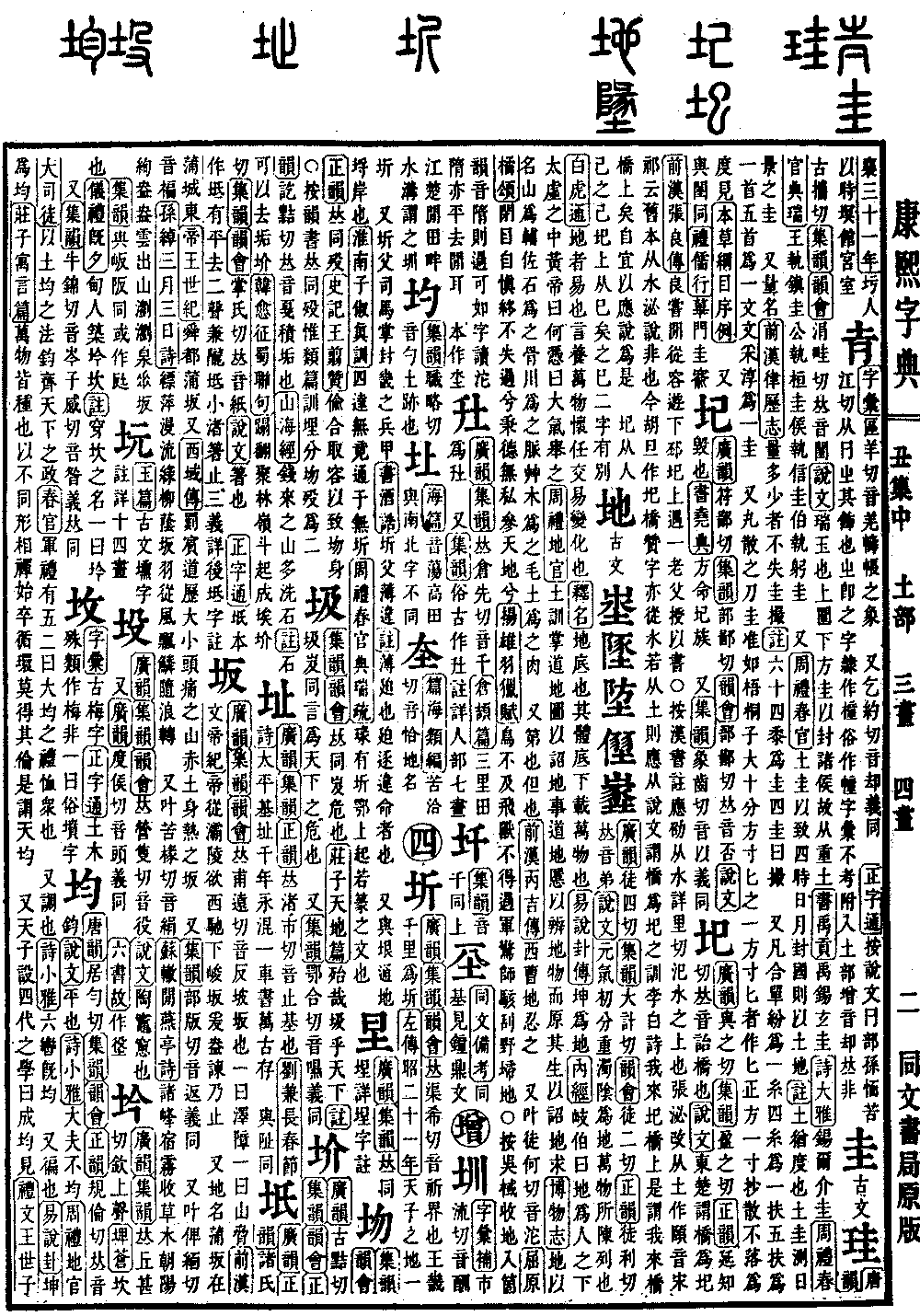
Chou Collection, Upper Volume. Radical: Earth (tǔ). Kangxi strokes: 6. Page 224, Entry 02. Ancient form is Gui. Pronounced gui. According to the Shuowen Jiezi, it is an auspicious jade. It is round on top and square on the bottom; the gui was used for the enfeoffment of feudal lords, which is why the character shape is composed of two earth characters stacked together. Book of Documents (Shangshu), Tribute of Yu: Yu was bestowed a gui. Book of Odes (Shijing), Greater Odes: Bestowed upon you a large gui. Rites of Zhou (Zhouli), Spring Officials, Canon of Auspicious Objects: The king holds the zhen-gui, the duke holds the huan-gui, the marquis holds the xin-gui, and the count holds the gong-gui. Also, Rites of Zhou (Zhouli), Spring Officials: The earth-gui is used to measure the four seasons and the sun and moon; when enfeoffing states, it is used to measure land. Note: Earth means measurement. The earth-gui is a gui used for measuring the sun's shadow. It is also a unit of volume. History of the Former Han (Hanshu), Treatise on Harmonics and Calendars: Measuring quantity, without missing a gui or a cuo. Note: Sixty-four grains of millet equal one gui. Book of the Later Han (Houhanshu), Treatise on Carriages and Attire: Furthermore, all single-strand spun threads are combined into one xi, four xi make one fu, five fu make one shou, five shou make one wen, and a pure pattern makes one gui. Also, a standard dose of pill or powder medicine, one dao-gui, is the size of a firmiana seed, which is one-tenth of a square-inch ladle; the square-inch ladle refers to a ladle made to be one square inch in size, used to scoop medicinal powder without spilling. See Compendium of Materia Medica (Bencao Gangmu), Preface and Examples. Also the same as gui. Book of Rites (Liji), Conduct of Scholars: Brushwood gate and gui-shaped window. Textual research: Note: Sixty-four grains of millet equal one gui, four gui equal one cuo. Also, all single-strand spun threads are combined into one xi, four xi make one fu. Carefully corrected according to the original text of the Book of the Later Han (Houhanshu), changing fen to spun thread. Changing xi to xi. Omitted the preceding sentence about four gui being called a cuo. Revised the reference to the Book of the Later Han (Houhanshu), Treatise on Carriages and Attire.