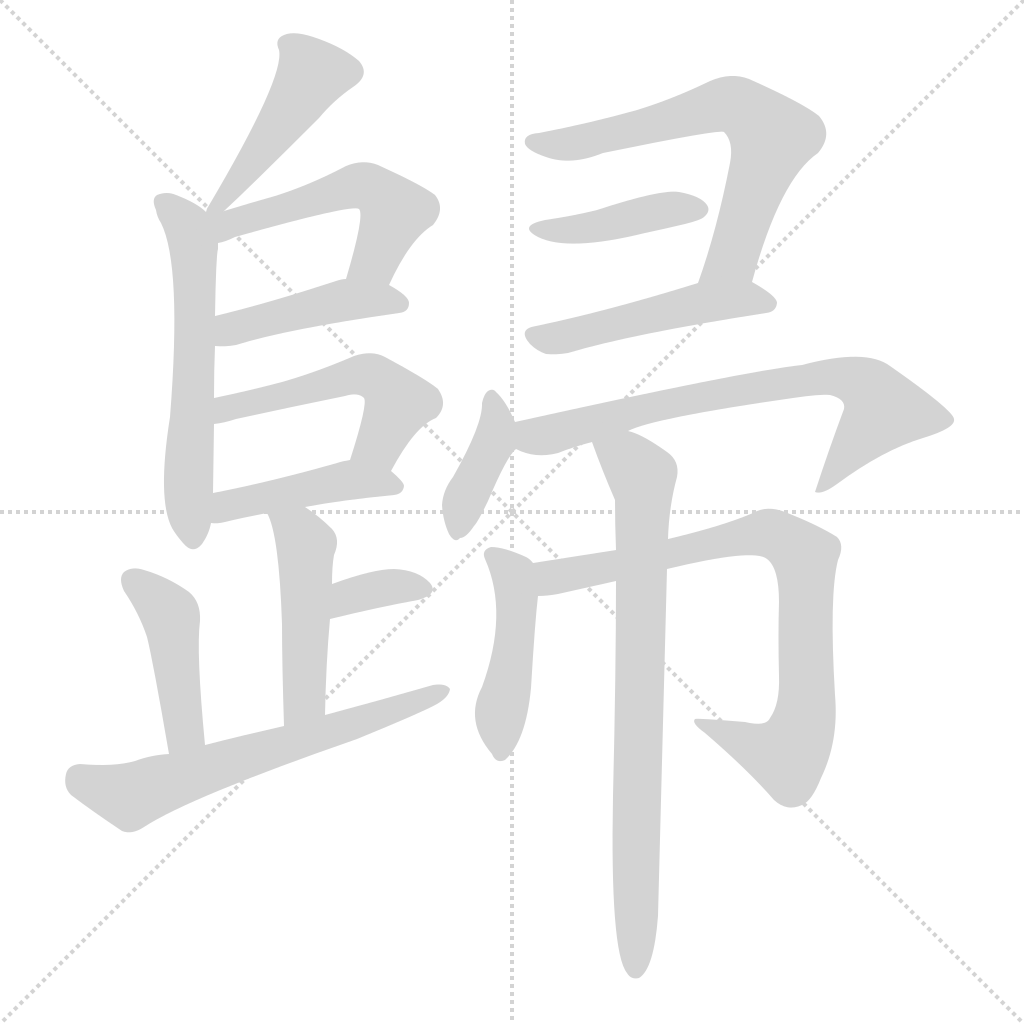
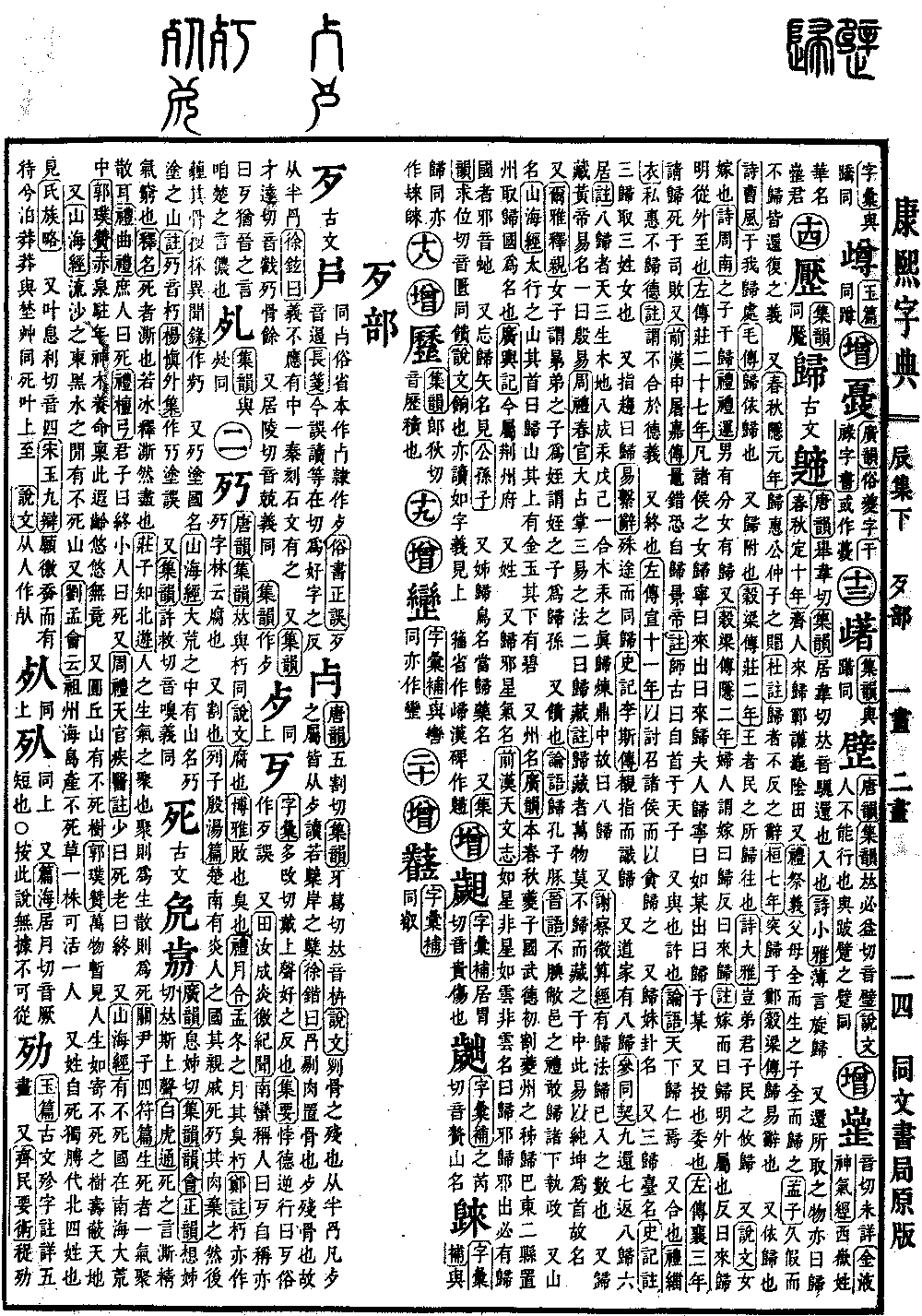
Chen Collection, Lower Volume
Radical: Stop (zhǐ)
Kangxi Strokes: 18
Page 578, Entry 07
Ancient script. Pronounced gui.
Meaning: To return, to enter.
Book of Odes (Shijing), Lesser Odes: To move and return.
Also refers to returning something taken.
Spring and Autumn Annals (Chunqiu), Tenth Year of Duke Ding: The people of Qi came to return the fields of Yun, Huan, and Guiyin.
Also, Book of Rites (Liji), Meaning of Sacrifices (Jiyi): Parents produce children in completeness; children should return them in completeness.
Mencius: Borrowing for a long time without returning. All these signify returning or going back.
Also, Spring and Autumn Annals (Chunqiu), First Year of Duke Yin: Returning the funeral gifts of Duke Hui and Zhongzi.
Commentary by Du Yu: Returning here signifies words indicating no return.
Seventh Year of Duke Huan: Tu returned to Zheng.
Guliang Commentary: Returning is a word indicating ease.
Also refers to reliance.
Book of Odes (Shijing), Odes of Cao: In me is a place to return.
Mao Commentary: Returning means to rely upon.
Also refers to submission.
Guliang Commentary, Second Year of Duke Zhuang: The King is the one to whom the common people return.
Book of Odes (Shijing), Greater Odes: The amiable gentleman is one to whom the people turn.
Also, Explaining and Analyzing Characters (Shuowen Jiezi): A woman getting married.
Book of Odes (Shijing), Odes of Zhou and South: This young lady is going to her marriage.
Book of Rites (Liji), The Evolution of Rites (Liyun): A man has his duty, a woman has her home.
Also, Guliang Commentary, Second Year of Duke Yin: When a woman marries it is called returning; when she returns to her maiden home it is called coming back.
Commentary: Getting married is called returning, indicating she is a relative by marriage. Returning to the maiden home is called coming back, indicating she has come back from the outside.
Zuo Commentary, Twenty-Seventh Year of Duke Zhuang: Whenever a daughter of a feudal lord returns to her maiden home it is called coming; being cast aside is called returning. A wife returning to her maiden home is called going to so-and-so; being cast aside is called returning to so-and-so.
Also refers to seeking refuge or entrusting.
Zuo Commentary, Third Year of Duke Xiang: Requesting to return and die before the Minister of Justice.
Also, History of the Former Han (Qian Hanshu), Biography of Shentu Jia: Chao Cuo feared he would surrender to Emperor Jing.
Commentary: Shigu says: To surrender oneself to the Emperor.
Also refers to giving or praising.
Analects of Confucius (Lunyu): The world will return to benevolence.
Also refers to conforming.
Book of Rites (Liji), Black Robes (Ziyi): Private kindness does not return to virtue.
Commentary: Meaning it does not conform to virtue and righteousness.
Also refers to the final outcome.
Zuo Commentary, Eleventh Year of Duke Xuan: Summoning feudal lords by means of punishment, and treating it with greed.
Also, Guimei is the name of a hexagram.
Also, Sangui is the name of a terrace.
Commentary on the Records of the Grand Historian (Shiji): Sangui refers to marrying women of three different surnames.
Also refers to orientation or final goal.
Book of Changes (Yijing), Appended Remarks (Xici): Different paths leading to the same goal.
Records of the Grand Historian (Shiji), Biography of Li Si: By looking at the pointer, one recognizes the goal.
Also, Daoism has the Eight Returns.
Triplex Unity (Cantongqi): Nine returns, seven reversals, eight returns, six dwellings.
Commentary: Eight Returns refers to Heaven producing wood at three, Earth perfecting mercury at eight, and when the Earth elements (Wu and Ji) unite, the true essence of wood and mercury is returned and refined in the cauldron, hence it is called Eight Returns.
Also, Xie Chawi, Mathematical Classic (Suanjing): There is a return method, which is a method for consolidating added numbers.
Also, Guicang is the name of the Book of Changes (Yijing) from the time of the Yellow Emperor. One theory says it is the Book of Changes of the Yin Dynasty.
Rites of Zhou (Zhouli), Spring Offices (Chunguan): The Grand Diviner manages the laws of the three Books of Changes, the second is called Guicang.
Commentary: Guicang means there is nothing among the ten thousand things that does not return and hide within it. This Book of Changes starts with the pure Kun hexagram, hence the name.
Also, Er Ya, Explaining Kinship (Shiqin): A woman calls her brother's son a nephew, and she calls a nephew's son a Guisun.
Also used as Kui, meaning to present as a gift.
Analects of Confucius (Lunyu): Presenting a pig to Confucius.
Discourses of the States (Guoyu), Jin Discourses: Not having enough of the rites of our humble state, I dare to offer them to the subordinate officials.
Also, the name of a mountain.
Classic of Mountains and Seas (Shanhaijing): Taihang Mountain; its beginning is called Gui Mountain, which contains gold and jade, with green jade at the bottom.
Also, the name of a prefecture.
Extended Rhymes (Guangyun): Originally the state of Kui during the Spring and Autumn period; at the beginning of the Wude reign, Zigui and Badong counties of Kui Prefecture were separated to establish Gui Prefecture, taking the name of the Gui state.
Expanded Records of the World (Guangyu Ji): Now belongs to Jingzhou Prefecture.
Also, a surname.
Also, Guixie is the name of a celestial phenomenon.
History of the Former Han (Qian Hanshu), Treatise on Astronomy: Resembling a star but not a star, resembling a cloud but not a cloud, it is called Guixie. When Guixie appears, there must be a state that will submit; Xie is pronounced like she.
Also, Wanggui is the name of an arrow, found in the Gongsun Longzi.
Also, Zigui is the name of a bird. Danggui is the name of a medicine.
Also, Pronounced kui. Same as kui (to present).
Explaining and Analyzing Characters (Shuowen Jiezi): Meaning to present a gift. Can also be read according to the original character pronunciation. Definitions are given above. The Zhou script is written in a simplified form. In the Han Dynasty, it was written as gui.
Textual Research:
Rites of Zhou, Spring Offices: The Grand Diviner manages the laws of the three Changes. The original text has been corrected from Diviner to Diviner (and similarly the character for Law has been corrected).