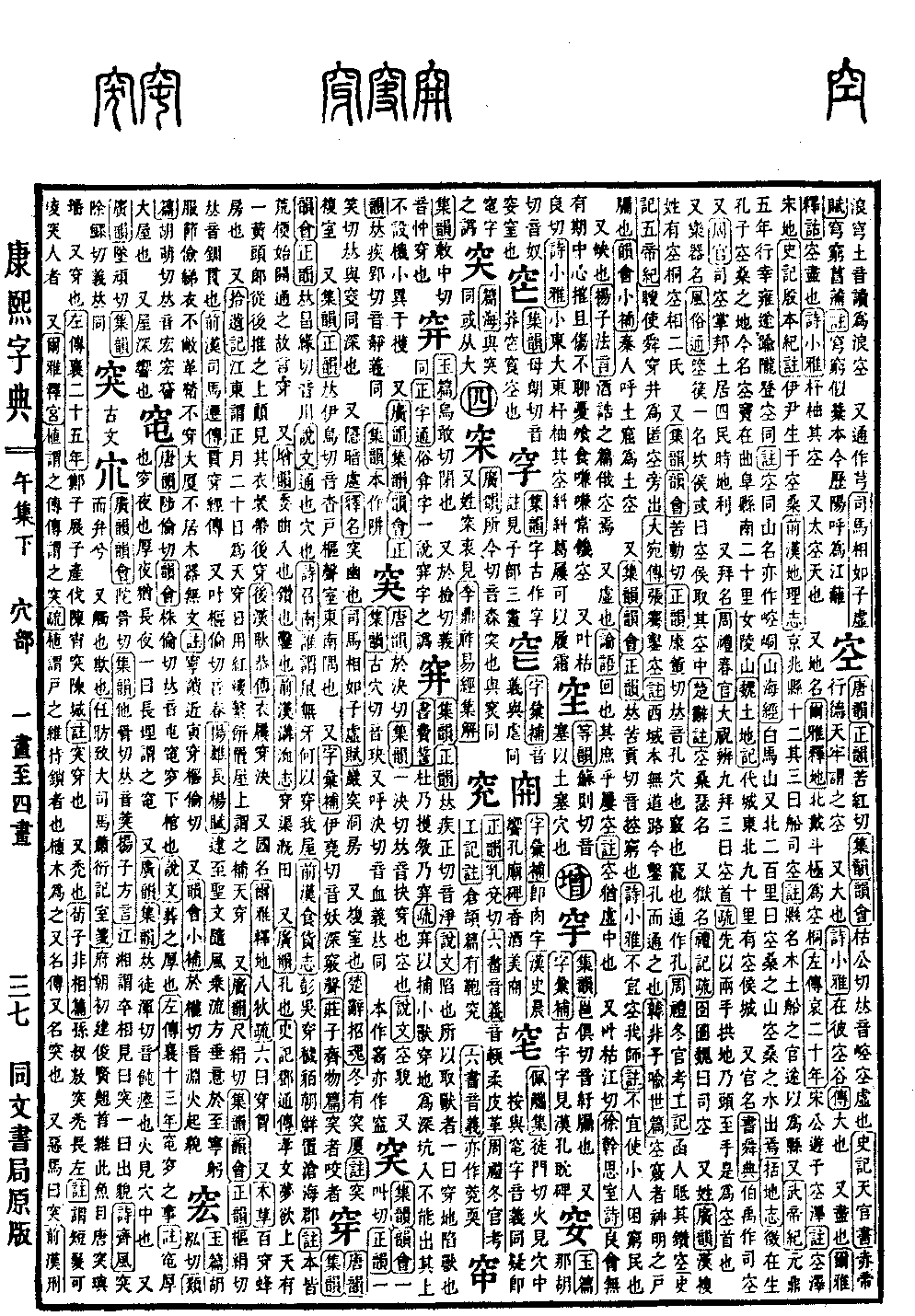
Wu Collection, Lower Volume
Radical: Cave (xué)
Kangxi Strokes: 9
Page 863, Entry 18
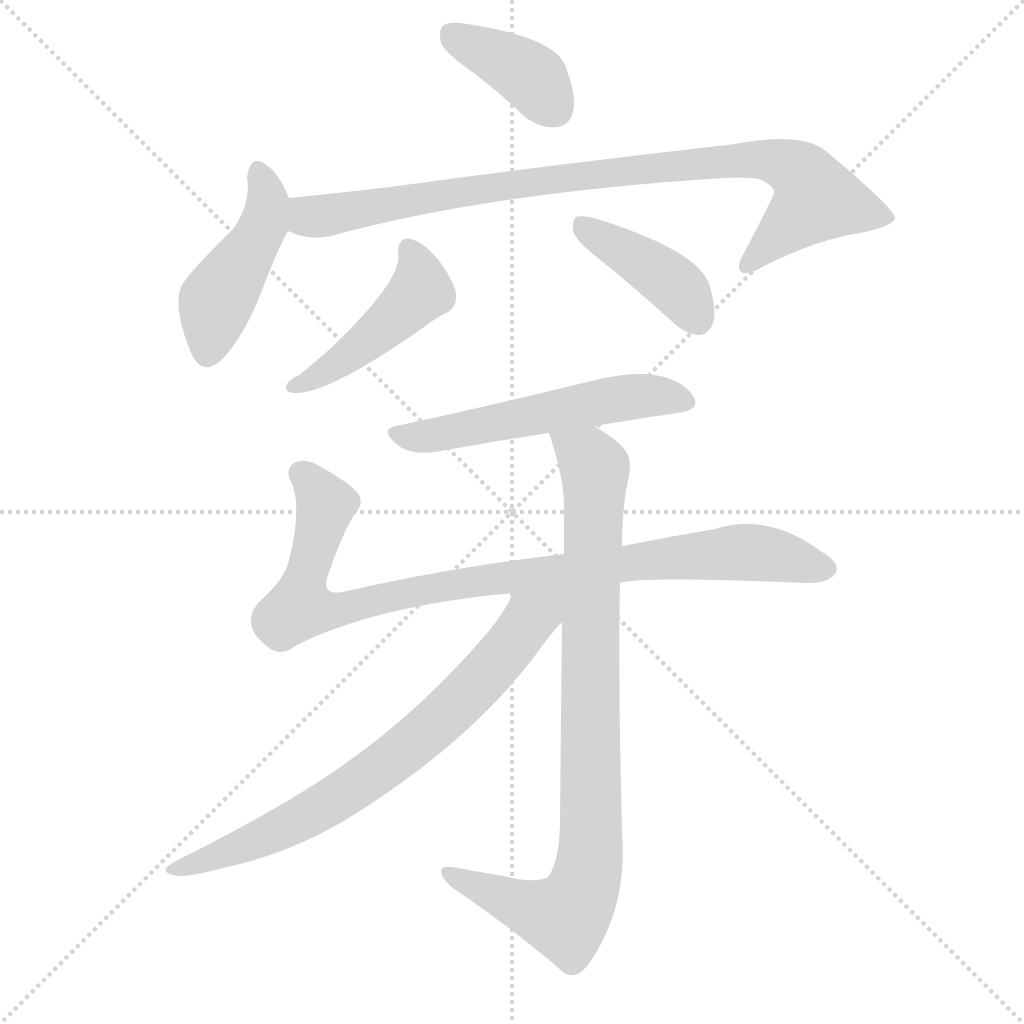
Pronounced chuan.
According to the Shuo Wen Jie Zi (Explaining Graphs and Analyzing Characters), it means to pass through or a cave.
Book of Odes (Shijing), Odes of Shao and Nan: Who says there are no thorns; how can one pierce my roof.
History of the Former Han (Qian Hanshu): Peng and Wu opened up the remote lands of the Hui and Mo and the Joseon region, establishing the Canghai Commandery. Note: Originally, these were all desolate and obstructed lands; since they were opened and cleared, it is called piercing.
Additionally, according to the Zeng Yun (Expanded Rhymes): to enter in a winding way, to drill, to chisel.
History of the Former Han (Qian Hanshu): To chisel water channels to irrigate the fields.
Additionally, according to the Guang Yun (Extensive Rhymes): a hole or aperture.
Records of the Grand Historian (Shiji): Emperor Xiaowen dreamed that he wanted to ascend to heaven; a yellow-headed attendant pushed him from behind. The Emperor turned back and saw that the back seam of his clothes and the area behind his belt had a hole.
History of the Later Han (Hou Hanshu): Clothes and shoes were worn through and torn.
Also, the name of a country.
Erya (Approaching Nearness): The sixth is called the Chuanxiong (Pierced Chest) country.
Also, according to the Bencao (Materia Medica): Baichuan refers to a beehive.
Also, according to the Shi Yi Ji (Record of Gleanings): In the Jiangdong region, the twentieth day of the first lunar month is called Heaven Piercing Day; red silk threads are used to tie cakes and place them on the roof, which is called patching the heaven's pierce.
Also, pronounced chuan (in the falling tone).
To pass through.
History of the Former Han (Qian Hanshu): To master the classics and commentaries.
Also, rhymes with chun.
Yang Xiong, Changyang Fu: Until the time of the sagacious Emperor Wen, who followed the wind and rode the currents, mindful of ultimate peace, personally practicing frugality—his coarse cloth garments were not worn thin, his leather shoes were not pierced, and he did not reside in tall palaces, nor were his wooden vessels adorned with patterns. Note: Ning is pronounced like yin. Chuan is pronounced like chun.
Also, according to the Yun Hui Xiao Bu (Minor Supplement to the Rhyme Compendium): Pronounced yuan. The appearance of fire burning.